4 / 7
NOTE: The silence feature of low baery voltage warning is
temporary acon to cancel warning sound eect, you need replace
the baery as soon as possible.
3.7 Fault warning
If the device chirps twice every 40 seconds with FAULT
indicator (yellow) will be flash. It indicates the CO alarm is
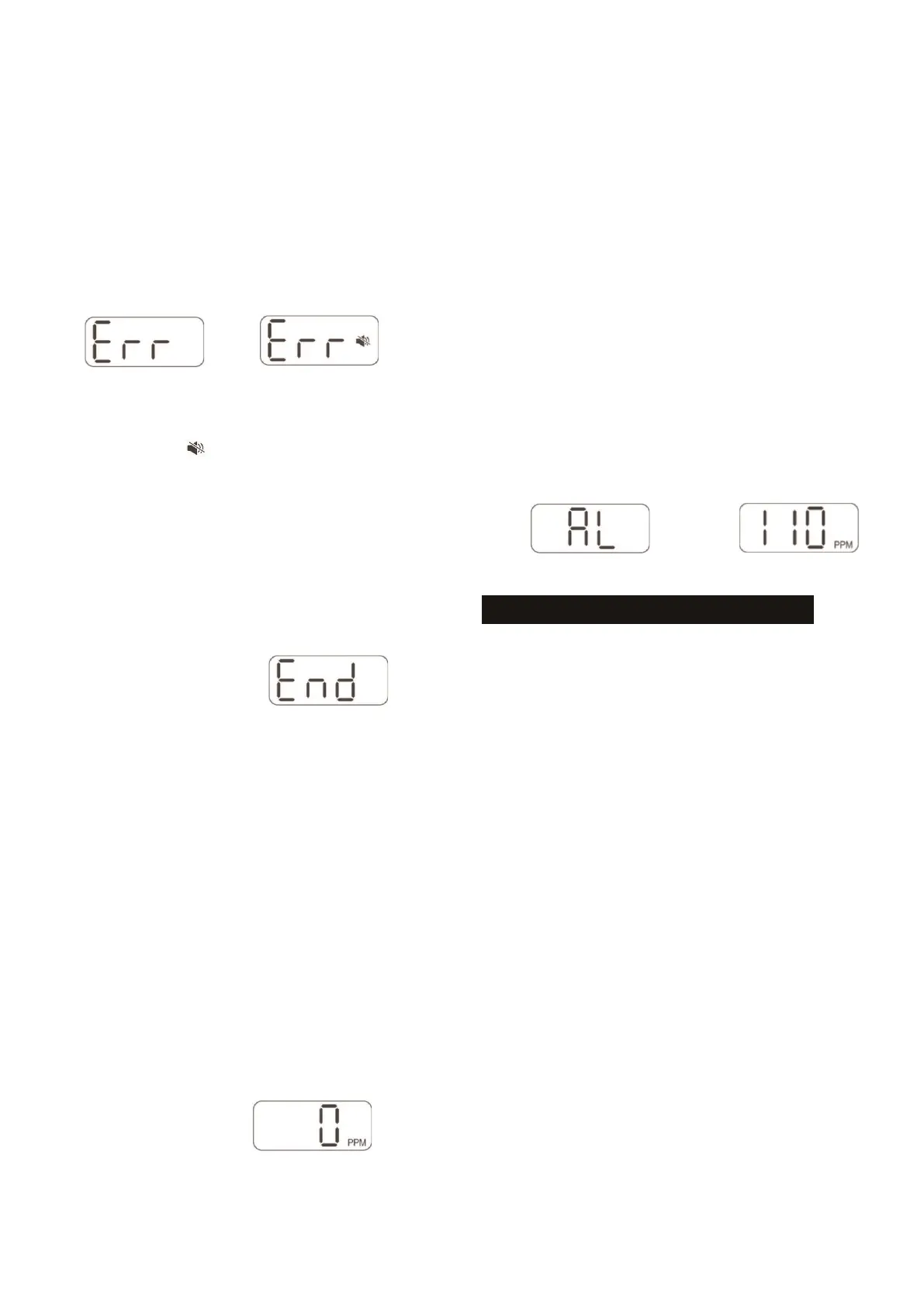
in malfunction condition. The LCD displays " Err ", that
means your CO alarm have no detecting function and no
respond CO.
NOTE: Maybe the sensor is missing, replace the device immediately.
Please contact us to more service.
3.8 Fault warning silence
When the device is in a fault state, press the TEST/SILENCE
button, it will enter the fault warning mute state for about 10
hours, while displaying " " on the LCD, and the FAULT
indicator (yellow) remains flashing.
NOTE: The silence feature of fault warning is a temporary acon to
cancel warning sound eect, you need replace the device as soon
as possible.
3.9 End-of-life warning
If the device chirps three times every 40 seconds with FAULT
indicator (yellow) flash 3 times and the LCD displays ‘End’.
It indicates end of life of CO alarm. You need to immediately
replace the CO alarm.
3.10 Test the device
When the device under normal operation status, you can test
the device by TEST/SILENCE button, press and hold the
TEST/SILENCE button, you should hear alarm sound
pattern (<85dB) and with a corresponding ALARM
indicator (red) flash. After the eight sound, the device will
issuing a normal alarm volume (≥85dB). Test process will
stop when release the button, but the alarm will ring for at
least two cycles. The LCD displays current CO
concentration during testing.
NOTE: Aer the TEST/SILENCE buon is enabled, the alarm sounds
and the red alarm light ashes. This does not indicate that CO is
present.
NOTE: If the device is in failure state and end of life state, the
device cannot be tested.
NOTE: Test the device every week! If at any me your device does
not perform as described, replace it immediately.
3.11 Weekly test
Recommend test the alarm weekly by pressing the
TEST/SILENCE button to ensure the normal operation of the
equipment.
3.12 Alarm memory
7 days alarm memory function.
When the device detects CO and alarms, after the device exits
the alarm, it will chirps once every 40 seconds with ALARM
indicator (red) will be flash. And when the CO concentration
<23PPM, the LCD will displays "AL".
After pressing the TEST/SILENCE button, the product will
clear the alarm memory warning, and respond to the
corresponding function of the button. Short press the button
to display the maximum CO concentration recorded on the
LCD for 4 seconds, press and hold the button to enter the test
alarm state.
Or 7 days later, the device will automatically clear the alarm
memory prompt.
NOTE: Press and hold the TEST/SILENCE buon during the display
period to clear the maximum concentraon value memorized and
enter the test alarm state.
4. What to do if the alarm sounds:
WARNING! – Actuaon of your CO alarm indicates the presence of
Carbon Monoxide (CO) which can KILL YOU. WARNING! – Acon of this
device indicates the presence of dangerous levels of CO! CO can be
fatal! If the alarm sounds:
4.1 Keep calm and open all doors and windows to increase
the rate of ventilation. Stop using all fuel-burning
appliances and ensure, if possible, that they are turned off,
e.g. for gas appliances, isolate the emergency control
valve;
4.2 If the alarm continues to be activated, then evacuate the
premises. Leave the doors and windows open, and only
reenter the building when the alarm has stopped. In multi-
occupancy and multi-storey premises, ensure that all the
occupants are alerted to the risk;
4.3 Get medical help for anyone suffering the effects of
carbon monoxide poisoning, and advise that carbon
monoxide inhalation is suspected;
4.4 Telephone the appropriate appliance servicing and/or
maintenance agency or, when necessary, the relevant fuel
supplier on their emergency number or the national Gas
Emergency Service Provider, if appropriate, so that the
source of carbon monoxide emissions can be identified
and corrected. Unless the reason for the alarm is
obviously spurious, do not use the fuel-burning appliances
again, until they have been checked and cleared for use by
a competent person according to national regulations.


 To Next Page
 Loading...