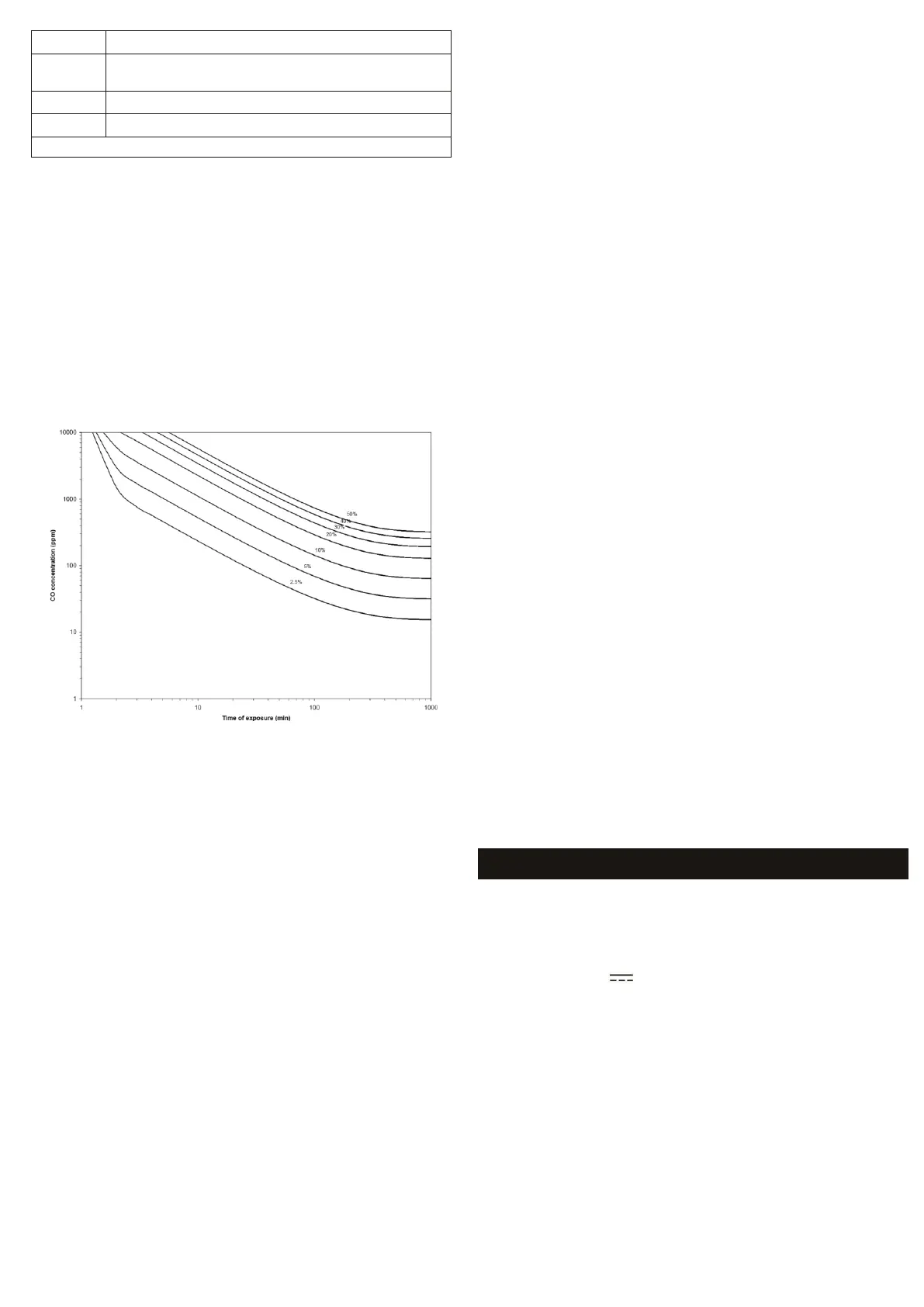
The relationship between the CO concentration and the
duration of exposure can be calculated for a given %COHb, by
parameterising the above factors. Figure 7.1 shows examples
for a person undertaking light/moderate exercise.
Figure 7.1–Relaonship between CO concentraon and exposure me
for various %COHb (light/moderate exercise)
7.2
Chronic eects on high risk groups
Individuals with coronary artery disease exposed to low
levels of CO show reduced ability to exercise and the time
of onset of exercise-induced angina pectoris in such
patients exposed to low levels of CO is reduced.
Carbon monoxide readily crosses the placental barrier and
may endanger the normal development of the foetus.
A number of high-risk groups are particularly sensitive to
the effects of CO because of various organ impairments or
specific changes, mainly:
a) those whose oxygen carrying capacity is decreased due to
anaemia or other haemoglobin disorders;
b) those with increased oxygen needs such as those
encountered in fever, hyperthyroidism or pregnancy;
c) those with systemic hypoxia due to respiratory
insufficiency;
d) those with heart disease and any vascular insufficiency.
WHO guidance states that in order to protect non-smoking,
middle-aged and elderly population groups with documented
or latent coronary artery disease from acute ischaemic heart
attacks, and to protect the foetuses of non-smoking pregnant
women from untoward hypoxic effects, a COHb level of
2.5% should not be exceeded. The following WHO
guideline values and periods of time-weighted average
exposures have been determined in such a way that the
COHb level of 2.5% is not exceeded, even when a normal
subject engages in light or moderate exercise:
· 100 mg/m³ (90 ppm) for 15 min;
· 60 mg/m³ (50 ppm) for 30 min;
· 30 mg/m³ (25 ppm) for 1 h; ·
10 mg/m³ (10 ppm) for 8 h.
7.3 Normal COHb levels
Under normal conditions, humans typically have low
levels of COHb of between 0.3% and 0.7% present within
the body.
These levels are considered neither beneficial nor harmful.
7.4 Tobacco smoking
Tobacco smokers are exposed to significant concentrations
of CO. In cigarette smokers, the COHb concentration varies
between 5%-9%, while heavy cigar smokers may exceed
10%.
WARNING! - Exposure to high levels of carbon monoxide can be
fatal or cause permanent damage and disabilies.
WARNING! - The device may not prevent the chronic eects of
carbon monoxide exposure, and that the device will not fully
safeguard individuals at special risk.
8. Specicaon:
Model: FC5003
Product standards: EN 50291-1:2018
EN 50291-2:2019
Type of apparatus: Type B
Power supply: 3V (2*AA alkaline battery)
Recommend baery type:
Raymax LR6/GP GN15A (The normal service life is 3 years)
Raymax LR6 Premium (The normal service life is 10 years)
Sensor type: Electrochemical
Product service life: 10 years after manufacture Sensivity
seng:
Conforms to EN 50291-1:2018 standard.
30PPM: Without alarm before 120 minutes 50PPM:
Alarm between 60 to 90 minutes 100PPM:
Alarm between 10 to 40 minutes


 To Next Page
 Loading...