11
© 2015 Emerson Climate Technologies, Inc.
AE4-1365 R4
with compressors of unequal capacity, check with
application engineering or on-line product information
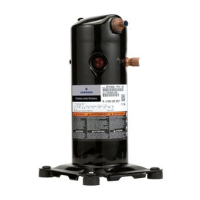
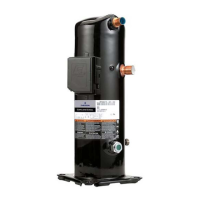
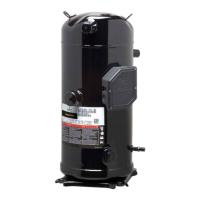
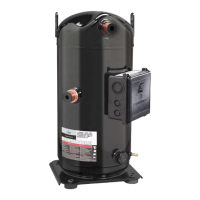
for availability. Tandem ready compressors are
designated with a -4XX bill of material number at the
end of the model number (e.g. ZP61KCE-TFD-420).
See Figure 5 for a picture of an assembled tandem
showing the hardware and parts required for assembly.
Drawings of tandem tubing assemblies are available
from Emerson Climate Technologies by contacting
your Application Engineer.
Tandem Applications
Tandem compressors follow the same application
guidelines as single compressors outlined in this
bulletin. The refrigerant charge limit for tandem
compressors is shown in Table 3. Crankcase heaters
must be installed on each compressor in the tandem
set when the system charge amount exceeds the
tandem charge limit.
The compressors in a tandem set can be started/
stopped in any desired sequence. To help reduce
the probability of light dimming and to reduce inrush
current, starting the compressors individually is
recommended. Should a compressor fail in the tandem
set the complete tandem should be removed from the
unit and replaced with a new tandem set. Replacing
individual compressors is discouraged because of
the care that must be used when installing the oil
equalization tube and the availability of manifolds to
the aftermarket.
APPLICATION TESTS
Application Test Summary
There are a number of tests the system designer
will want to run to ensure the system operates as
designed. These tests should be performed during
system development and are dependent on the
system type and amount of refrigerant charge. These
application tests are to help identify gross errors in
system design that may produce conditions that could
lead to compressor failure. The Continuous Floodback
Test and Field Application Test, both outlined below, are
two tests to run to help verify the design. When to run
these tests can be summarized as follows:
Continuous Floodback:
Required on all heatpumps.
Field Application Test:
Required for any unit where both the design system
charge is higher than the compressor refrigerant
charge limit listed in Table 3; and a capillary tube,
xedorice,orbleed-typeTXVisusedoneither
the indoor or the outdoor coil of the unit.
Continuous Floodback Test
Itisexpectedthat the design would not ood during
standard air conditioning operation. Running a partially
blockedindoorairlterorlossofevaporatorairowtest
and comparing the sump temperature results to Figure
2 is recommended. The use of a TXV in heating does
notguaranteeoperationwithoutoodbackinthelower
end of the unit/TXV operating range.
Totestforexcessivecontinuousliquidrefrigerantood
back, it is necessary to operate the system in a test
roomatconditionswheresteadystateoodbackmay
occur (low ambient heating operation). Thermocouples
should be attached with glue or solder to the center of
the bottom shell and to the suction and discharge lines
approximately 6 inches (15 cm) from the shell. These
thermocouples should be insulated from the ambient air
with Permagum® or other thermal insulation to be able
to record true shell and line temperatures. If the system
isdesignedtobeeldcharged,itshouldbeovercharged
by 15% in this test to simulate overcharging often found
ineldinstallations.
The system should be operated at an indoor temperature
of 70°F (21°C) and outdoor temperature extremes of
10°F(-12°C)orlowerinheatingtoproduceoodback
conditions. The compressor suction and discharge
pressures and temperatures as well as the sump
temperature should be recorded. The system should
be allowed to frost up for several hours (disabling the
defrost control and spraying water on the outdoor coil
may be necessary) to cause the saturated suction
temperature to fall below 0°F (-18°C). The compressor
sump temperature must remain above the sump
temperature shown in Figure 2 or design changes
mustbemadetoreducetheamountofoodback.Ifan
accumulator is used, this test can be used to test the
effectiveness of the accumulator. Increasing indoor coil
volume,increasingoutdoorairow,reducingrefrigerant
charge, decreasing capillary or orice diameter, and
adding a charge compensator can also be used to reduce
excessivecontinuousliquidrefrigerantoodback.


 To Next Page
 Loading...