
 Need help?
Do you have a question about the Emerson Copeland Scroll ZPS KC Series and is the answer not in the manual?
General guidelines for safe operation and handling of Copeland Scroll™ compressors.
Explanation of hazard alert symbols (Danger, Warning, Caution, Notice) used in the bulletin.
Detailed safety instructions covering electrical shock, fire, and personal injury hazards.
Key statements regarding proper use, installation, commission, and maintenance of compressors.
Explains the modulation mechanism using a 24-volt DC solenoid valve and a 3-way solenoid valve.
Describes how capacity modulation is achieved by venting gas within the scroll compression process.
Explains how model numbers relate to compressor capacity and operating conditions.
Details acceptable operating conditions for ZPS*KC compressors, noting part-load limitations.
Recommended settings and manual reset for high-pressure cut-out controls.
Recommended low-pressure cut-out settings for heat pumps and air-conditioning units.
Information on Therm-O-Disc™ protection against excessive discharge gas temperature.
Requirement for crankcase heaters in systems exceeding 120% of refrigerant charge limit.
Recommends full-load operation for defrosting to improve efficiency and performance.
Notes on the current requirements for the modulation solenoid to ensure proper operation.
Details on how a nominal 24-volt DC coil activates the internal unloader solenoid.
Information on CoreSense diagnostics and active protection for modulated compressors.
Guidelines for dielectric strength testing of the modulation solenoid circuit.
Methods to verify unloader operation by checking amperage and coil resistance.
Procedures to test unloader function with CoreSense, checking voltage and coil resistance.
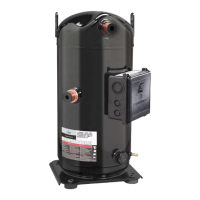
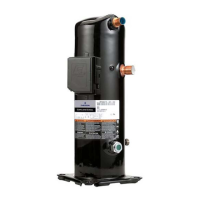
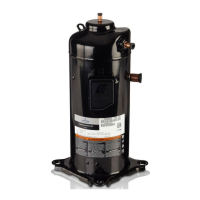
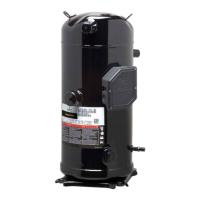
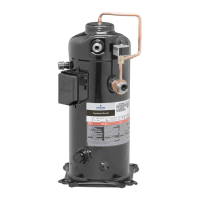
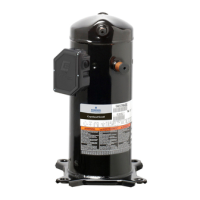
The document describes the 6 to 10 Ton ZPS*KC Copeland Scroll™ Two-Stage Compressors, which are designed for commercial and light commercial applications requiring capacity stage reduction and part-load efficiency.
These compressors are two-stage modulated Copeland Scroll™ units that provide capacity control by modulating between full-load and part-load operation. A 24-volt DC solenoid valve inside the compressor controls this modulation. When the solenoid valve is energized, the compressor operates in full-load (100% capacity). When de-energized, it operates in part-load (approximately 67% of full-load capacity). This modulation is achieved by a 3-way solenoid valve that provides pressure to a lift ring assembly, which opens and closes scroll modulation ports. This process vents a portion of the gas in the first suction pocket back to the low side of the compressor, reducing effective displacement. The compressor's single-speed motor continues to run while the scroll modulates, allowing "on the fly" capacity changes without shutting off the motor. The unloaded (part-load) mode is the default, as it's expected to be the most common operating mode and allows for simple two-stage thermostat control in both cooling and heating.
The ZPS*KC compressors are approved for use with R410a refrigerant only. They can operate at full-load capacity throughout their specified operating envelope, though there are limitations in part-load operation.
 General
| Brand | Emerson |
|---|---|
| Model | Copeland Scroll ZPS KC Series |
| Category | Air Compressor |
| Language | English |



 To Next Page