EasyManua.ls Logo

Emerson Fisher LS200 Series - User Manual

Emerson Fisher LS200 Series
20 pages
Print Icon
To Next Page IconTo Next Page
Loading...
LS200 Series Direct-Operated Regulators
Table of Contents
Introduction .................................................................. 1
Specifications .............................................................. 2
Principle of Operation .................................................. 7
Installation ................................................................... 8
Overpressure Protection.............................................. 8
Startup ......................................................................... 9
Adjustment ..................................................................9
Shutdown...................................................................10
Maintenance .............................................................. 10
Parts Ordering ........................................................... 12
Parts List....................................................................13
WARNING
Failure to follow these instructions or
to properly install and maintain this
equipment could result in an explosion,
fire and/or fire causing property damage
and personal injury or death.
Fisher™ regulators must be installed,
operated and maintained in accordance
with federal, state and local codes, rules
and regulations, and Emerson Process
Management Regulator Technologies Inc.
(Emerson) instructions.
If the regulator vents gas or a leak
develops in the system, service to
the unit may be required. Failure
to correct trouble could result in a
hazardous condition.
Call a qualified service person to service
the unit. Installation, operation and
maintenance procedures performed
by unqualified person may result
in improper adjustment and unsafe
operation. Either condition may result in
equipment damage or personal injury.
Only a qualified person shall install or
service the regulator.
Introduction
Scope of the Manual
This manual provides specications, installation,
adjustment, maintenance instructions and parts
ordering information for the LS200 Series Regulators.
Only personnel qualied through training or experience
should install, operate and maintain this regulator. If
there are any questions concerning these instructions,
contact your local Emerson Impact Partner O󰀩ce
before proceeding.
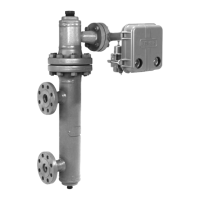
Figure 1. LS200 Series Regulator
LS200 Series
January 2023
Instruction Manual
D104616X012
Question and Answer IconNeed help?

Do you have a question about the Emerson Fisher LS200 Series and is the answer not in the manual?

Overview

The LS200 Series Direct-Operated Gas Regulators are designed for industrial and commercial applications, supplying gas to furnaces, burners, and other appliances. These regulators feature a balancing system that ensures accurate control of gas pressure, optimizing combustion efficiency even with varying inlet pressure conditions. The single-port construction provides bubble-tight shutoff. The product is suitable for use with fuel gases of the 1st and 2nd family according to EN 437, as well as other non-aggressive and non-fuel gases.

Function Description

The LS200 Series operates by registering downstream pressure under the diaphragm via an external control line, which acts as the operating medium. When gas demand increases, downstream pressure drops, allowing the control spring to move the diaphragm and stem assembly downwards, opening the valve disk and increasing gas supply. Conversely, decreased demand raises downstream pressure, moving the diaphragm and stem assembly upwards, closing the valve disk and reducing gas supply. The integrated boosting system, which includes a balancing diaphragm, enhances rangeability and performance by compensating for spring and diaphragm effects. When the trim is open, gas flows from the inlet over the disk edge to the outlet. Pressure near the disk, which is higher than in the flow path due to gas velocity, is registered on the top of the balancing diaphragm, aiding downward disk travel.

Important Technical Specifications

Actuator Sizes:

  • Types LS220 and LS224 (13.8 in. / 350 mm):
    • Medium pressure construction for outlet pressure ranges: 4.35 to 10 psig (0.3 to 0.69 bar) and 10 to 21.75 psig (0.69 to 1.5 bar).
    • Maximum operating inlet pressure: 125 psi (8.61 bar) for lower outlet ranges, up to 284 psig (19.6 bar) for higher outlet ranges.
    • Maximum emergency inlet pressure rating: 284 psig (19.6 bar) at 100°F (38°C).
  • Types LS250 and LS254 (10.0 in. / 255 mm):
    • High pressure construction for outlet pressure range: 20 to 60 psig (1.37 to 4.2 bar).
    • Maximum operating and emergency inlet pressure rating: 284 psig (19.6 bar) at 100°F (38°C).

Pressure Registration: External, requiring a downstream control line.

Temperature Capabilities:

  • -20 to 150°F (-29 to 66°C)
  • -4 to 140°F (-20 to 60°C) for PED certified units.
  • Lockup and function tested to -40°F (-40°C).

Control Line Connection:

  • Without Slam-Shut: 1/4 NPT (internal), positioned directly over the body outlet (standard) or 90 degrees right or left.
  • With Slam-Shut: 1/4 NPT (internal) connection right or left directly over the slam-shut, selectable or changeable after shipment.

Vent Connection: 3/4 NPT (internal) vent assembly.

Certifications: EN 334, EN 14382, Pressure Equipment Directive (PED), DVGW. Approved for up to 25% Hydrogen Blend (pending 100%). Hydrogen Construction Available.

PED Categories:

  • A single LS200 Regulator without Slam-shut is not classified as a safety accessory under PED 2014/68/EU.
  • With integral strength type and Class A configuration (over and under pressure protections set up), the built-in safety shut-off device can be classified as a safety accessory according to EN 14382.

Usage Features

  • Installation: Can be installed in any position, provided flow through the body matches the direction arrow and the vent opening is unobstructed and protected. External threads require pipe compound; flanged connections require even bolt tightening. Parallel installation is recommended for continuous operation during maintenance.
  • Overpressure Protection: Due to the outlet pressure rating being lower than the inlet, overpressure protection is necessary if the actual inlet pressure exceeds the outlet pressure rating. All models must be protected against inlet pressure above their listed maximum.
  • Startup: If the downstream system is already pressurized, extra precautions are needed. The regulator outlet must never be subjected to pressure higher than the inlet pressure, and the control line pressure must not exceed the set point by more than 3 psig (0.21 bar) to prevent damage. For unpressurized systems, ensure appliances are off, then slowly open upstream and downstream shutoff valves, check for leaks, and make final control spring adjustments.
  • Adjustment: To increase the pressure setting, remove the closing cap and turn the adjusting screw clockwise. To lower the setting, turn counterclockwise. A pressure gauge must always be used during adjustments. Do not exceed the nameplate's stamped outlet pressure limit. If the desired pressure is outside the spring's range, a different spring or actuator may be required.
  • Shutdown: Isolate the regulator from the pressure system and release pressure from the outlet and control line. Inlet pressure will automatically release as the regulator opens. If a slam-shut is present, ensure it has not isolated pressure upstream or downstream before maintenance.

Maintenance Features

  • General: All maintenance requires isolating the regulator and relieving internal pressure. Only Emerson-manufactured parts should be used for repairs.
  • Reset Procedure (Slam-Shut Option): Use the rearm tool (or a 17 mm wrench) to rotate the lever counterclockwise past the reset point until it points down and no longer rotates back to the tripped position.
  • Downstream Control Line: Essential for proper operation. It should be a pipe or tubing of at least 1/2 inch (12.7 mm) diameter, connected 5 to 10 pipe diameters from the regulator in a straight section of pipe.
  • Vent: Features a dampening assembly for improved performance. The damper is screened to prevent foreign material. For indoor installations, the damper assembly can be removed, and the vent piped outside. The vent pipe should be as short as possible with minimal bends, and the opening positioned to prevent water, ice, or foreign material entry.
  • Disk or Pad Maintenance: Involves isolating the regulator, bleeding downstream pressure, removing bolts and diaphragm plate, unscrewing the locknut, and replacing the disk and O-ring as needed. Reassembly requires checking O-rings and lubricating with elastomer sealant and anti-seize compound.
  • Actuator Maintenance: Requires isolating the regulator, bleeding downstream pressure, removing the closing cap and adjusting screw (to release spring compression), removing cap screws, lifting the spring case, and replacing the diaphragm. Reassembly involves aligning bolt holes, setting the diaphragm and spring seat, and tightening the locknut. All O-rings should be checked and lubricated.
  • Balance Diaphragm Replacement: Similar to actuator maintenance, but also involves removing the slam-shut mechanism (if present) and the intermediary flange screws to lift the actuator assembly and trim out of the body. The balance diaphragm is replaced, and all O-rings are checked and lubricated during reassembly.
  • Replacing Orifice or Seat: Involves isolating the regulator, bleeding pressure, manually tripping the slam-shut (if present), removing the closing cap and adjusting screw, removing bonnet screws, lifting the actuator assembly and trim, removing the locknut and disk, and finally removing the torx screws to replace the orifice. All O-rings are checked and lubricated during reassembly.

Emerson Fisher LS200 Series Specifications

General IconGeneral
BrandEmerson
ModelFisher LS200 Series
CategoryController
LanguageEnglish

Related product manuals