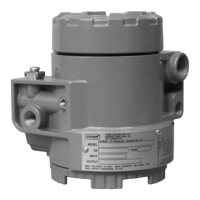
i2P-100 Transducer
Instruction Manual
Form 5777
September 2004
10
COIL
ZERO
AND
SPAN
CIRCUIT
DC
CURRENT
INPUT
SIGNAL
PNEUMATIC
RELAY
DIAPHRAGM
EXHAUST
DIAPHRAGM
OUTPUT
PRESSURE
MAGNET
BEAM
FLAPPER
NOZZLE
RESTRICTION
VALVE
PLUG
SUPPLY
PRESSURE
A3877-2/IL
-
+
{
CURRENT-TO-PRESSURE
CONVERTER ASSEMBLY
FIELD TERMINATOR AND
ELECTRONICS CIRCUIT
F
F
Figure 11. Type i2P-100 Transducer Schematic
9. Repeat steps 5 through 8 until the output
pressure is within the referenced accuracy
requirements without further adjustment.
10. If a current source other than the control device
was used, disconnect the current source and
reconnect the control device.
Principle of Operation
The converter module receives a standard dc
current input signal from a control device to operate
coils in a force balanced beam system which in turn,
controls bleed air through an integral nozzle/flapper
arrangement. The nozzle pressure provides the
input signal to operate the relay as shown in figure
11. Relay output pressure is applied, through tubing,
directly to the final control element or valve/actuator
assembly.
Maintenance
The normal mode of operation for Type i2P-100
transducer requires that the pneumatic output
pressure be piped to the final control element. If this
is not done the resulting pneumatic output will vent
to the atmosphere.
Due to normal wear or damage from external
sources such as debris in the supply medium,
periodic maintenance or repair of the transducer
may be necessary. Maintenance of the transducer
consists of troubleshooting, removal for inspection,
and replacement of component parts, as well as
removal and inspection of the external removable
filter/restriction and cleaning or replacing as
necessary (see figure 1).
WARNING
To avoid personal injury or property
damage from the sudden release of
pressure:
D Always wear protective clothing
and eyewear when performing any
maintenance operations.
D Disconnect any operating lines
providing air pressure, electric power,
or a control signal to the actuator. Be
sure the actuator cannot suddenly
open or close the valve.
D Use bypass valves or completely
shut off the process to isolate the
valve from process pressure. Relieve
process pressure on both sides of the
valve.
D Use lock-out procedures to be
sure that the above measures stay in
effect while you work on the
equipment.
D Check with your process or safety
engineer for any additional measures
that must be taken to protect against
process media.
WARNING
For explosion-proof applications, or
when using natural gas as the supply
medium, disconnect power before
removing the housing cap. Personal
injury or property damage from fire or
explosion may result if power is not
disconnected before removing the cap.
CAUTION
When you replace components, use
only components specified by the
factory. Always use proper component
replacement techniques, as presented


 To Next Page
 Loading...