To Next PageTo Next Page
 Need help?
Do you have a question about the Emerson SP and is the answer not in the manual?
Provides instructions for installation, troubleshooting, maintenance, valve setting, and parts ordering.
Details the complete pressure regulator with safety pilot, including Type E Main Valve or Type D pilot.
Details sizes, connections, ratings, coefficients, and materials for the Type E Main Valve.
Lists maximum inlet temperature/pressure and pressure ranges for the Type D pilot.
Specifies maximum inlet temperature/pressure and pressure ranges for the SP/P safety pilot.
Explains how the main spring, pilot, and diaphragm control valve operation.
Describes how the safety pilot functions to close the main valve if house pressure rises.
Highlights risks of personal injury or damage from improper installation or overpressure conditions.
Details steps for adjusting the pilot stem length and compression.
Outlines the process for adjusting the pressure stem and plate position.
Explains how to adjust delivery pressure for Type ED and EW pilots.
Warns against disassembly without isolating pressure and advises on testing and parts.
Provides steps for disassembling and cleaning the main valve.
Details the procedure for dismantling and cleaning the Type D pilot.
Outlines steps for dismantling, cleaning, and reassembling the safety pilot.
Lists checks and actions for when the regulator does not open or build sufficient pressure.
Provides steps for resolving issues where delivery pressure is too high.
Advises referencing assembly numbers when contacting sales or ordering parts.
Lists specific part numbers for the Type SP/P Safety Pilot components.
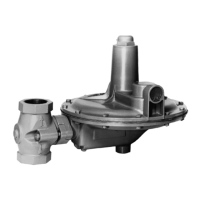
The Spence Regulators with Type SP/P Pressure Safety Pilot is a pilot-operated, normally closed, single-seat pressure regulator designed to reduce a steady or varying initial pressure to a constant, adjustable delivery pressure. It features packless construction, balanced metal diaphragms, and a protected main spring. The safety pilot acts as a standby feature, preventing pressure buildup on the house side in cases of primary or secondary regulator failure, but does not regulate under normal conditions.
The main valve operates by the interaction of its main spring and the initial pressure on top of the disk, which keeps the valve closed. High-pressure steam from the inlet side of the main valve flows through a nipple and union to the Type D pilot. The pilot, held open by its adjusting spring, discharges steam into a copper tubing tee. From this tee, part of the steam flows through a bleedport (3/32 in. / 2.38 mm orifice) located on the outlet side of the main valve, and the rest flows down to a restriction (orifice size varies with valve size) to exert pressure on the main valve diaphragm, causing the main valve to open. As the delivery pressure approaches the desired set point, it acts on the pilot diaphragm via a control pipe, throttling the pilot and reducing steam flow. This reduction in steam flow allows pressure under the main valve diaphragm to escape through the bleedport, causing the main valve to throttle down and maintain the desired delivery pressure.
The safety pilot's inlet is connected to the restriction tee at the bottom of the primary main valve. This tee has a restriction on the Type D pilot side but none on the safety pilot side. This design ensures that when the safety pilot opens, it can bleed off pressure under the main valve diaphragm faster than the Type D pilot can build it up, thereby closing the primary main valve. The safety pilot's control pipe is connected to the house side and is set for a slightly higher pressure than the normal house pressure. If the house pressure increases for any reason, the safety pilot will throttle the primary main valve to maintain the house pressure at its set point.
 General
| Brand | Emerson |
|---|---|
| Model | SP |
| Category | Controller |
| Language | English |