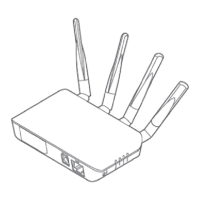
Rx is a receiver which connects wired and wireless connectivity.
A transmitter is connected to a receiver.
Received Signal Strength Indication
A mark for WECA to check linking between wireless products. The name is originated
from "Wireless Fidelity". WECA carries out an elaborate test and grants a Wi-Fi logo to a
product that satisfies the linking standards.
Tx (Client) or Rx ( Master) that uses a wireless network to connect between two different
wired networks.
Has a table that controls the packet route between Rx and Tx
Maintains Rx and Tx.
Service Set Identifier
SSID is a unique identifier of 32 bytes length added to the header of a packet
transmitted through a WLAN. It is used like a password when Tx connects to BSS (basic
service set). Rx or Tx must the same SSID. A Tx that does not know the unique of a
certain BSS cannot access the BSS.
WEP (Wired Equivalent Privacy): An encryption standards prepared by IEEE 802.11 for
WLAN security. There are various types of application developed to use encryption keys
to strength security.
Refers to the difference between the highest and lowest frequencies of a signal usable in
a network. It means, commonly, the highest transmission speed or a capacity to transmit
information and uses ‘bps’ its unit.
DHCP allows the network administrator to manage and allocate IP addresses and to send
new IP addresses when the computer connects to a different location of the network.
Can use fixed IP addresses. There is no need for the administrator to allocate IP
addresses.
802.11ac operates at 5G Hz’s V10.1 frequency bandwidth.
The lowest sub layer of the physical layer and
a block for connection with the
outside. It changes a protocol layer into a physical layer.
Wireless Distribution System
WDS forms a wireless network between Rx’s to provide the larger support range of
wireless network than when one Rx is used.
Base Service Set
Refer to a minimal size of WLAN formed based on a Rx if a wire network consists of
multiple wireless Rx’s in the infrastructure mode.


 To Next Page