29
EN
HOW TO MAKE COFFEE
With powder coffee
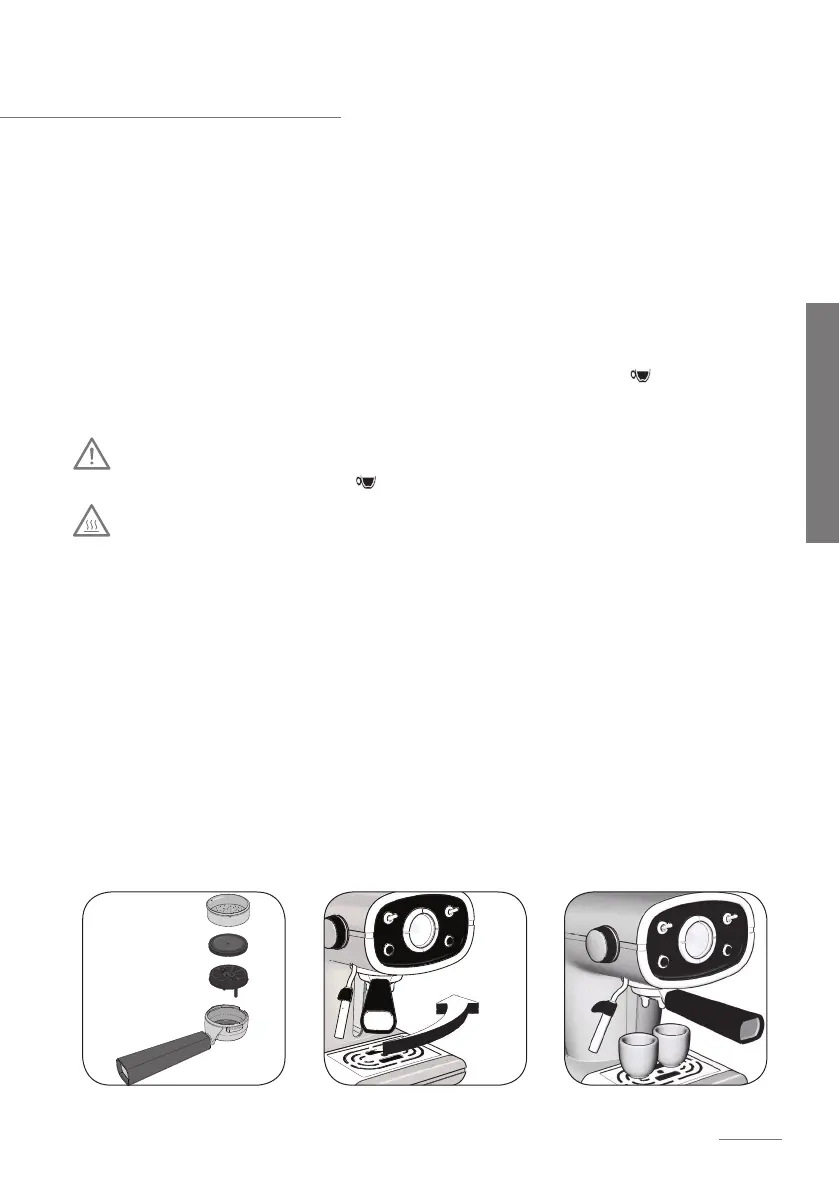
Insert the dripper (B), the perforated silicone disc (C) and the 2 cup (E) or 1 cup (D) filter, in the
filter holder (A) (Fig. 5). The perforated silicone disc can be inserted only in one direction on the
dripper. Measure out the coffee in the filter and lightly press with the specially provided presser:
for two coffees completely fill two measuring units, while for one coffee fill only one. Insert the
filter holder into its seat. Tighten it securely by turning it from left to right, making sure it is
correctly fitted to the flange (Fig. 6).
If too much ground coffee is put inside the filter, turning the filter holder may prove difficult
and/or you may get leaks from the filter holder when the coffee is being dispensed.
The filter ring should be preheated for a few minutes to ensure a nice, hot cup of coffee. This
will not be necessary for the following coffees.
8BJUGPSUIFMJHIU/UPUVSOPO1PTJUJPOUIFTXJUDI2UPDPGGFFCSFXJOH
): coffee will flow
from the spouts of the filter holder. Stop dispensing setting the switch (Q) in the upper position.
The minimum serving of coffee is 50 ml.
Warning!
As in professional coffee machines, do not remove the filter holder when the dispensing
switch is ON (in coffee position ).
Warning!
After dispensing coffee wait about ten seconds before removing the filter holder. To re-
move it, turn it slowly from right to left so as to prevent splashes or spurts of water or
DPGGFF8IFOSFNPWJOHUIFGJMUFSIPMEFSUIFGJMUFSNJHIUHFUMPDLFEUPUIFGMBOHFEPOPU
try to remove the filter with your fingers. Fasten the filter holder to its seat again and
turn it on the left.
8IFOXBSNJOHVQZPVSBQQMJBODFNBZSFMFBTFTNBMMQVGGTPGTUFBNGSPNUIFGJMUFSIPMEFSUIJT
is perfectly normal.
The indicator light (N) will switch off and on periodically, showing the intervention of the boiler
thermostat, which serves to maintain the best water temperature (around 100°C / 212°F for
making coffee, and about 140°C / 284°F to dispense steam).
8IFOVTJOHUIFDPGGFFNBLFSGPSUIFGJSTUUJNFBOEUIFSFBGUFSJUJTCFTUUPCFHJOCSFXJOHDPGGFF
only when the light (N) is on.
Fig. 5 Fig. 7Fig. 6


 To Next Page