-7-
Wiring Instructions and Connections
Attention! 060
®
Super Bender
®
machines ship 120V single phase. Have a qualied electrician connect
your machine according to the following instructions. Note: CML USA Ercolina
®
is not responsible for
damage that may occur from improper installation.
1. Determine location of machine installation.
2. Measure incoming line voltage at power source.
3. Conrm incoming line voltage matches machine’s voltage rating.
4. 060
®
’s are equipped with two multi-tap transformers (TR1 and TR2).
Voltage taps on (TR1) and (TR2) transformers must be set to match incoming line voltage.
5. Access front panel to make necessary adjustments to electrical controls.
6. Complete wiring installation, close and lock cabinet door.
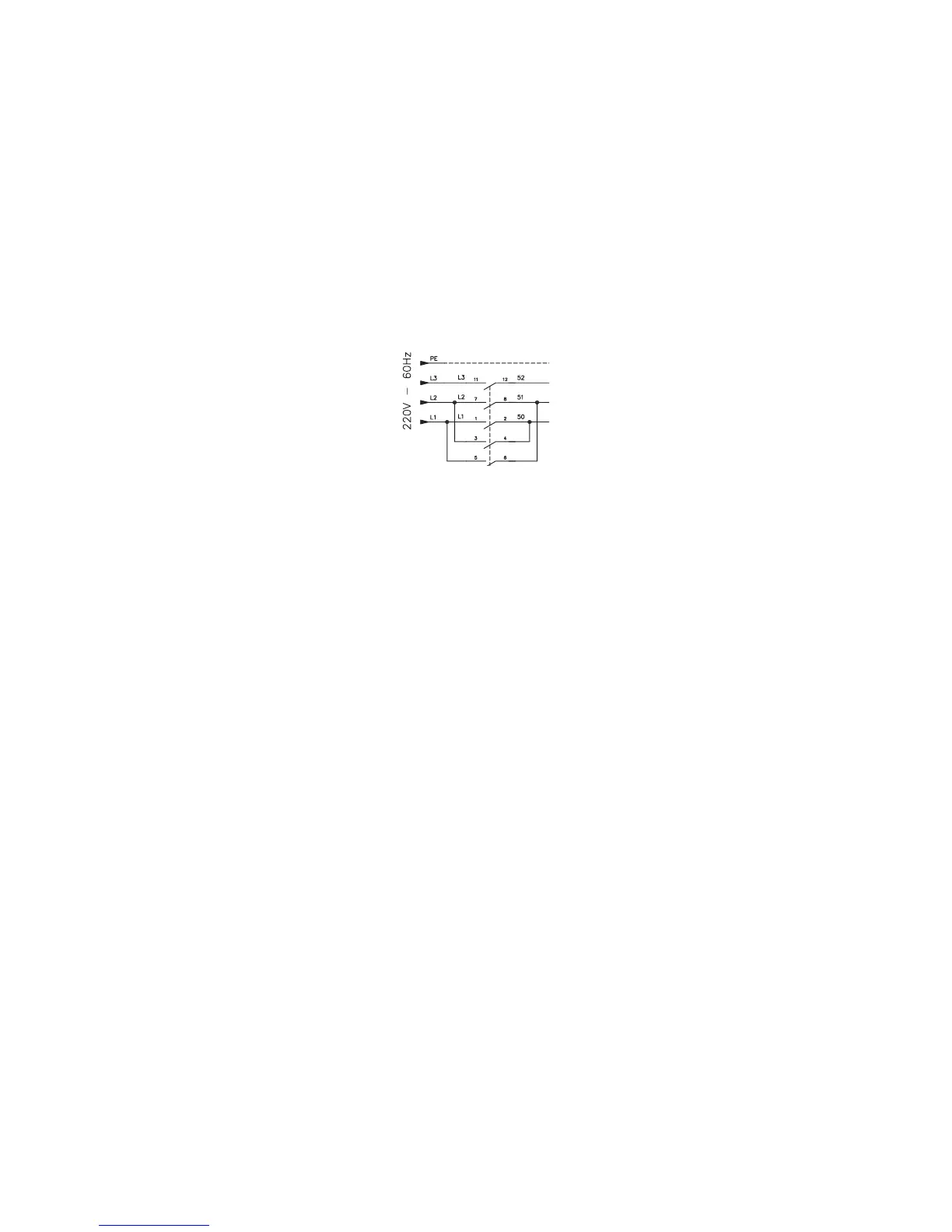
(Note to electrician: When connecting machine to WYE power supply, connect highleg to wire #52 at
machine. See diagram.)
7. Release emergency stop switch and rotate main power switch to “ON” position.
If panel displays “rotation error”, turn machine power “OFF”, rotate power switch in opposite direction
to automatically change phasing.
General Assembly and Setup
- Connecting foot pedal -
Insert male end of DIN plug connector into female socket on front of base cabinet.
- Changing hex shafts -
The 060
®
Super Bender
®
ships with 50mm hex shaft installed. Smaller tooling requires using 40mm hex
shaft.
To interchange shafts:
1. Remove (8) 8 x 1.25 x 25mm SHCS securing hex shaft to machine
2. Remove existing hex shaft - install desired shaft (Note: Only one tting position is possible)
3. Replace and securely tighten (8) SHCS
- Hand wheel installation -
Place hand wheel on hex head of lead screw. Hand wheel is used for positioning (X) axis and setting
counterbend die pressure.
Bending Terminology
OD: Outside diameter of pipe or tube
ID: Inside diameter of pipe or tube
Wall thickness: Pipe wall thickness is measured in terms of schedule (i.e. 5, 10, 40). Tube wall thickness
is measured in terms of gauge (i.e. 16 gauge = .065).
Center Line Radius (CLR): Exact measured distance from centerline of tooling to centerline of material’s
neutral axis
Degree of bend: Number of degrees required in a bend - right angle requires 90° of bend
Springback: A material’s tendency to return to its original shape after bending
Ovality: Amount of distortion created in the cross section of pipe or tube from a normal round shape
Tangent Points: The two points at which bend starts and ends
Distance between bends: Straight section between two tangent points of bends
Tensile strength: Point at which material is stretched beyond yield strength


 To Next Page