P14/37 E-IM54f
Flammable Anaesthetics and Spirits
4.41 The use of flammable anaesthetics and nitrous oxide
(N
2
O) or oxygen should be avoided if a surgical procedure
is to be carried out in the region of the thorax or the head,
unless these agents are removed by suction. Flammable
agents used for cleaning or disinfecting, or as solvents of
adhesives should be allowed to evaporate before the
application of electrosurgery. (Also see WARNING above
section 6.1).
4.42 There is a risk of pooling of flammable fluids under
the patient or in body depressions such as the umbilicus
and in body cavities such as the vagina. Any fluid pooled
in these areas should be mopped up or removed by suction
(for gaseous fluids) before the equipment is used.
4.43 Attention is drawn to the danger of ignition of
endogenous gases (i.e. those gases produced within the
body). Some materials, e.g. cotton wool and gauze, when
saturated with oxygen may be ignited by sparks produced
in normal use of the equipment.
Implanted Cardiac Pacemakers
General
4.44 If in monopolar electrosurgery the intervening tissue
and organs contain an implanted pacemaker and its leads,
it is possible under certain conditions that the
electrosurgical current will have undesirable effects. The
following notes offer guidance on the risks and on possible
precautions.
WARNING
For patients with cardiac pacemakers or other
active implants, a possible hazard exists
because interference with the action of the
pacemaker may occur or the pacemaker may
be damaged. In case of doubt, approved
qualified advice should be obtained.
Risks
4.45 Operating with electrosurgical equipment on patients
who have an implanted pacemaker incurs the risks of
affecting the pacemaker's operation, either by direct contact
or by radiated interference, and of inducing burns at the
pacemaker electrode implantation site. Clearly the risks
are very much lower with bipolar than with monopolar
electrosurgery, because of the highly localised current path.
Precautions
4.46 Recommendations published in the U.S.A.
(References ¹ and ²) suggest that an implanted pacemaker
should be unaffected, or only revert to fixed-rate operation,
if the electrosurgical active electrode and plate electrode
are kept a few inches away from the pacemaker pulse
generator and its electrode leads; while to avoid burns to
the myocardium at the electrode site, or possible ventricular
fibrillation, they should remain at least 15 cm away from
the heart.
4.47 It will also be sensible to choose a location for the
plate electrode which puts the path of electrosurgical
current through the patient's body as far as possible from
the heart and from the pacemaker and its leads.
4.48 If the pacemaker is programmable, it is suggested
that it is set to either the VVT (ventricular sensing and
triggering) or the V00 (fixed rate) mode (preferably the latter
if the patient is not at particular risk from a competitive
rhythm) so that it functions as a fixed rate pacemaker during
the surgical procedure.
4.49 It is further recommended
(References ¹ and ²) that
the peripheral pulse be monitored during the course of
electrosurgery, and (Reference ²) that precautions be taken
to ensure that the patient's well-being is maintained in the
event of interference with pacemaker operation. By using
the electrosurgical equipment in short bursts, it is
suggested
(References ¹ and ²) that, at most, only one or
two beats will be affected.
WARNING
More severe consequences, local heating and
destruction of the pacemaker circuit
(Reference ¹), would result if an electro-surgical
electrode touched the pacemaker.
Electrosurgical Interference
4.50 Electrosurgical equipment can produce interference
with other electromedical apparatus used in the operating
theatre. Particular attention should be given to the selection
of ECG monitors with good interference rejection if it is
desired to monitor the patient when the electrosurgical
equipment is active.
4.51 In certain conditions a reduction in ECG interference
can be obtained by placing the ECG electrodes closer
together than normal. Modern monitors with high input
isolation allow electrode placement close to the
electrosurgical plate electrode, if required.
4.52 It is inadvisable to use mobile telephones or ‘walkie-
talkie’ equivalent equipment close to electrosurgical or any
other medical electrical equipment.
4.53 To minimize the possibility of electrical interference
from an arc, between the active electrode and the patient,
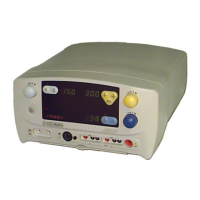
affecting the TD830, it is good practise, in common with all
electrosurgical units, to keep them as far as is reasonably
possible from the surgical site.


 To Next Page