General Safety Notes Page 2 Dimensions and Clearances Page 6
Installation Instructions Page 2 Installing the Stove Page 6
Chimney and Fuel Page 3 Operating Instructions Page 8
Flue Draught Page 4 Wood Burning Page 9
Flue Stabilizer Page 5 Solid Mineral Fuel Burning Page 10
• Properly installed, operated and maintained, this appliance will not emit fumes into the dwelling. However
occasional fumes from de-ashing and re-fuelling may occur. Persistent fume emission is potentially
dangerous and must not be tolerated. If fume emission does persist, open doors and windows to ventilate the
room. Let the fire burn out or eject and safely dispose of fuel from the appliance. Once the fire is cold, check
the flue and chimney for blockages and clean if required. Do not attempt to relight the fire until the cause of
the fume emission has been identified and corrected. Seek expert advice if necessary.
• Do not fit an extractor fan in the same room as the appliance.
• An adequate air supply for combustion and ventilation is essential in accordance with Building Regulations
Document J Section 2. Air openings provided for this purpose must not be restricted.
• It is important that flue ways are cleaned frequently and the chimney swept regularly. Also the stove must be
maintained in good mechanical order. The chimney should be swept at least once per year for smokeless fuel
and a minimum of twice per year for other fuels.
• If the chimney was previously used for an open fire, it is possible that the higher flue gas temperatures
generated by the stove may loosen deposits that were firmly adhering to the inner surface of the chimney and
cause blockage of the flue pipe. We recommend that in such a situation a second sweeping of the chimney
should be carried out within one month of regular use of the stove after installation. Also, lock open or
remove any existing dampers in the flueway.
• Should it be likely that children, aged or infirm people approach the fire, then a fireguard should be fitted.
• Avoid the use of aerosol sprays in the vicinity of the stove when it is in operation.
The installer has a responsibility under the Health and Safety at Work Act 1974 to provide for the safety of persons
carrying out the installation. Attention is drawn to the fact that fire cement is caustic and hands must be washed
thoroughly after use. The appliance is heavy and care must be taken during handling. Although the appliance does
not contain asbestos products, it is possible that asbestos may be disturbed in existing installations and every
precaution must be taken.
These instructions give a guide for the installation of the appliance but in no way absolves the installer from
responsibilities to confirm to British Standards, in particular BS8303 and BS6461, relating to the installation of solid
fuel appliances. The installation should also comply with local Building Regulations and Local Authority Bye-Laws.
The stove must be placed at least 40cm away from any combustible materials. If necessary, any adjoining walls
should be protected from the effects of heat.
CONTENTS
GENERAL SAFETY NOTES
INSTALLATION INSTRUCTIONS
The successful operation of the ESSE 500 relies on the adequate performance of the chimney to which it is
connected. The chimney must:
• Have an internal cross section of no less than 320cm
2
(200mm dia). If a flue liner is used it should be 125mm
(5'') diameter and suitable for solid fuel.
• Be a minimum 4.6m high from hearth level to pot.
• Be terminated at least 1m above roof level so that the chimney does not terminate in a pressure zone (see
Fig.2)
• Be free from cracks, severe bends, voids and obstructions.
• Be connected to this one appliance only.
• New chimneys must be built in accordance with local building regulations.
• If the stove is installed as freestanding appliance, it should not support any part of the chimney.
• Voids in the chimney should be avoided, as these will prevent a steady flue draught.
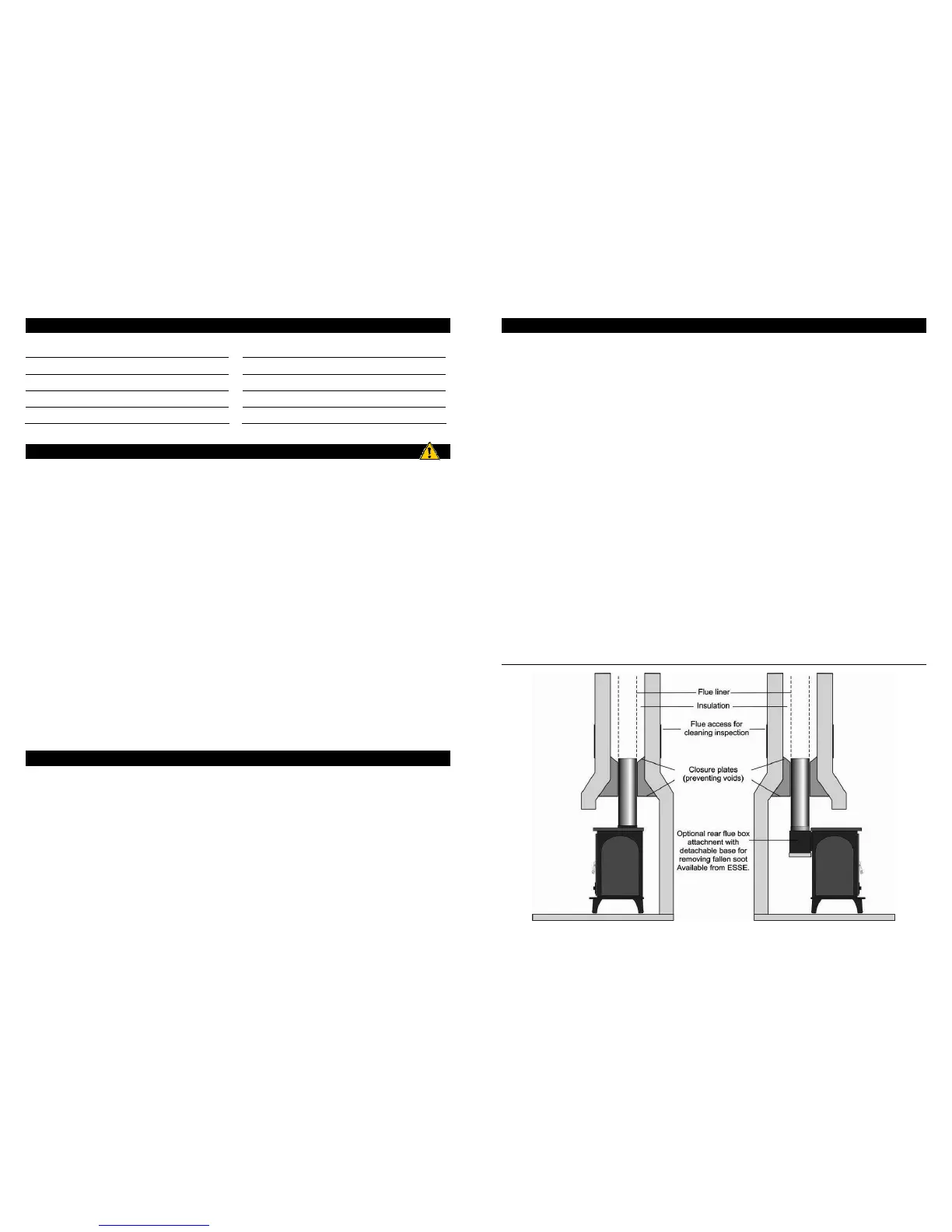
• The stove flue pipe should pass beyond the narrowing of the chimney (see Fig.1)
• Consideration should be given to falling soot. For rear outlet stoves it may be necessary to provide a soot
catchment area in the flue pipe so that soot does not settle in the path of the flue gases. The optional rear flue
box attachment available from ESSE has a detachable base that allows for fallen soot to be removed (see
Fig.1).
• A flue/chimney access point may also be required so that the state of the chimney can be checked and any
fallen soot removed.
• External flues must be insulated to prevent heat loss.
CHIMNEY AND FLUE


 To Next Page
 Loading...