58 www.eta.co.at
[Heating circuit] function block ETAtouch controller
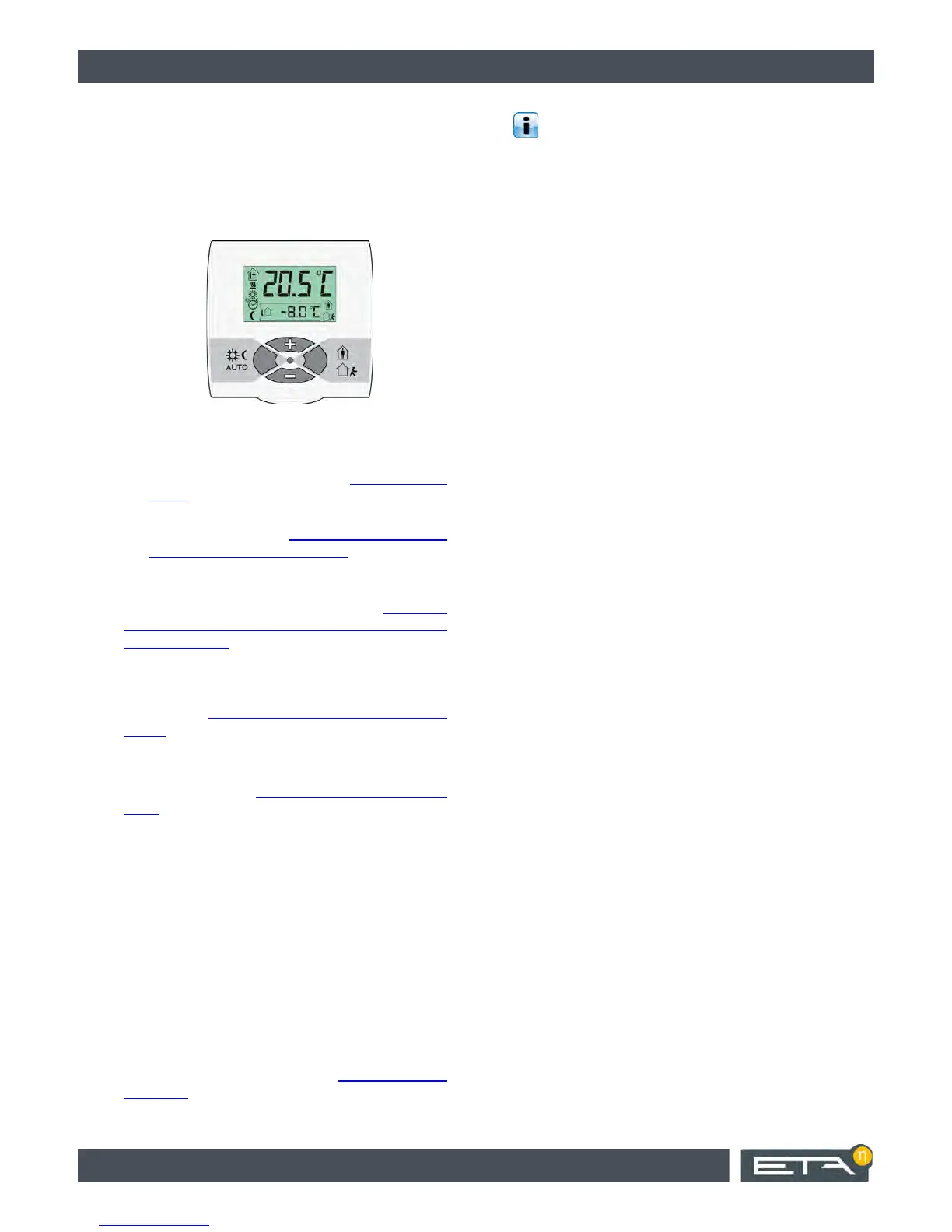
Check operating mode and target room
temperature on the ETA room sensor
• If a room is too cold, check the room sensor, or in
the control system set the operating mode and the
desired room temperature. It is possible that the
heating circuit has been switched off or the room
temperature is set too low.
Fig. 6-50: ETA room sensor
• Check the settings of the following parameters in
the text menu of the heating circuits:
–[Room effect], see chapter 6.6.4.1 "
Room
effect"
–[Switch-on diff. room] and [Switch-off diff.
room] see chapter 6.6.4.2 "
Switch-on diff.
room and Switch-off diff. room"
• If during heating mode the rooms are constantly
too cold (within the set heating times), the heating
curve must be adjusted. See chapter Fig. 6-51:
"Adjust heating curve (at outdoor temperatures
above freezing)".
If the rooms are too cold in reduced-temperature
mode (outside the heating times), only the [Set-
back difference] parameter needs to be adjusted.
See chapter Fig. 6-53: "
Adjust reduced operation
mode".
Check the heating time settings
• Check the heating time settings in the control
system, see chapter 6.6.2 "
Setting the heating time
slots".
For heating systems with buffer storage, often
heating times that are too short are the reason for
insufficiently warm rooms. Short heating times
(less than 5 hours continuous heating) are particu-
larly ill-advised for underfloor heating because
such systems react very slowly.
Optimal operation is enabled with low feed tem-
peratures (=[Flow at +10 °C] and [Flow at -10 °C])
for the heating curve and long continuous heating
times (10-14 hours). Thus, the heat is transferred
evenly throughout the room. Therefore, it is
advisable (in heating systems with a buffer) to first
set a longer heating time and wait a few days. If the
rooms are then still too cold, the heating curve
must be adjusted. See chapter 6.6.1 "
Operating
elements".
If no buffer storage tank is available,
several short heating times must be set with
pauses in between. This increases the heat
absorbed by the heating circuit from the boiler in
the short heating times. Through this heating time
interruption, the screed becomes a "buffer" in case
of underfloor heating. Between the heating times,
the screed cools and then absorbs heat again. In a
well-insulated building, observe the following
guidelines:
–Radiator heating: several intervals with
3 hours of heating and 2 hours break
–Underfloor heating: several intervals with
4 hours of heating and 3 hours break
The optimum settings depend on the heat demand
of the building and each room. Explore this in con-
sultation with your heating contractor or ETA
customer service.


 To Next Page