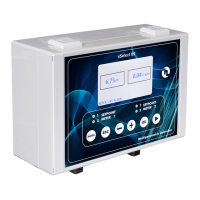
The Etatron eSelect M is a versatile instrument designed for precise control and monitoring in various applications, particularly those involving pH, Rx (ORP), and CL (Chlorine) measurements. It offers both basic and expert operating modes, catering to a wide range of user needs from straightforward control to advanced parameter management.
Function Description:
The eSelect M serves as a multi-channel controller capable of managing up to three different parameters (pH, Rx, CL) simultaneously, as indicated by the mention of "eSelect M3" for multiple channels. Its primary function is to maintain desired setpoints for these parameters through controlled dosing. The instrument provides a clear, intuitive menu-driven interface accessible via an OK button, arrow buttons (left, right), and an ESC button for navigation.
Key functionalities include:
- Setpoint Control: Users can define specific setpoints for each channel (e.g., pH, Rx, CL). The instrument then activates dosing mechanisms (e.g., pumps) to adjust the measured parameter towards the setpoint.
- Working Mode Selection: The eSelect M supports different working modes, including acid or alkaline dosing for pH control, and on/off or timed pulse dosing for various applications.
- Calibration: The device allows for accurate calibration of its sensors for pH, Rx, and CL. This ensures the reliability and precision of measurements.
- Alarm Management: Users can configure minimum and maximum alarm settings for each channel. If the measured parameter falls outside these limits, the instrument can trigger an alarm.
- Priming Function: A priming feature is available, likely for preparing dosing pumps or lines.
- 4-20mA Output: The eSelect M can output a 4-20mA signal, which is a standard industrial communication protocol. This allows the instrument to integrate with other control systems or devices, either by reflecting the dosing setpoint or acting as an mA device.
- Safety Features: Advanced features like "Overdosing" and "Max Dosing Timing" are included to prevent excessive chemical addition and ensure that metering processes are completed within safe timeframes.
Important Technical Specifications (Inferred):
While specific numerical specifications are not provided, the manual implies the following:
- Multi-channel Capability: Available in configurations for one, two, or three channels (e.g., eSelect M3 for pH, Rx, CL).
- Measurement Parameters: pH, Rx (ORP), and CL (Chlorine).
- Output: 4-20mA output for external control or monitoring.
- Control Modes: On/off and timed pulse dosing.
- Input/Output: BNC connector for Rx calibration (implying standard electrode connections).
- User Interface: LCD screen with button navigation (OK, ESC, Left/Right arrows).
Usage Features:
The eSelect M is designed for user-friendly operation with a clear, menu-driven interface.
- Navigation: All functions are accessed through a main screen, using the OK button to enter menus and the left/right arrow buttons to scroll through options and adjust values. The ESC button allows users to exit menus.
- Basic Mode: For straightforward applications, the basic mode simplifies setup by offering essential parameters like working mode (acid/alkaline), dosing mode (on/off, timed pulses), alarm min/max, and priming.
- Expert Mode: For more complex control requirements, the expert mode unlocks additional parameters such as Hysteresis value, Setpoint delay, Measuring parameter, Overdose timing, Max dosing timing, and Startup delay. This allows for fine-tuned control and optimization.
- Factory Reset: A factory reset function is available to restore the instrument to its default settings, which is useful for troubleshooting or reconfiguring the device. This process involves navigating through specific menu options to confirm the reset. After a reset, users must reconfirm default settings like time, date, language, and channel-specific parameters.
- Setpoint Configuration: Setting setpoints is a direct process. From the main screen, users select the desired channel, press OK, adjust the setpoint value using arrow keys, and confirm with OK.
- 4-20mA Configuration: The 4-20mA output can be configured to either reflect the dosing setpoint or function as an mA device. Users select this option, adjust the setpoint value, and define the working mode (acid or alkaline). Advanced settings in expert mode include "Window Width" for defining the operational range of the 4-20mA mode, "Overdosing" time to prevent excessive chemical addition, and "Max Dosing Timing" as a safety feature.
Maintenance Features:
Regular calibration is a crucial maintenance aspect to ensure the accuracy of the eSelect M.
- pH Calibration:
- ZERO Calibration: Involves placing a clean pH electrode in buffer solution 7 for 2-3 minutes. Users then adjust the display to match pH 7 and confirm.
- Slope Calibration: Follows ZERO calibration, using buffer solution 4 or 9. The process is similar, adjusting the display to match the buffer value.
- Rx (ORP) Calibration:
- ZERO Calibration: Can be performed by using a blanking plug or short-circuiting the BNC connector. The mV reading is then adjusted to 0 mV.
- Slope Calibration: Requires placing a clean electrode into a 450mV buffer solution. After a brief period, the reading is adjusted to match the buffer value.
- CL (Chlorine) Calibration:
- The calibration process begins by pressing the OK button.
- It involves taking a water sample from the flow cell, implying an external measurement (e.g., with a DPD test kit) is needed to provide a reference value for calibration. This suggests a manual input of the measured chlorine concentration to calibrate the sensor. This applies to basic mode only, implying a more automated or advanced method might be available in expert mode, though not explicitly detailed.
The instrument's design emphasizes ease of calibration, which is vital for maintaining the accuracy and reliability of its measurements over time. The clear step-by-step instructions provided in the manual facilitate these maintenance tasks.

 Need help?
 General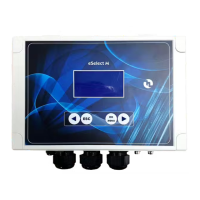

 To Next Page