Need help?
Do you have a question about the ETC Eos Apex 10 and is the answer not in the manual?
Provides an overview of the physical layout, components, and capacities of the Eos Apex 5 console.
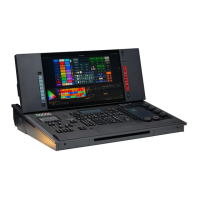
Details the physical layout, components, and capacities of the Eos Apex 10 console.
Details the physical layout, components, and capacities of the Eos Apex 20 console.
Provides an overview of the physical layout, components, and capacities of the Eos Ti console.
Details the physical layout, components, and capacities of the Gio console.
Provides an overview of the physical layout, components, and capacities of the Gio @5 console.
Details the physical layout, components, and capacities of the Ion Xe console.
Provides an overview of the physical layout, components, and capacities of the Ion Xe 20 console.
Details the physical layout, components, and capacities of the Element 2 console.
Provides an overview of the physical layout, components, and capacities of the Ion Classic console.
Details the physical layout, components, and capacities of the Element Classic console.
Details the step-by-step process to power on the console.
Explains how to safely power down the console via the browser menu.
Details the process for creating a new show file, including Augment3d model preservation.
Explains how to open existing Eos Family show files from various locations.
Details how to save the current show data to the Show File Archive.
Explains how Eos treats fixtures and channels, and the purpose of patching.
Details patching conventional devices by channel or address.
Explains the process for patching automated fixtures and requires specific information.
Describes patching multicell fixtures, similar to automated fixtures but with differences.
Explains how library changes update show files and fixture profiles.
Allows creation and storage of custom fixture types within patch.
Provides settings for the entire system, impacting all connected consoles and clients.
Explains how to use channel faders on the Element console for channel control.
Describes multiple ways to select channels using keypad, direct selects, and groups.
Details manual intensity entry via keypad, palettes, or level wheel.
Explains setting non-intensity parameters using keypad, CIA buttons, and encoders.
Details how to store groups of channels for fast recall later.
Details how to adjust fan values with an encoder or keypad.
Explains how Mark automates presetting fixtures for cues prior to fading intensity up.
Describes the AutoMark feature, its system default settings, and triggering conditions.
Explains user-specified marks manually applied to channels or parameters.
Palettes as building blocks for presets, cues, and effects, saving programming time.
Explains methods for determining what data is stored into a palette using Record, Record Only, or filters.
Describes how to recall palettes from control keypad or direct selects.
Presets are similar to palettes but collect all data for a given channel for cue creation.
Explains how to record presets live using keypad or direct selects.
Describes how to recall presets from control keypad or direct selects.
Defines a cue as a record target with channels, timing, and attributes.
Explains Eos operation modes (Cue Only or Tracking) and their impact on cue editing.
Details how to store parameters of fixtures with non-home values into a target cue.
Explains the [Q Only/Track] key as an exception to cue only/track system settings.
Describes cue timing categories and discrete timing for channels/parameters.
Explains the Update feature for modifying information and manual data.
Used to select specific parameter data to store to record targets.
Outlines features and methods for working efficiently with multiple cue lists.
Details how to record cues to a new cue list, specifying a different cue list.
Explains how to use Go To Cue instructions with multiple cue lists.
Allows copying data from one channel to another or to different record targets.
Retrieves data from other locations and can be used for channel list recalling.
Withholds parameter data from record/update actions in live, removes data in blind.
Converts cue or submaster data into manual values for [Record Only] operations.
Transforms referenced data into absolute data, breaking palette or preset references.
Captures all parameters of selected channels, making them unavailable for playback.
Reverts certain operations performed in the software, changing data saved to the show file.
Explains Eos cue playback features, fader configuration, and controls.
Describes how the selected cue is displayed in Live or Blind and its attributes.
Explains out-of-sequence cues fired by Go To Cue, link, or loaded faders.
Describes access to additional faders using the virtual faders.
Explains how cue playbacks, submasters, palettes, and presets can be assigned to faders.
Details how navigation changes to fader banks and wings advance all fader pages.
Lists buttons found in Master Fader controls or Fader Page controls area.
Explains how cues can be divided into parts with channels, parameters, levels, and timing.
Details storing a multipart cue in Live by selecting and storing channels for each part.
Explains effects as dynamic, repetitive actions for channels and their types.
Displays effect properties and attributes for editing.
Describes step effects as chases with on/off behavior for channels.
Describes absolute effects as progressive behavior, not on/off states.
Describes relative effects as offsets from current parameter values.
Details how to park and unpark channels and parameters from the live display.
Details how to record current stage contents directly to a submaster.
Displays system information like address count, software version, and device name.
Details selecting a curve or creating a new curve by pressing {Curve} [x] [Enter].
Details storing the current state of the console by recording a snapshot.
Explains how to view and recall snapshots from the snapshot list.
Details the most effective way to store a macro using live mode and [Learn] mode.
Explains how to play a macro from the command line, direct selects, or linked cue.
Details how to create and edit magic sheets using the editing tools.
Lists requirements for Augment3d on consoles, PC/Mac, and iOS/Android.
Explains how to run Augment3d natively on consoles or in tether mode.
The secondary Augment3d view for editing and configuration of models, fixtures, and objects.
Details image, video, HTML, and text files applicable to pixel maps.
Explains pixel maps as fixture layouts determining playback order and media interpretation.
Explains partitioned control for simultaneous work without data conflict.
Details enabling or disabling partitioned control, a system-wide setting.
Adjusts settings for optimal functionality when using multiple Eos devices on a network.
Explains activating synchronized backup to ensure show data security.
Provides settings for device name, 24-hour clock, and time.
Details network configuration settings including IP address and subnet mask.
Details settings for MIDI Show Control, time code, analog, and serial functions.
 General
| Brand | ETC |
|---|---|
| Model | Eos Apex 10 |
| Category | Control Systems |
| Language | English |


 To Next Page