INTRODUCTION TO SINGLE SIDEBAND (SSB)
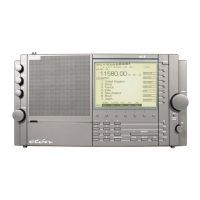
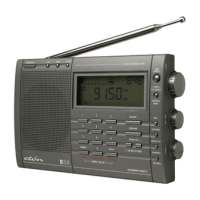
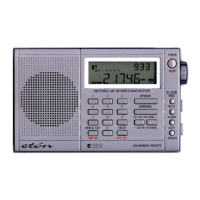
Many higher-end shortwave radios have special circuitry enabling
SSB, a highly efcient way of electronically processing transmitted
and received signals for two-way communication. Examples of this
are amateur radio (hams), maritime and aeronautical communication.
Either upper side band (USB) or lower side band (LSB) can be used.
Non-voice methods of communication can also be heard, including
CW (Morse code) and RTTY (radio teletype).
Receiving SSB signals is not always easy. Since this is two-way
communications, transmissions are often very short and sporadic.
Also, most two-way communication uses relatively low power, 50 to
1000 watts. The amateur radio operators are easiest to nd, Best
results are experienced when using an outdoor shortwave antenna
such as a dipole.
Follow your radio’s instructions on how to engage its SSB feature.
Shown next are some selected frequency ranges on which SSB com-
munications can be found. All frequencies are shown in kilohertz.
Amateur Radio Shortwave Bands (m=meters)
34
16 INTRODUCTION TO SHORTWAVE continued
80m: 3500-4000 17m: 18068-18168
40m: 7000-7300 15m: 21000-21450
30m: 10100-10150 12m: 24890-24990
20m: 14000-14350 10m: 28000-29700
E5 OWNER’S MANUAL


 To Next Page