Need help?
Do you have a question about the Euromaid GWH50NG and is the answer not in the manual?
Lists essential safety precautions for using the cooker and protecting people.
Provides advice on safe operation and home environment for the cooker.
Details specific overhead, rear, and side clearances for safe installation.
Details natural gas and LPG connection requirements and hose standards.
Procedures for identifying and responding to gas leaks.
Instructions for turning hob burners on, off, and controlling flame.
Emphasizes safe flame heights and burner operation.
Step-by-step instructions for using the grill function safely.
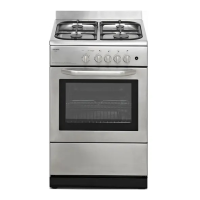
This document is a user manual for a 500mm Upright Gas Cooker, specifically the Euromaid GWH50NG (Natural Gas) and GWH50LP (LPG Gas) models. It covers installation, operation, and maintenance.
The cooker is designed for domestic use, primarily for cooking food. It features a hob with multiple burners, a grill, and a main oven. The appliance is designed to be installed in a well-ventilated space and must be installed by a suitably authorized person, such as a licensed gasfitter, in accordance with current local regulations.
The cooker's hob is operated using control knobs. To turn on a burner, the user pushes the appropriate knob in slightly, turns it anti-clockwise to the desired setting, and then presses the automatic ignition button. The ignition button provides a spark to all burners, but only the one turned on will light. If a burner doesn't light immediately, the user should press the ignition button again. To switch a burner off, the knob is turned fully anti-clockwise to the small flame symbol. Turning the control knob fully anti-clockwise also allows for simmering without accidentally switching off the burner.
Flame control is crucial for safety and efficiency. The burner flame should not extend beyond the bottom of the pan to prevent inefficiency and potential fire hazards. Periodic checks of the cooker's operation are advised. At low settings, burners should not be left unattended for long periods. The burner flames should exhibit a visible bluish cone within the main flame, without any yellowness. If the flames are noisy or yellow upon first lighting, the user should turn them off, check that the burner cap is correctly replaced, and if the issue persists, contact their supplier. The pan supports on the hob are not interchangeable.
For cooking on the hob, flat-bottomed pots and pans are recommended. Pan handles should be easy to hold and remain cool. Unstable or easily tipped pans, as well as those too heavy to move when filled, should be avoided. For maximum efficiency and safety, specific pan sizes are recommended for each burner. Pans should have sufficient capacity to prevent boiling over and should always be positioned centrally over the burners. Lids should not be placed on the burners. When transferring pans, they should always be lifted, not slid.
Deep fat frying requires specific safety precautions. The pan should never be filled more than one-third full of fat or oil and should never be left unattended during heating or cooking. It's important not to fry too much food at once, especially frozen food, as this can lower the oil temperature and result in greasy food. Food should be thoroughly dried before frying and lowered slowly into hot oil or fat, as frozen foods can cause frothing and spitting. Fat should never be heated or fried with a lid on the pan. The outside of the pan should be kept clean and free from oil streaks. In the event of a chip pan or other pan fire, the cooker should be turned off, and flames should be smothered with a fire blanket or damp cloth. Water should not be used on oil or fat fires, and the pan should be allowed to cool for at least 30 minutes.
The grill is operated using the oven/grill control knob. When grilling, the door must be kept fully open at all times. To operate the grill, the user opens the grill door, positions the shelf, presses and turns the control clockwise to the large flame symbol, and while keeping it depressed, presses the ignition button to light the burner. The control should be kept depressed for 15 seconds after the burner lights to override the safety device. The grill should preheat for 5 minutes and can only be operated at the maximum setting. To switch off, the knob is turned anti-clockwise to the "off" position. If the burner doesn't light initially, the ignition button should be pressed once or twice more. If it still fails to light, the user should turn it off, wait 1 minute for gas to disperse, and then try again. The control should not be held in for more than 15 seconds. Food should be correctly positioned on the grill pan under the burner. Oiling the grill rack prevents meat from sticking. The grill pan should not be lined with aluminum foil. The grill pan should be removed from the compartment as soon as grilling is finished to facilitate cleaning. If meat is placed too close to the grill burner, the fat may ignite. For thicker food, the grill rack should be turned over to its lowest position. The grill pan has a detachable handle that can be fixed with a screw. Users should always use an oven glove when handling the grill pan, as all metal parts become very hot. The handle should be securely located between the raised profiles across the front of the grill pan. If the handle is left in position during grilling, it will become very hot. To prevent the control panel knobs from heating up during grilling, a knob heat shield plate must be placed in the pins at the bottom of the control panel.
The main oven is also operated using the oven/grill control knob. A safety device prevents gas build-up if the burner doesn't light or goes out. To use the oven, the door is opened, shelves are adjusted to the required positions, and the control is pressed and turned anti-clockwise to 270°C. While keeping it depressed, the ignition button is pressed to light the burner. The control must be kept depressed for 15 seconds after the burner lights to override the safety device. The oven should preheat for 10 minutes, and then the knob can be set as required or according to the temperature chart provided in the manual. To switch off, the knob is turned clockwise to the "off" position. If the burner doesn't light initially, the ignition button should be pressed once or twice more. If it still fails to light, the user should turn it off, wait 1 minute for gas to disperse, and then try again. The control should not be held in for more than 15 seconds. Users should stand back when opening the oven door to allow steam or heat to escape. Food should be thoroughly cooked and piping hot. Unopened glass or metal containers should not be heated in the oven. Spillovers should not accumulate, as they can present a fire hazard. The oven's openings and vents must not be blocked or covered. Aluminum foil should not be used on the oven bottom.
Regular cleaning is essential for the cooker, ideally after each use. Before cleaning, the mains electricity supply should be turned off, and all gas controls should be in the OFF position. The oven, grill, and burners must be sufficiently cool before touching them, as residual heat will remain.
For the exterior, a damp cloth should be used for cleaning. Sharp instruments, abrasive household cleaners, or detergents should be avoided. For hard stains, a suitable washing liquid can be used.
The pan supports and top burner plate can be removed and cleaned with soapy water and rinsed with a dry cloth. Gas burner caps and pan supports should be washed and rinsed with soapy water, but not in a dishwasher. For stubborn dirt on burner heads, a proprietary metal surface cleaner can be used.
The hob surround can be cleaned with a cloth wrung out in soapy water. Stubborn stains can be removed with a cream, paste, or liquid cleaner.
The control panel should be wiped with a damp cloth and polished with a dry cloth. Oven cleaners, aerosols, scouring pads, or abrasive powder should not be used on plastic knobs or end caps to prevent damage. Extreme care should be taken when removing and re-fitting control knobs. The appliance should never be operated without all control knobs fitted, and the correct knob must be fitted to its corresponding control.
For models with catalytic-enamelled interiors, the oven cleans itself, eliminating the need for extra cleaning after cooking. If the oven has a steel rack, it can be unscrewed (4 screws) for cleaning and then reassembled.
For grill and oven interiors, all trays and pans should be removed. The interior can be cleaned with a moist, soapy cloth, then with a wet cloth, and left to dry. Aluminum pastry trays should not be washed in a dishwasher. Grill elements should be wiped with a damp cloth to remove fat splashes, preventing fumes when the cooker is next used. Hard brushes, steel pads, or knives should not be used to clean the inside of the grill or oven and trays. Cleaning agents containing acid or chlorine should not be used on the handle; a soft cloth with soapy water or commercially available special surface cleaners are suitable.
The oven door's outer panel can be wiped with a cloth wrung out in hot soapy water, then with a cloth wrung out in clean water, and dried with a soft clean cloth. Scouring pads or abrasive powder should not be used to avoid scratching the surface. Care should be taken not to damage or distort the door seal, and the seal should be dry after cleaning. The door seal should not be lifted.
For the door glass, household detergents, bleach, scouring pads, or rust removers should not be used. The inner glass door panels can be removed for cleaning by opening the door fully and gently lifting out the glass, taking extreme care to protect the edges. They should be cleaned as described above, avoiding harsh cleaning agents. The glass panels should be carefully reinstalled to prevent sudden shocks. Over time, slight discoloration of liners and other surfaces may occur, which does not affect the appliance's functioning.
The manual also provides instructions for converting the cooker between Natural Gas and LPG, which involves changing the gas source and the top burner, oven, and grill injectors. This procedure must be carried out by an authorized service person. It also details how to adjust the reduced tap flow for burners.
Before first use, protective coatings need to be burnt off. This process will emit fumes, which is normal. The room should be very well ventilated, and direct inhalation of fumes should be avoided. For the grill, the door should be open, and the grill operated for about 15 minutes. For the oven, it should be operated at 220°C for 30 minutes. After burning off, the appliance should be cleaned as recommended.
The manual also includes troubleshooting tips for when the cooker does not work, advising checks on power and gas supply, fuses/circuit breakers, and control settings. It emphasizes that servicing should always be referred to an authorized service person/agency, ideally every 2 years, to ensure correct and safe operation.
For future transportation, the original carton and packaging materials should be kept. If the original carton is unavailable, precautions should be taken to protect exterior panels and glass surfaces, such as packing the oven in bubble wrap or thick cardboard. The oven must be transported upright, and no other items should be placed on top of it.
 General
| Fuel Type | Natural Gas |
|---|---|
| Width | 500 mm |
| Type | Freestanding |
| Number of Burners | 4 |
| Material | Stainless Steel |
| Dimensions (WxDxH) | 500 x 600 x 900 mm |
| Weight | 40kg |

 To Next Page