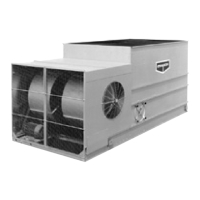
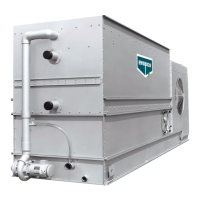
This document provides reduced European maintenance instructions for EVAPCO Induced Draft and Forced Draft Closed Circuit Coolers and Evaporative Condensers. It emphasizes the importance of regular maintenance for optimal performance and longevity of the equipment.
Function Description
EVAPCO evaporative cooling units are designed to provide efficient cooling by evaporating a portion of recirculated water into the atmosphere. These units are considered "Partly completed machinery," meaning they require additional components and an integrated operational, control, and safety strategy to function safely and effectively within a specific application. The equipment is custom-made and not designed to address specific needs and safety measures for every application.
Important Technical Specifications
The manual provides detailed tables for recommended operating water levels and minimum flow rates for various models. For instance, operating water levels vary from 200 mm to 380 mm depending on the model and size (e.g., ATW, eco-ATW, ESWA, LSWA, LSCE, LRW, PMCQ, ATC). Required inlet pressure for remote sump applications also varies by model, ranging from 7 kPa to 39 kPa. For closed circuit coolers, minimum recommended flow rates (Standard Flow LPS and Series Flow LPS) are specified for different unit footprints (e.g., 0.9 m wide units, 2.3 x 2.6 m, 4.9 m wide, 3 m x 3.6 m, 7.3 m x 12.9 m), ranging from 1.7 LPS to 58.6 LPS for standard flow and 0.9 LPS to 29.3 LPS for series flow.
The pressure vessel's maximum working temperature, as stated on the PED nameplate, exceeds the nominal operating temperature of the unit. Users should never apply pressure vessel temperatures above 65°C without consulting the factory. The spray water inlet pressure should never exceed 0.7 bar to avoid damage to spray system components.
Usage Features
The units offer several methods for capacity control:
- Fan Motor Cycling: Uses a single-stage thermostat to sense fluid or condensing temperature. Allows for 100% capacity when the fan is on and approximately 10% when off. Controls should limit cycles to a maximum of six start/stop cycles per hour. The recirculation pump should not be used for capacity control and should not be cycled more than six times per hour.
- Two-Speed Motors: Provides an additional step of capacity control, with low speed offering approximately 60% of full speed capacity. Requires a two-stage thermostat and a proper two-speed motor starter with a decelerating time delay relay (minimum 30 seconds) when switching from high to low speed.
- Variable Frequency Drives (VFDs): Offers the most precise capacity control by adjusting voltage and frequency. Beneficial in cold climates for minimizing icing and reversing for de-icing cycles. VFDs should have a pre-set shutoff to prevent excessively cold water temperatures and operation at near-zero speed. Operating below 25% of motor speed yields minimal energy savings. Pump motors should not be used with VFDs for capacity control.
For cold weather operation, the counterflow design encases heat transfer media, protecting it from external elements. Remote sumps are recommended to prevent recirculating water from freezing when the pump is off. Basin heaters are available for units without remote sumps, but they only prevent pan water from freezing when the unit is completely shut down and do not protect coil fluid or residual water in piping.
Maintenance Features
The manual outlines a comprehensive maintenance checklist with monthly, quarterly, semi-annual, and annual tasks:
- Monthly: Clean pan strainer, check bleed-off valve operation, check operating water level and adjust float valve, inspect water distribution system and spray pattern, check fan screens/inlet louvers/dry cooler coil for debris, check belt tension and adjust.
- Quarterly: Clean and flush pan, check drift eliminators, check fan blades for cracks/balancing weights/vibrations, inspect heater elements for scale build-up, clean electronic water level controller probe ends.
- Semi-annually: Inspect heater junction box for loose wiring/moisture, inspect electronic water level controller junction box for loose wiring/moisture, inspect sump sweeper piping for debris, clean dry coil(s), megger test motor windings (during idle periods).
- Annually: Lubricate fan shaft bearings (every 1000 hours or three months for induced draft; every 2000 hours or six months for forced draft), lubricate fan motor bearings (every 2-3 years for non-sealed bearings), inspect and grease sliding motor base, inspect and clean protective finish (scrape and coat galvanized with ZRC; clean and polish stainless steel), inspect electronic water level controller inside standpipe, adjust vibration switch sensitivity.
- Regularly: Check water quality for biological contamination and contact a water treatment program.
- Every 6 months: Check coil surface for scale and/or corrosion.
During Idle Periods:
- Two or more days: Energize motor space heaters or run motor for 10 minutes twice daily.
- One month or longer: Rotate motor shaft/fan 10 turns bi-weekly.
The document also emphasizes the importance of a proper water treatment program, including passivation for galvanized steel units, to prevent corrosion, scale, and biological fouling. It advises against batch feeding chemicals directly into the basin and recommends automated conductivity controllers for bleed-off management. Regular inspections for microbiological control are crucial, and any excessive contamination requires aggressive cleaning or water treatment. The use of gray or reclaimed water is discouraged unless all associated risks are understood and documented.
Safety precautions include ensuring fan screens and access doors are secured, following rigging instructions for assembly/disassembly, using appropriate personal protective equipment (PPE) during maintenance, conducting Last Minute Risks Assessments (LMRA) for non-routine work, implementing lock-out/tag-out procedures, and avoiding the top horizontal surface as a working platform. It also warns about the potential for Legionella Pneumophila in recirculating water systems and the need for respiratory protection during cleaning.



 To Next Page

 General