7
Operation and Maintenance Instructions
At initial start up or after the unit has been drained, the unit must
be filled to the overflow level. Overflow level is above the normal
operating level and accommodates the volume of water normally
in suspension in the water distribution system and the riser piping.
The water level should always be above the strainer. Check by
running the pump with the fan motors off and observing the water
level through the access door or remove the air inlet louver.
Water Make Up Valve
A mechanical float valve assembly is provided as standard
equipment on the evaporative cooling unit (unless the unit has
been ordered with an optional electronic water level control
package or the unit is arranged for remote sump operation).
The water level in the basin is adjusted by repositioning the
float and all-thread using the wing nuts.
The make up valve assembly should be inspected monthly
and adjusted as required. The valve should be inspected
annually for leakage and if necessary, the valve seat should
be replaced. The make up water pressure for the mechanical
valve should be maintained between 140 and 340 kPa.
Drift Eliminators
Check the drift eliminators quarterly to make sure the drift
eliminators are still in the correct position and not clogged
by any debris. If required after inspection, drift eliminators
must be removed, cleaned and reinstalled correctly.On forced
draft models, the worker must use personal precautions
and adequate safety measures against the risk of a fall,
in accordance with local regulations. Remove one or two
eliminator sections from the top of the unit, protect the fill by
use of a hard board before entering the unit and walking on
the fill. Never walk on the eliminators! Once standing on the
fill, the remaining drift eliminators can be removed. On induced
draft models, lifting handles are provided along the top
layer of eliminators. Remove one or two eliminator sections,
protect the fill by use of a hard board before entering the unit
and walking on the fill. Never walk on the eliminators! Once
standing on the fill, the remaining drift eliminators can be
easily removed through the access door.
Pressurized Water Distribution Systems
Check the water distribution system monthly to make sure it
is operating properly. Always check the spray system with the
pump on and the fans off (locked and tagged out).
On forced draft models, remove one or two eliminator sections
from the top of the unit and observe the operation of the water
distribution system.
On induced draft models, lifting handles are provided along
the top layer of eliminators. Eliminators can be easily removed
from the access door and the distribution system observed.
The diffusers are essentially non-clogging and should seldom
need cleaning or maintenance.
If the water diffusers are not functioning properly, it is a sign
that the pan or system strainer has not been working properly
and that foreign matter or dirt has accumulated in the water
distribution pipes. The nozzles can be cleared by taking a
small pointed probed and moving it rapidly back and forth in
the diffuser opening, with the pump(s) running and the cooling
load and fan(s) off.
If an extreme build-up of dirt or foreign matter occurs, remove
the end cap in each branch to flush the debris from the header
pipe. The branches or header can be removed for cleaning,
but do so only if necessary. Check the strainer in the pan to
make sure it is in good condition and positioned properly so
that cavitation or air entrainment does not occur.
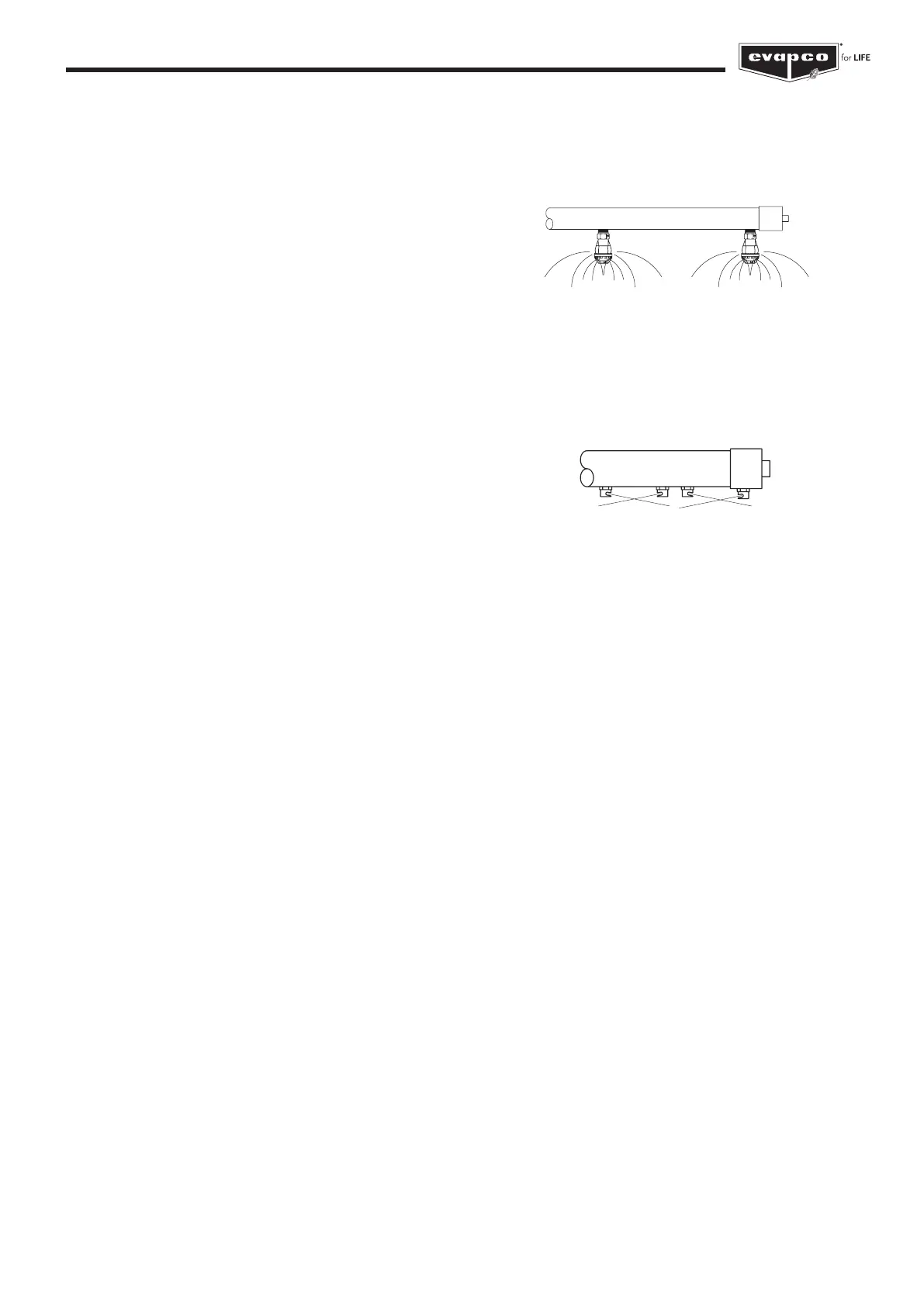
All Evaporative Condensers and Closed Circuit Coolers, except
the ESWA Closed Circuit Cooler, are supplied with ZM II
®
spray
nozzles as standard. The ZM II
®
spray nozzles do not need to
be oriented a specific way to achieve proper coil coverage.
Figure 1 shows the proper spacing of the ZM II
®
spray nozzles.
For the ESWA, wide orifice water diffusers are supplied. When
inspecting and cleaning the water distribution system, always
check that the orientation of the water diffusers is correct as
shown in Figure 2.
Bleed-Off Valve
The bleed-off valve, whether factory or field installed, must be
checked weekly to make sure it is functioning and set properly.
Keep the bleed-off valve wide open unless it has been
determined that it can be set partially open without causing
scaling or corrosion.
Pump (When Supplied)
The pump and pump motor should be lubricated and serviced
in accordance with the pump manufacturer’s instructions.
The recirculation pump should not be used as a means
of capacity control, and should not be cycled frequently.
Excessive cycling can lead to scale build-up, and reduce wet
and dry performance.
Note: for the eco-ATW(E), please consult the Sage
2
and Sage
3
manual.
Coils
Contact Evapco in case of damage to the pressure vessel.
Do not affect the integrity of the pressure vessel without
approval of Evapco.
Evaporative Coil(s)
Check coil surface periodically, but at least twice a year. Inspect
the coil surface for scale and/or corrosion.
Dry Coils (optional)
Depending on outdoor conditions and unit type, the dry coil
should be inspected and cleaned at least twice a year. If the
unit is located near trees, construction, etc., the required
cleaning may be more frequent. The coil should be visually
inspected monthly along with inlet louvers and inlet screens.
The best cleaning solution for the dry coil is plain water. If the
coil has maintained and cleaned at regular intervals, water is
sufficient to remove dirt and debris from the fins. Heavy build
up on the exterior of the fins can be removed with a brush. If a
pressure washer is used, make sure the equipment is set to a
low pressure setting and that the nozzle is set to the fan spray,
not stream, otherwise damage to the fins could result.
Figure 1 - ZM II
®
Spray Nozzle Orientation.
All Coil Products except the ESWA
Figure 2 - Proper Water Diffuser Orientation
(2A Nozzles) ESWA Models



 To Next Page