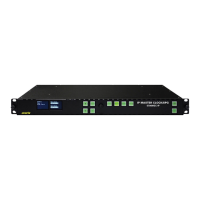
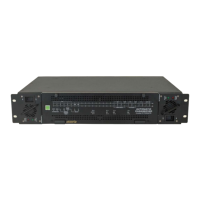
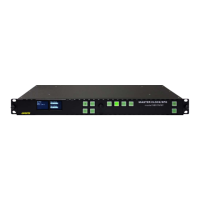
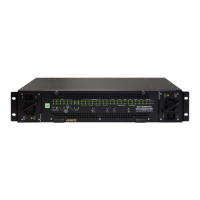
Model 5700MSC
Master Clock System
Revision 1.0 Page - 5
1.8. CONFIGURING THE SYNC OUTPUTS
The sync outputs of the 5700MSC are configured in the OUTPUT menu, accessed by pressing the
OUTPUT button. All sync outputs are derived from the master oscillator and will be locked in frequency
and phase. The sync outputs are all programmable to output several different sync types and can be
phased independently from each other.
In the OUTPUT menu, the sync outputs are configured using the SYNC 1 to SYNC 6 sub-menus.
Each sync output can set to output any number of black burst or HD tri-level standards. They are all
phased independently. When configuring a sync output, the mode must be selected first. By default,
the mode of all sync outputs are set to NTSC-M black burst for North American units, and PAL-B black
burst for European units. Configure the mode of each sync output to the format desired for the
installation.
There are numerous other configuration settings for each sync output, some may be disabled (dark
text) or enabled (white text) depending on the output mode selected. Scroll over each of the available
menu items and press the HELP button for more information on the function of each menu item.
1.9. CONFIGURING THE TEST GENERATOR OUTPUTS
The unit has been equipped with four video test generators on Mini-BNC outputs. Each generator can
output a number of SDTG, HDTG, or 3GTG options. These are configured in the TG 1, TG 2, TG 3,
and TG4 menus. All test generators are derived from the master oscillator and will be automatically
locked in frequency and phase. The test generators are independent from one another and can be
configured to different formats and different phase offsets. By default, all phases will be aligned to the
selected frequency reference.
The unit also has two 10GbE ports that can output test generators if the +10G-TG option is ordered.
Each 10GbE port can output 3 test generators, which can be configured in the TG 5, IP 1a; TG6, IP1b;
TG7, IP1c; TG8, IP2a; TG9, IP2b; and TG10, IP 2c menus.
The quickest and easiest way to discover how to configure the outputs is to scroll through the available
menu items and press the HELP button for a description of each menu item function.
1.10. CONFIGURING THE TIME OUTPUTS
All time outputs from the unit come from the System Time clock. This clock can be viewed by pressing
the STATUS button and selecting the System/In time screen. When the time reference is obtained
from a GNSS sources, the system time will be Coordinated Universal Time (UTC). UTC time is the
same at all locations around the world.
In order to output local time, the Time Zone must be selected to match the time zone offset of your
location. For example, in North America, Eastern Standard Time (EST) is UTC –5:00 hours. Central
Standard Time (CST) is UTC –6:00 hours. Mountain Standard Time (MST) is UTC –7:00 hours. Pacific
Standard Time is UTC –8:00 hours. The 5700MSC also supports Daylight Savings Time, which must
be enabled separately for each time output. Below are descriptions of the time outputs available from
the 5700MSC.
• Sync Outputs – When a Sync output mode is set to NTSC-M or PAL-B black burst, VITC time
can be inserted onto two lines in the vertical blanking interval. The VITC is controlled by the Vitc


 To Next Page