Need help?
Do you have a question about the evertz 5700ACO and is the answer not in the manual?
Explains manual structure, chapter organization, and usage guidelines.
Details the connectors and physical layout of the unit's rear panel.
Describes BNC connectors for sync, video, 10MHz, and word clock signals.
Details terminal strips for balanced audio and DARS signal interfaces.
Explains D-connectors for Linear Time Code (LTC) and GPIO signals.
Covers network connectivity, cable types, and RJ45 pinout standards.
Details power supply specifications and connection methods.
Explains rack mounting procedures and ventilation clearance requirements.
Specifies electrical input voltage, frequency, and typical power consumption.
Details connections required for the Master A and Master B 5700MSC-IP units.
Connects sync outputs from master units to the 5700ACO inputs.
Connects 10 MHz reference signals from master units to the 5700ACO.
Connects Word Clock signals from master units to the 5700ACO.
Connects unbalanced DARS and AES audio signals from master units.
Connects balanced DARS and audio signals via terminal strips from master units.
Connects SD/HD/3G SDI test signal generator outputs from master units.
Connects LTC and GPIO signals from master units via AUX I/O ports.
Explains connections for general purpose I/O and GPI/GPO signal interfaces.
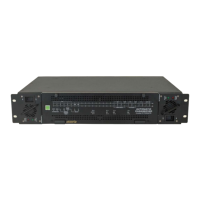
Describes the front panel status LEDs indicating operational status at a glance.
Explains LEDs for AUTO, MANUAL, GPI, and FRONT PANEL modes.
Details the front panel toggle switches and their operational functions.
How to set and operate the unit in Automatic mode.
How to set and operate the unit in Manual GPI mode.
How to operate the unit in Manual Front Panel mode.
Explains the function of the front door pushbutton for recent events.
Details the location and functions of the 8-position DIP switch.
Selects between single or dual GPI input modes for manual operation.
Controls the speed of the decision process for automatic changeovers.
Controls priority between Bank A and Bank B for switching decisions.
Limits the number of automatic switch changes within a specified period.
Describes the general purpose outputs used for signaling alarm conditions.
Explains how the ACO determines when to switch between inputs.
Details how to limit the number of switch changes to minimize disturbances.
Mode to suspend further changes after one switch event occurs.
Mode to suspend switching after two consecutive criteria are met within a short time.
Mode to switch whenever a valid criterion is met without limitation.
Diagram illustrating the logic for automatic switching decisions.
Lists technical specifications for various aspects of the unit.
Specifications for LTC output connectors and signal level.
Details coaxial connector types, numbers, and signal compatibility.
Details terminal strip specifications for balanced signal inputs/outputs.
Specifies behavior for ACO GPI/GPO inputs and outputs.
Specifies connections for MSC GPI/GPO inputs and outputs.
Defines the criteria for valid signals in the voting system.
Specifies Ethernet network types, standards, and cabling requirements.
Details power, configuration, fuse rating, safety, and EMI/RFI compliance.
Provides dimensions and weight of the 5700ACO unit.
Outlines the process for updating the unit's firmware.
General information regarding firmware updates and required equipment.
Steps to configure a terminal program for firmware uploads.
How to enter the firmware upgrade mode via terminal.
Process of transferring the firmware file using X-Modem.
Final steps to complete the firmware upgrade process.
Using the COM serial port for configuration and status monitoring.
Setting IP address, netmask, gateway, and DHCP for the unit.
Configuring SNMP trap destination IP addresses.
Configuring input channels for monitoring in the voting process.
Displays a synopsis of input channels and system status.
Enters the firmware upgrade mode from the menu.
Steps to connect the 5700ACO to the Ethernet network for VistaLINK.
Guide to installing the VistaLINK-C Configuration tool software.
How to discover and configure the 5700ACO via VistaLINK PRO.
Controls for setting manual/automatic mode and selecting active banks.
Displays current operating mode, GPI, rate, lockout, and firmware version.
Configures input channels for monitoring in the voting process.
Views the status of various GPO inputs and outputs.
Controls for enabling/disabling SNMP trap messages for various faults.
Enables/disables analog fault traps and monitors trap status.
Enables/disables AES DARS fault traps and monitors status.
Enables/disables LTC fault traps and monitors trap status.
Enables/disables MSC GPO fault traps and monitors status.
Enables various traps like Ten MHz, Word Clock, Power Supply, Fan.
 General
| Brand | evertz |
|---|---|
| Model | 5700ACO |
| Category | Network Hardware |
| Language | English |

 To Next Page