8
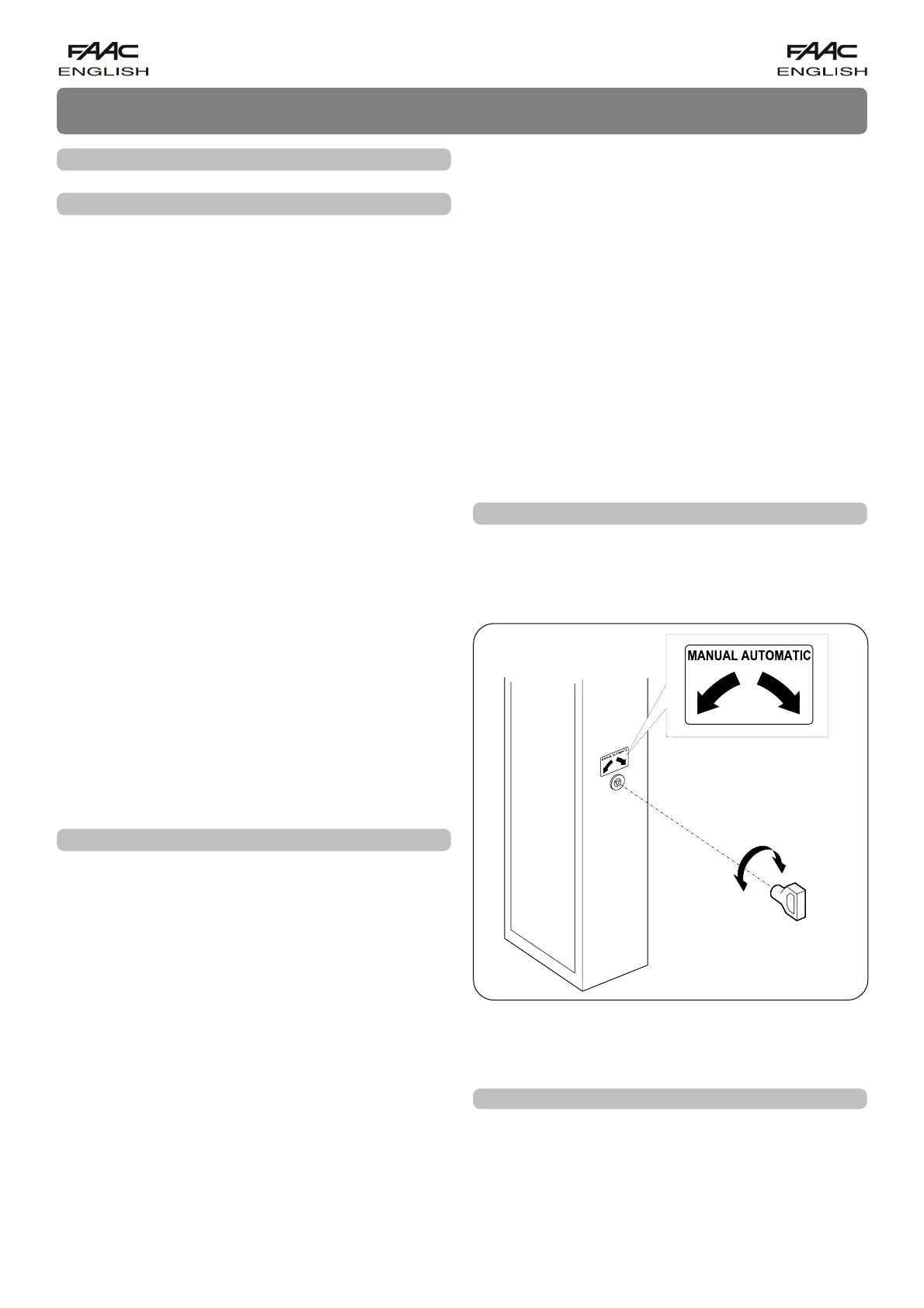
fig. 1
USER’S OPERATING MANUAL
615BPR AUTOMATIC SYSTEM
GENERAL SAFETY REGULATIONS
If correctly installed and used, the 615BPR automatic
system ensures a high degree of safety.
Some simple rules on behaviour can prevent accidental
trouble:
- Do not pass under the beam when it is moving. Wait for
the beam to open fully before passing under it.
- Do not, on any account, stay under the beam.
- Do not stay near the automatic system, and do not allow
children, persons or things to do so, especially when it is
operating.
- Keep radio controls or other pulse generators away from
children, to prevent the automatic system from being
activated involuntarily.
- Do not allow children to play with the automatic system.
- Do not willingly obstruct beam movement.
- Prevent any branches or shrubs from interfering with
beam movement.
- Keep indicator-lights efficient and easy to see.
- Do not attempt to activate the beam by hand unless
you have released it.
- In the event of malfunctions, release the beam to allow
access and wait for qualified technical personnel to do
the necessary work.
- When you have set manual operation mode, cut power
to the system before restoring normal operation.
- Do not in any way modify the components of the
automation system.
- Do not attempt any kind of repair of direct action
whatever and contact qualified personnel only.
- At least every six months: arrange for qualified personnel
to check the automatic system, safety devices and
earth connection.
DESCRIPTION
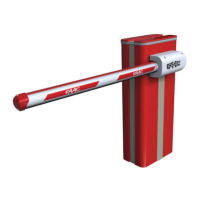
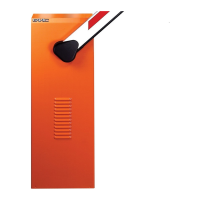
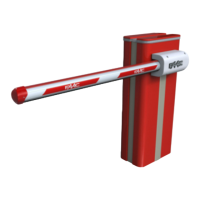
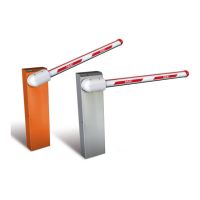
The 615BPR automatic system is an ideal barrier for
controlling vehicle access areas up to 5 m in width and of
medium transit frequency.
The hood contains a hydraulic pump unit, a double-
acting cylinder, and the beam balancing spring.
The beam consists of an aluminium profile with red reflex
reflectors so it can easily be seen even in the dark.
Barrier operation is controlled by a electronic control unit
housed in an enclosure with adequate degree of
protection against atmospheric agents, and which can
be housed inside the hood.
The beam is normally closed in horizontal position.
When the electronic control unit receives an opening
command via the radio control or any other pulse
generator, it activates the hydraulic equipment which
rotates the beam through 90° until it reaches the vertical
position allowing access. If automatic mode was set, the
beam closes automatically after selected pause time has
elapsed.
If the semi-automatic mode was set, a second pulse must
be sent to close the beam.
An opening pulse given during re-closing always reverses
movement.
A stop pulse (if supplied) always stops movement.
For details on barrier behaviour in different function logics,
consult the installation Technician.
The automatic systems include safety devices (photocells)
that prevent the beam from re-closing when there is an
obstacle in the area they protect.
The 615BPR automatic system is supplied (as a standard
item) with an anti-crushing protection safety devices
which limits the torque transmitted to the beam.
The hydraulic system guarantees the beam is stopped in
any position.
Manual opening is, therefore, only possible by using the
release system.
The (flashing) indicator-light indicates that the beam is
moving.
- Fit the triangular key (Fig.1) in the lock and turn it anti-
clockwise through 1 turn.
- Open and close the barrier manually.
MANUAL OPERATION
If the barrier has to be moved manually due to a power cut
or fault of the automatic system, use the release device as
follows:
The supplied key is triangular.
RESTORING NORMAL OPERATION MODE
To prevent an involuntary pulse from activating the barrier
during the manoeuvre, before restoring normal operation,
switch off power to the system, and turn the triangular key
clockwise until it stops, and then remove it.
UNLOCK
LOCK


 To Next Page