Need help?
Do you have a question about the Faro Freestyle2 and is the answer not in the manual?
Describes how Android 11 updates impact mobile phone network settings, causing USB tethering to fail.
Provides a step-by-step guide to install PC Admin Utility and reconfigure network settings for Freestyle2 USB tethering.
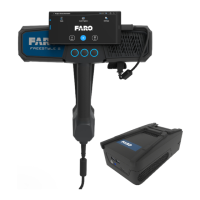
The FARO Freestyle2 is a portable 3D scanner designed for capturing detailed and accurate three-dimensional data in various professional applications. This device is particularly useful in fields such as forensics, architecture, engineering, construction, and product design, where precise spatial data is critical. Its primary function is to create digital models of real-world objects and environments by capturing millions of data points, which are then processed to form a comprehensive 3D representation.
The core function of the Freestyle2 is to perform high-resolution 3D scanning. It operates by projecting a structured light pattern onto the object or scene being scanned and then capturing the deformation of this pattern with its integrated cameras. This process allows the device to calculate the depth and geometry of surfaces, generating a dense point cloud. The scanner is designed for handheld operation, offering significant flexibility in capturing data from various angles and hard-to-reach areas. Its mobility is a key advantage, enabling users to move freely around an object or within a space, ensuring complete coverage without the constraints of a fixed setup.
The Freestyle2 is equipped with advanced algorithms that enable real-time data processing and visualization. As the user scans, the device's integrated display shows a live preview of the captured data, allowing for immediate feedback and ensuring that all necessary areas are covered. This real-time feedback mechanism helps prevent gaps in the scan data and reduces the need for rescanning, thereby improving efficiency. The scanner's ability to track its own position in space, often referred to as "self-positioning" or "SLAM" (Simultaneous Localization and Mapping) technology, is crucial for maintaining accuracy during freehand scanning. This technology allows the device to build a consistent 3D model even as the user moves around, without requiring external tracking markers in many scenarios.
The device is capable of capturing both geometric and textural information. While the primary output is a 3D point cloud, the integrated color camera simultaneously captures high-resolution images, which can then be mapped onto the 3D model to create a photorealistic representation. This feature is particularly valuable for applications where visual fidelity is as important as geometric accuracy, such as in virtual reality, augmented reality, or detailed documentation. The combination of precise geometry and realistic texture provides a comprehensive digital twin of the scanned object or environment.
Connectivity is another vital aspect of the Freestyle2's functionality. It is designed to integrate seamlessly with a mobile computing unit, often referred to as the "Mobile PC," which handles the intensive data processing and storage. This mobile PC typically runs specialized software that manages the scanning process, displays the data, and allows for post-processing tasks. The communication between the scanner and the mobile PC can occur wirelessly via Wi-Fi or through a wired USB connection, offering flexibility depending on the operational environment and specific needs. The device is engineered to maintain stable and reliable data transfer, ensuring that large datasets can be handled efficiently.
The Freestyle2 is designed with user-friendliness in mind, aiming to simplify the 3D scanning process for both experienced professionals and new users. Its ergonomic design makes it comfortable to hold and operate for extended periods, reducing user fatigue. The intuitive user interface on the mobile PC guides the user through the scanning workflow, from setup to data acquisition and review. This interface typically features clear visual cues and straightforward controls, minimizing the learning curve.
One of the standout usage features is its adaptability to various scanning environments. The Freestyle2 can perform effectively both indoors and outdoors, making it a versatile tool for a wide range of projects. Its robust design is intended to withstand typical field conditions, ensuring reliability in diverse settings. The device's ability to handle different surface types, including dark, reflective, or transparent materials, often without the need for specialized surface preparation (such as applying matte sprays), further enhances its usability. This capability saves significant time and effort in the field.
The real-time visualization on the integrated display or connected mobile PC is a critical usage feature. It allows users to immediately assess the quality and completeness of their scan data. Areas that have not been sufficiently covered or where data quality is low can be identified and rescanned on the spot, preventing costly revisits to the site. This immediate feedback loop significantly improves workflow efficiency and data integrity. The software often includes tools for live quality assessment, highlighting areas that might require additional attention.
The flexibility in connectivity options, specifically Wi-Fi and USB tethering, provides users with choices based on their operational needs. Wi-Fi connectivity offers greater freedom of movement, allowing the user to operate the scanner without being physically tethered to the mobile PC. This is particularly useful in large or complex environments where mobility is paramount. USB tethering, on the other hand, provides a stable and high-bandwidth connection, which can be advantageous in environments with potential wireless interference or when maximum data transfer speed is desired. The ability to switch between these modes ensures optimal performance in different scenarios.
The integrated software on the mobile PC also offers features for project management and data organization. Users can create new projects, manage multiple scans within a project, and add metadata to their data, facilitating efficient archiving and retrieval. The software often includes basic editing tools for trimming, aligning, and merging scan data, allowing for preliminary processing directly in the field. This capability streamlines the workflow by reducing the amount of post-processing required back in the office.
Maintaining the Freestyle2 primarily involves software updates, proper handling, and ensuring clean optical components. The device is designed for durability, but like any precision instrument, it benefits from regular care.
Software maintenance is crucial for optimal performance and access to the latest features and bug fixes. The provided documentation highlights the importance of downloading and installing the latest PC Admin Utility. This utility is essential for managing the device's software, including firmware updates for the scanner itself and updates for the mobile PC's operating system and scanning application. Regular updates ensure that the device benefits from performance enhancements, improved stability, and compatibility with new operating systems or accessories. The process for updating typically involves downloading the utility to a USB drive, transferring it to the Freestyle2 Mobile PC, and then initiating the installation through the device's user interface. This method is designed to be straightforward, guiding the user through each step.
Physical maintenance focuses on keeping the device clean and protected. The optical components, including the cameras and structured light projector, are critical for accurate data capture. Users are advised to keep these components free from dust, smudges, and debris. Cleaning instructions typically recommend using a soft, lint-free cloth and, if necessary, a specialized lens cleaning solution to avoid scratching or damaging the delicate surfaces. Proper storage in a protective case when not in use is also recommended to shield the device from physical impacts, dust, and environmental contaminants.
Battery management is another aspect of maintenance, particularly for the mobile PC and any integrated batteries within the scanner itself. Following recommended charging practices, such as avoiding deep discharges and overcharging, helps prolong battery life. Monitoring battery health and replacing batteries when their capacity significantly diminishes ensures consistent field operation.
Troubleshooting common issues, such as connectivity problems, is also part of maintenance. The provided documentation, for example, addresses USB tethering issues that can arise from operating system updates on connected mobile phones. The solution involves specific steps to reconfigure network settings and update the PC Admin Server, demonstrating a structured approach to resolving technical challenges. This proactive approach to maintenance, guided by manufacturer recommendations, helps ensure the longevity and reliable operation of the Freestyle2. Regular checks of cables and connectors for wear and tear are also advisable to prevent intermittent connectivity issues.
 General
| Technology | Laser triangulation |
|---|---|
| Laser Class | Class 1 |
| IP Rating | IP50 |
| Type | Handheld |
| Light source | Laser |

 To Next Page