Need help?
Do you have a question about the Faro Focus S Series and is the answer not in the manual?
Explains the On-Site Compensation process for improving scanner angular accuracy using SCENE software.
Outlines the time required (20 minutes) and skills needed, including knowledge of Windows, computer skills, Laser Scanner, and SCENE.
Ensures the scan site has required facilities like target sheets at specific distances and no reflective surfaces.
Procedure to connect the computer to the scanner through WLAN for remote access and control.
Verifies the network security status, ensuring the PC is connected to the scanner's network securely.
Place at least six target sheets uniformly, ensuring specific vertical range and distance from the scanner.
Mount the scanner on a tripod on a stable surface, ensuring it is horizontal and aimed correctly.
Compensate using SCENE software, execute scanning, and review the compensation report.
Addresses common errors encountered during compensation, providing solutions for issues like connectivity or target detection.
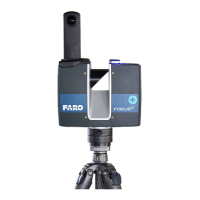
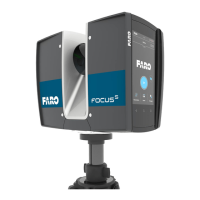
The FARO Focus S Series is a line of laser scanners designed for on-site compensation, a process that tests and improves the angular accuracy of the scanner using SCENE software. This document provides instructions for preparing the site, connecting the scanner to a computer via Wireless LAN, and performing the compensation.
The primary function of the FARO Focus S Series scanners, in the context of this manual, is to perform on-site compensation. This involves a procedure to test and improve the angular accuracy of the scanner. The compensation process utilizes SCENE software to analyze scanned data and generate a compensation report. This report details the results of the compensation and allows the user to apply the compensation data to the scanner, thereby enhancing its angular accuracy. The process is designed to be performed on-site, ensuring that the scanner's accuracy is optimized for the specific environment in which it will be used.
The FARO Focus S Series scanners offer several usage features that facilitate the on-site compensation process:
Manage > General Settings > WLAN, toggle the Status button to ON, and set the Mode to Access Point. The scanner's IP Address and Network Name are provided for connection, along with a default encryption key (0123456789). For faster data transfer, the scanner can also be connected over a local network by setting the Mode to WLAN instead of Access Point, supporting speeds up to 150Mbit/s in 5GHz networks.targetImage.png file is stored, showing identified markers (blue circles) and areas with sufficient (green background) or insufficient (red background) targets. Solutions are also provided for issues like reading/writing to output folders (permission/disk space), inconsistent solutions (stable tripod/targets), SD card access problems (insertion/write-protection/free space), and communication failures (stable WLAN connection).While the document primarily focuses on the compensation process, it implicitly touches upon aspects related to maintaining scanner accuracy and operational integrity:
SCENE 7.0 or later implies the importance of keeping the accompanying software updated to ensure compatibility and access to the latest compensation algorithms and features. General
| 3D Scanning Speed | up to 976, 000 points/second |
|---|---|
| Ranging Error | ±1mm |
| Weight | 5.2 kg |
| Dimensions | 230 x 183 x 103mm |
| Battery Life | 4.5 hours |
| Temperature Range | 5°C to 40°C |
| Protection Class | IP54 |
| Laser Wavelength | 1550nm |
| Vertical Field of View | 300° |
| Horizontal Field of View | 360° |
| Laser Class | Class 1 |
| Data Storage | SD card |
| Connectivity | Wi-Fi, USB |

 To Next Page