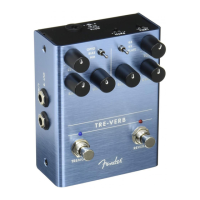
The Fender Tre-Verb is a compact, easy-to-use pedal that brings the classic sounds of Fender amp Tremolo and Reverb to your feet. Designed to deliver the lush, dynamic amp effects that have inspired entire genres of music, this pedal offers independent Tremolo and Reverb effects, allowing for versatile tone shaping and creative soundscapes.
Function Description
The Tre-Verb pedal combines two iconic Fender effects: Tremolo and Reverb. It features classic reverb voicings based on Fender's renowned spring reverb units from 1963 and 1965, providing a rich, authentic spring reverb sound. For the tremolo effect, it offers multiple modes, ensuring you can achieve the exact tremolo sound you desire. The pedal is equipped with stereo inputs and outputs, making it easy to integrate into any pedalboard or amplifier setup, and allowing for expansive stereo effects.
Usage Features
The Tre-Verb offers a comprehensive suite of controls for both its tremolo and reverb sections, allowing for detailed customization of your sound.
Tremolo Section:
- Tremolo Footswitch (1): This dedicated footswitch engages or disengages the tremolo effect. It can be used independently or in conjunction with the reverb effect.
- Tremolo LED Indicator (2): This LED illuminates when the tremolo effect is active, providing a clear visual cue of its status.
- Rate (5): This knob adjusts the speed of the tremolo effect. Turning it clockwise increases the tremolo speed, while turning it counter-clockwise slows it down.
- Rate LED (7): This LED blinks in time with the current tremolo rate, offering a visual representation of the effect's speed.
- Level (6): This control adjusts the overall output level of the tremolo effect, allowing you to balance its volume with your dry signal or other effects.
- Depth (8): This knob controls the intensity or depth of the tremolo effect. Higher settings produce a more pronounced tremolo, while lower settings result in a subtler effect.
- Tremolo Type Switch (9): This three-position switch allows you to select between different tremolo voices:
- Opto: Emulates optical tremolo sounds, known for their smooth and warm character.
- Bias: Replicates tube-biased tremolo sounds, often characterized by a more organic and slightly asymmetrical modulation.
- HM (Harmonic Vibrato): Provides a harmonic vibrato style tremolo, which is a more complex modulation that often involves phase shifting and filtering, creating a swirling, psychedelic effect.
Reverb Section:
- Reverb Footswitch (17): This dedicated footswitch engages or disengages the reverb effect. Like the tremolo footswitch, it can be used independently or with the tremolo effect.
- Reverb LED Indicator (16): This LED illuminates when the reverb effect is active, providing a clear visual cue of its status.
- Reverb Type Switch (10): This three-position switch allows you to toggle between three different reverb voices, each based on classic Fender spring reverb units:
- '63: Emulates the sound of early Brownface-era reverb amps, similar to Fender's standalone Reverb Tank. This typically offers a bright, splashy, and vibrant reverb.
- '65: Replicates the classic Blackface-Amp reverb sounds, known for their lush, deep, and smooth character.
- Plate: Provides a splashy studio reverb sound, often characterized by a dense, metallic, and expansive decay.
- Tone (12): This control affects the amount of high-frequency (treble) content in your instrument's signal within the reverb. Turning it counter-clockwise makes the reverb sounds darker, while turning it clockwise makes them brighter. This allows you to tailor the reverb's brightness to suit your instrument and musical context.
- Blend (11): This control adjusts the amount of reverb added to your instrument's signal. Rotating it fully counter-clockwise results in a completely dry signal, while rotating it fully clockwise provides 100% ambient or 'wet' sounds, allowing for a wide range of mix possibilities.
- Dwell (13): This control adjusts the amount of reverb sustain. Lower settings create a "choked" or gated effect, where the reverb decays quickly. Higher settings produce a bouncy or saturated effect, reminiscent of water dripping in a cave, offering a longer and more resonant decay.
Connectivity and Signal Path:
- Right Input Jack (14): This is a high-impedance input suitable for electric guitar, bass, acoustic guitars with pickup systems, keyboards, and other instruments. It is used in conjunction with the Left/Mono Input Jack for stereo signal chains.
- Left/Mono Input Jack (15): This is also a high-impedance input suitable for various instruments. It can be used in mono signal paths or in conjunction with the Right Input Jack for stereo signal chains.
- Right Output Jack (3): This is a low-impedance output jack that connects to an amplifier or the next effect pedal in a stereo signal chain. It is used in conjunction with the Left/Mono Output Jack for stereo setups.
- Left/Mono Output Jack (4): This is a low-impedance output jack that connects to an amplifier or the next effect pedal in a mono signal chain. It can be used in mono signal paths or in conjunction with the Right Output Jack for stereo signal chains.
- Path Switch (19): This switch allows you to change the order of the effects in the signal path:
- R ► T: Places the reverb effect before the tremolo effect.
- T ► R: Places the tremolo effect before the reverb effect. This flexibility allows for different sonic interactions between the two effects.
- DC Power Connector (20): This is a standard center-negative 9VDC jack for connecting the appropriate power supply.
Additional Features:
- LED Kill Switch (18): This switch extinguishes the LEDs that illuminate the knobs. This can be useful in dark environments or for users who prefer not to have the knob illumination.
Maintenance Features
The Tre-Verb is designed for ease of use and durability. For maintenance, it is important to follow general guidelines for electronic devices.
- Cleaning: Unplug the AC power adapter before cleaning the exterior of the unit. Use only a damp cloth for cleaning and ensure the unit is completely dry before reconnecting it to power. Avoid using harsh chemicals or abrasive materials that could damage the finish or internal components.
- Power Supply: Always use a standard center-negative 9VDC power supply with the specified current rating (350mA @ 9VDC). Using an incorrect power supply can damage the pedal.
- Environmental Protection: To prevent damage, fire, or shock hazard, do not expose the unit or its AC power to rain or moisture. Do not drip or splash liquids on the unit.
- Internal Components: The unit contains no user-serviceable parts inside. Any servicing should be referred to qualified personnel only. Attempting to open or repair the unit yourself may void the warranty and could cause damage.
- Signal Integrity: Ensure all cables (input, output, and power) are securely connected to prevent signal loss or intermittent operation.
- Regulatory Compliance: The unit must only be connected to a safety agency certified, regulated power source (adapter) approved for use and compliant with applicable local and national regulatory safety requirements.
By adhering to these usage and maintenance guidelines, you can ensure the longevity and optimal performance of your Fender Tre-Verb pedal, allowing you to enjoy its rich tremolo and reverb effects for years to come.

 Need help?
 General



 To Next Page