6
Use only U.L. and CSA listed extension cords. Never
use two extension cords together. Instead, use one
long one.
Note: The lower the AWG number, the stronger the
cord.
Tool settings
Always remove the power plug from
the socket before carrying out any work on the
power tool.
Electronic control
You can regulate the speed steplessly between 6000
and 10500 rpm using the adjusting wheel (2.3). This
lets you optimize the sanding speed to suit the ma-
terial (see "Working with the tool").
Dust extraction
Dust extractors prevent large accumulations of
dust in the air in the working environment and dirt
collecting in the workplace.
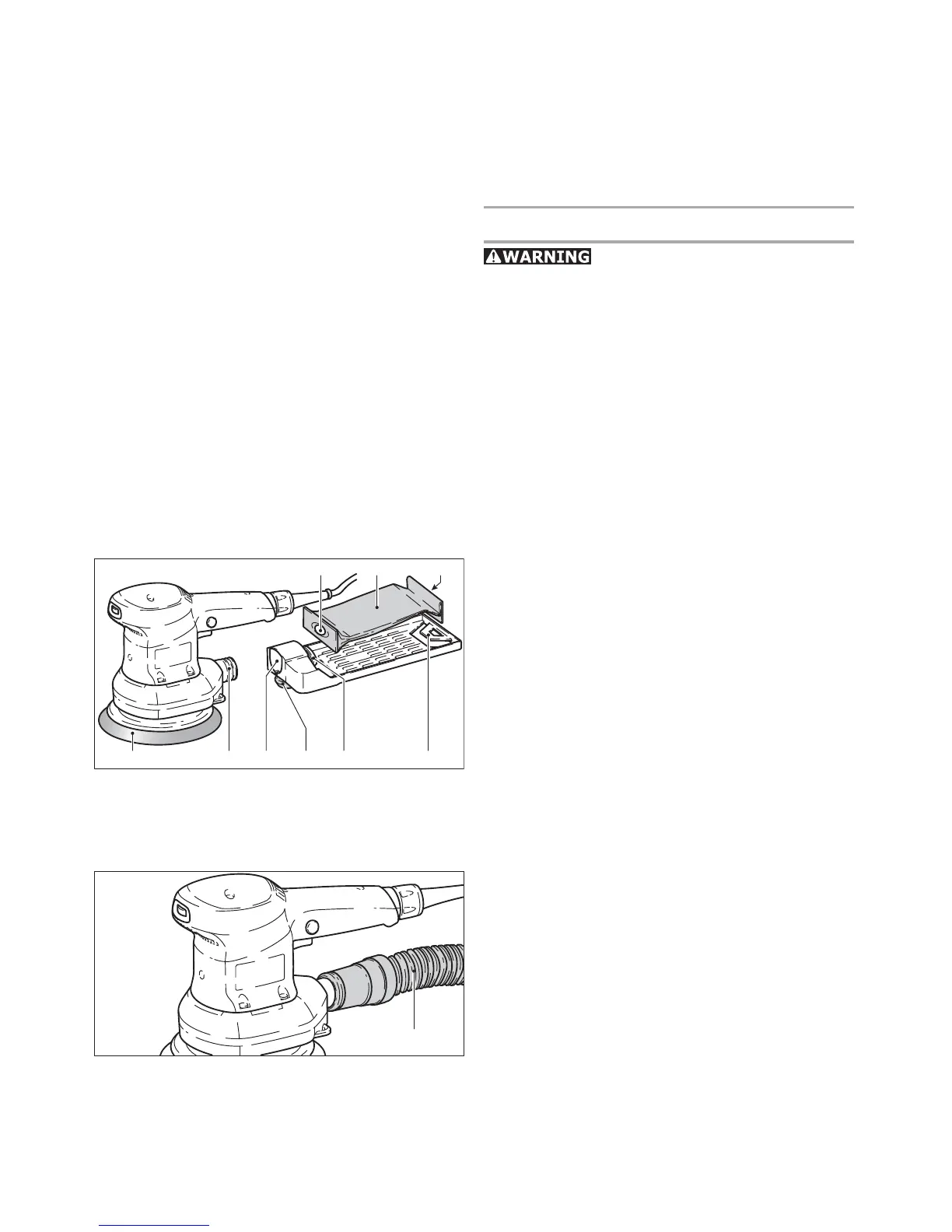
Turbo-fi lter (partly accessories)
The sanding dust is extracted through suction
openings in the sanding base (3.4) and trapped in
the turbo-fi lter (3.2).
The turbo-fi lter has to be changed when it is so full
of dust that the extraction power diminishes:
– Push the front cardboard section of the turbo-
fi lter with the sealing lip (3.1) onto the extraction
nozzle (3.8) of the fi lter holder
– Insert rear cardboard section with slot (3.3) onto
the retaining strip (3.9) of the fi lter holder
– Push the fi lter holder with its opening (3.6) as far
as it will go onto the extraction nozzle (3.5) of the
machine and clamp tight by turning rotary knob
(3.7).
External extraction by an extraction unit
In order to avoid frequent changing of the turbo-fi l-
ter when carrying longer sanding jobs, it is possible
to connect a Festool extractor to the unit instead of
using inbuilt extraction.
In this case, the extraction pipe (Ø 27 mm) (4.1)
of the extraction unit is connected to the suction
nozzle.
3.33.23.1
3.4 3.5 3.6 3.7 3.8 3.9
4.1









 To Next Page