The FIAB 4427 Easypace is a compact, single-chamber, temporary heart stimulator designed for use in pathologies of spontaneous generation and conduction of impulses. It is a versatile unit suitable for single-chamber temporary intracardiac stimulation, specifically for extreme bradycardia, paroxysmal atrial-ventricular block, interruption of paroxysmal tachycardia from atrial flutter, and atrial-ventricular blocks of various types prior to implantation or replacement of a definitive pacemaker.
Function Description
The 4427 Easypace operates in synchronous and asynchronous modes, controlled by a fully microprocessor-operated system that ensures high precision in setting stimulation parameters and continuous checking for correct operation. It features a back-lit LCD display and dedicated keys for quick access to stimulation, battery replacement, and display illumination. The device supports stimulation capability with a quadruple rate and decreasing ramp to reduce tachycardia events. It also includes stand-by batteries for replacement of main batteries without interrupting stimulation.
Safety functions are a key aspect of the device, including a self-test at power-on, on-line control of the batteries level, turn-on inhibition with low battery charge, and checks for run-away and lead connection. It provides protection against defibrillation discharges and electromagnetic interference. Dangerous situations are signaled to the operator by an acoustic alarm and a suitable display message.
The device's output stimulation is current (mA) controlled and governed by the microprocessor according to values entered via the keyboard and visualized on the display. The stimulation impulse is a short period of electrode depolarization obtained through a short-circuit of the two catheter poles.
Important Technical Specifications
- Manufacturer: FIAB SpA Via Costoli, 4 – 50039 Vicchio, Florence (ITALY)
- Model: 4427
- Class and Type: Portable unit with internal power supply, Type CF, protected against defibrillator discharges
- Conditions for use: Device for continuous functioning
- Compliance to directives: EN 60601-1 "Medical electrical equipment - Part 1: general requirements for safety" File 4745 C (1998-12), EN 60601-2-31 "Medical electrical equipment - Part 2: particular requirements for the safety of external cardiac pacemakers with internal power source" File 2689 E (1995-11), EN 60601-2-31/A1 "Medical electrical equipment - Part 2-31: particular requirements for the safety of external cardiac pacemakers with internal power source" File 5226 (1999-07), EN 60601-1-2 "Medical electrical equipment - Part 1: general requirements for safety - Collateral standard: Electromagnetic compatibility - Requirements and tests" File 6977 (2003-07), EN 60601-2-31 Electro-medical equipment - Part 2: rules for safety of external cardiac stimulators with internal power supply, MDD 93/42/CEE.
- Destination for use: Single-chamber temporary intracardiac heart stimulator
- Sensitivity: Variable with continuous steps couple to SENSE keys
- Maximum sensitivity: (+) 0.75 mV ± 5%, both for positive and negative polarities
- Detectable spontaneous rate: 30-300 ppm; the value is shown on the display during STAND-BY and VVI modes
- Post stimulation refractory period (ASRP): 3/8 stimulation period
- Blanking width: 48 ms
- Input impedance: Approx. 30 kΩ
- Input filtering: Pass band filter tuned for recognition of R wave
- Sense signalling: By blinking of the green LED at each recognition of R wave
- EMI signalling: Acoustic (emission of a tone) and visual (turning on of LCD) for detected rate values that exceed 300 ppm
- Amplitude of stimulation impulse: Varying between 0.4 and 40 mA (by steps of 0.4 mA up to 10 mA, and then by steps of 2 mA)
- Maximum available current: 40 mA @ 300 Ω, 25 mA @ 500 Ω
- Waveform of the stimulation impulse: Rectangular
- Length of stimulation impulse: 1.4 ms ± 10%
- Post depolarization: Short-circuit of 16 ms length after the stimulus
- Post sense refractory period (ASRP): 200 ms
- Stimulation rate: 0 ms
- Stimulation for burst and ramp: 30-180 ppm, with 1 ppm steps variation. High rate stimulation (up to 720 ppm) for burst and ramp.
- Anti runaway: 300 ppm with warning circuit independent of the microprocessor
- Stimulation signalling: By blinking of the red LED at each stimulus emitted
- Stimulation output: In the VVI mode, the output is black/red sockets. In the V00 mode, the output is black sockets.
- Default parameters at power on: Upon completion of self-test, the stimulator is set on Mode Stand-By: frequency 72 ppm, amplitude 0 mA, sense threshold 1 mV.
- Display: Liquid crystals with LCD, with back light. During monitoring stimulation and sense parameters, 20 sec after the last key pressure, the display goes off, to be switched on again at any touch of any key.
- Keyboard: Thermoformed, with EMI shielding, for setting stimulation and sense parameters.
- Power supply: 2 main batteries: AA size 1.5 V alkaline type (LR6). 3 stand-by batteries: 1.4 V type PR44 or NR44 or 3 batteries of 1.5 V type D375H.
- Switch on: ON/Off button
- Switching on signals: Acoustic (emission of a tone) and visual (turning on of LCD)
- Max. input: 11 mA
- Autonomy: Main batteries: > 10 days prior to low warning; at least 12 hours of residual autonomy afterwards. The replacement can be done (within 120 seconds) without the necessity of interrupting the stimulation. Stand-by batteries: > 350 main batteries replacements; batteries life > 12 months. When these batteries are dead, the replacement of main batteries is prevented with unit interruption (self-test of charge level).
- Signalling of batteries discharge: Acoustic and visual, with no variation of sensing and pacing set parameters.
- Operating conditions: Temperature: +10 to +40 °C. Relative humidity: 30% to 70% RH uncondensed. ATM. pressure: 700 mbar to 1060 mbar.
- Storage and transportation conditions (for 4 weeks max.): Temperature: 0 to +50 °C. Relative humidity: 20% to 80% RH uncondensed. ATM. pressure: 500 mbar to 1060 mbar. Batteries designed to prevent chemical deterioration following the batteries.
- Dimensions: 130 x65 x 32 mm
- Weight: Approx. 210 g (including batteries)
Usage Features
The 4427 Easypace offers several operating modes:
- STAND-BY mode: This is the default mode upon power-on. It allows setting stimulation and sense parameters under no-stimulation conditions and performs a self-test procedure. Preset values are frequency 72 ppm, current 10 mA, and sense threshold 1 mV.
- V00 (A00), BURST x4 and DECREASING RAMP mode: This asynchronous stimulation function allows a pacing to be set independent of the presence of a spontaneous activity. The stimulation is started by simply acting on the V00 key. The amplitude and rate of the stimuli can be modified without interrupting the stimulation. The BURST x4 mode generates an asynchronous stimulation at a rate four times the set one, while the DECREASING RAMP mode decreases the stimulation rate by 8 ppm every stimulus until a new updated value is reached.
- VVI mode: This is a demand function that enables the unit to intervene only in case the spontaneous rate is lower than the one set by keys ppm ▲ and ▼. The unit's sensitivity threshold is adjustable.
- EMERGENCY mode: This mode provides an immediately asynchronous stimulation (both during synchronous mode and in STAND-BY mode) with a rate of 72 ppm and amplitude of 20 mA. It is activated by pressing the EMERGENCY key.
- AUTO mode: This mode, activated by pressing the AUTO key, is a synchronous VVI mode that automatically sets all necessary parameters.
The device features a keyboard lock function to prevent accidental changes to parameters. This function is activated by pressing both the "STAND BY" and "LIGHT" keys together for several seconds. The display will show "KEYBOARD LOCKED" and then "KEYBOARD UNLOCKED" when unlocked.
Maintenance Features
Regular maintenance is crucial for the safe and effective operation of the 4427 Easypace.
- Periodic Check: It is advisable to perform a periodic check by the User on the device functions, its accessories, and the state of connections. Any failures or bad state of connections should lead to the device not being used. A comprehensive check by a measuring laboratory is necessary at least once a year.
- Controls: This includes replacing stand-by batteries, functioning's check, electrical safety test, and certified final inspection.
- Cleaning: The User should take care of the cleaning of the unit to meet ordinary sanitary requirements. For the cleaning of the external parts of the unit and accessories, it is recommended to use ethyl alcohol or Citrosil®. Belts can be washed with water and soap at a temperature of 40 °C. For cleaning parts in contact with the Patient, reference should be made to the relevant instructions.
- Battery Replacement: The device uses two main AA-size 1.5V alkaline batteries and three auxiliary batteries (1.4V type PR44 or NR44 or 1.5V type D375H). The main batteries should be replaced every 120 seconds to avoid interruption of stimulation. The auxiliary batteries provide power during main battery replacement. The device signals low battery levels with acoustic and visual indicators.
- Self-Test Program: The device includes a self-test program that runs upon power-on and checks the correct operation of the CPU, internal and external logic, memory, timer, and charge levels of main and stand-by batteries. Error messages are displayed if any issues are detected.
- Lead Connection Check: The unit is provided with a sentinel circuit intended to check the connection or disconnection between the catheter and the 4427 Easypace. Measurement is carried out only for impulses with amplitude in the range of 2.8 to 20 mA.
- Protection against Defibrillator Discharges: The stimulator is provided with a protection circuit able to fend off defibrillator discharges. The recovery time after defibrillation discharge is about 10 seconds.

 Need help?
 General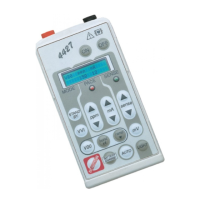

 To Next Page