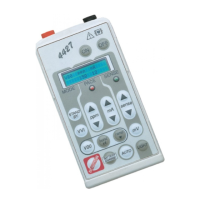
Cardiac stimulator 4427 Easypace - Instructions for use
6/40
2. CAUTIONS AND WARNINGS
Indicated here below are the precautions to be taken for the correct use of the heart
stimulator 4427 Easypace. Further information can be found in other sections of this
manual.
The manufacturer shall hold responsible for the safety, reliability and performance of the
unit provided the following indications are strictly observed.
• The device must be used by physicians with extensive knowledge of cardiac
stimulation.
• The device must only be used in compliance with these instructions for use. It is
necessary to read every part of this manual, if possible in front of the device which is
turned on and operating, in order to fully understand its functioning.
• Before each use, especially if prolonged, it is firmly recommended replacing the main
(alkaline) batteries. The battery replacement will be indispensable if the stimulator has
been turned off after the request to change batteries.
• In the case of prolonged use it will be necessary to make periodic checks of the
stimulation parameters (sensing and pacing thresholds).
• It is indispensable to continuously monitor the patient during stimulation. In emergency
situations it will also be necessary to have a defibrillator on hand and ready for use.
• The programming of a low value for the sensing threshold increases the probability of
the 4427 Easypace operations being influenced by muscular tremors. The device may
interpret false signals as spontaneous cardiac activity, with consequent inhibition of the
stimulation.
• All the automatic functions offered by the 4427 device have been implemented to help
the User make a rapid search for the correct parameters. However, it will always be the
physician’s responsibility to evaluate the suitability of these values in each specific
case.
• In order to use components in contact with the Patient that have to be connected up to
the device, follow the instructions supplied with the same.
• In general, an endocavitary or epimiocardiac electrode connected to any type of
electro-medical device represents a pathway for direct current with low resistance
towards the myocardium. The risk of inducing threatening ventricular arrhythmias
resulting from the dispersion of alternate current increases considerably when a device


 To Next Page