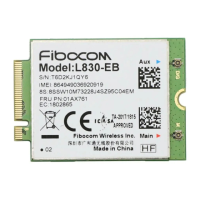
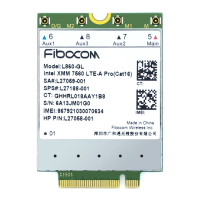
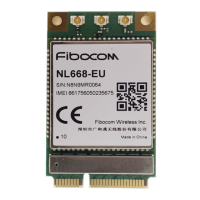
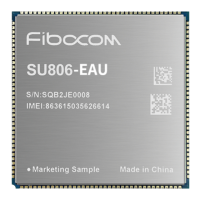
The Fibocom FG621-LA Series Hardware Guide describes a CAT6 wireless module designed for various applications such as CPE, VR/AR, gateways, internet TV set-top boxes, and intelligent monitoring. The module is based on the UNISOC SL8563 platform and supports Carrier Aggregation (CA) network architecture.
Function Description:
The FG621-LA series module integrates core components including Baseband (CPU, PMIC, LPDDR2, NAND, USB, (U)SIM, PCM, I²C, SPI, UART, SDIO, GPIOs, ADCs, WCDMA/LTE TDD/LTE FDD controller) and RF features (RF Transceiver, RF PA, RF Switch, RF filter, Antenna). It supports multi-format long-distance communication modes, including FDD-LTE, TDD-LTE, and WCDMA. The module is designed for reliable wireless connectivity in diverse environments.
Important Technical Specifications:
Product Model:
- FG621-LA-00: LPDDR2 1Gb, SPI NAND 1Gb, supports MAIN_ANT, DIV_ANT.
Operating Frequencies:
- LTE FDD: Band 2, 4, 5, 7, 12, 13, 28, 66
- LTE TDD: Band 40
- WCDMA/HSPA+: Band 2, 4, 5
2xCA Combinations:
- Intra-band contiguous: CA_2C / CA_5B / CA_7C / CA_7B / CA_12B / CA_B40C, CA_66B / CA_66C
- Intra-band non-contiguous: CA_2A-2A / CA_4A-4A / CA_5A-5A / CA_7A-7A / CA_12A-12A, CA_B40A-B40A / CA_66A-66A
- Inter-band: CA_B2-B4/B5/B7/B12/B13/B28/B66, CA_B4-B5/B7/B12/B13/B28, CA_B5-B7/B66, CA_B7-B12/B28/B66, CA_B12-B66
Data Transmission:
- LTE FDD: 300Mbps DL, 50Mbps UL
- LTE TDD: 260Mbps DL, 30Mbps UL
- HSPA/HSPA+: 42Mbps DL, 11Mbps UL
- WCDMA UMTS: 384 kbps DL/384 kbps UL
Power:
- Input Voltage: 3.4V~4.3V (3.8V recommended)
- Power-off leakage current: ≤ 100uA
- Base current: ≤ 2.5mA
- Sleep mode: ≤ 4.5mA
- Idle mode: ≤ 50mA
- VDD_EXT output: 1.85V (50mA max)
- VDD_2V8 output: 2.8V (200mA max)
Physical Characteristics:
- Package: LGA 299Pin
- Size: 39.5mm × 37mm × 2.6 mm
- Weight: About 8.3g
Temperature Range:
- Normal operation: -30°C ~ +75°C
- Extended operation: -40°C ~ +85°C (some indicators may exceed 3GPP standards)
- Storage: -40°C ~ +85°C
Interfaces:
- Antenna: Main × 1, DIV × 1
- (U)SIM: 3.0V/1.8V
- USB: 2.0 × 1
- Status Indicator
- UART: 4
- PCM
- I²C
- SDIO
- SPI
- GPIOs
- RESET_N
- PWRKEY
- ADC: 2
Software:
- Protocol stack: IPV4 and IPV6
- AT command: 3GPP TS 27.007 and 27.005, and proprietary FIBOCOM AT
- Firmware update: USB
- Voice service: VoLTE, AMR, DTMF and caller ID
- SMS service: Point-to-point MO, MT, Text and PDU modes
Antenna Specifications:
- Antenna efficiency: >40% (-4dB) recommended.
- S11 or VSWR: S11 < -10dB recommended.
- Polarization: Linear polarization recommended.
- Antenna area: 6mm high * 10mm wide * 100mm long.
- Antenna radiation direction: Omni-directional.
- Recommended antenna gain: ≤ 2.5dBi.
- Impedance: 50Ω
- Input power: > 25dBm average power for WCDMA & LTE
- Standing wave ratio: ≤ 2:1
ESD Characteristics:
- VBAT, GND: ±10KV (Air Discharge), ±5KV (Contact Discharge)
- Antenna interface: ±8KV (Air Discharge), ±4KV (Contact Discharge)
- Other interface: ±1KV (Air Discharge), ±0.5KV (Contact Discharge)
Usage Features:
Power-on/Off:
- Power-on: Pull down PWRKEY pin for at least 1.6s (2s-3s recommended). An OC/OD drive circuit or a button switch with TVS protection (ESD9X5VL-2/TR recommended) can be used. VBAT voltage must be stable for at least 30ms before pulling PWRKEY.
- Shutdown:
- Hardware Shutdown: Pull down PWRKEY for at least 2.1s (3s-8s recommended).
- Software Shutdown: Send AT command AT+CPWROFF.
- Low Voltage Shutdown: Module shuts down if VBAT voltage is too low.
- Reset:
- Hardware Reset: Pull down RESET_N pin for more than 2s (3s-8s recommended). OC/OD drive circuits or a button switch can be used. RESET_N is a sensitive signal and requires a regulator capacitor close to the module, with PCB layout kept away from RF interference and protected by Ground.
- Software Reset: Send AT command AT+CFUN=15.
Network Status Indication:
- Three pins (170, 147, 171) indicate network status. Default is pin 147, configurable via AT+LEDCFG.
- Indicator light statuses:
- Quick flashing (600ms High / 600ms Low): No SIM card, SIM PIN, Registering network (T<15S), Register network failed.
- Slow flashing (3000ms High / 75ms Low): Standby.
- Speed flashing (75ms High / 75ms Low): Data link established.
- Low: Voice call.
- High: Sleep.
(U)SIM Card Interface:
- Supports 1.8V and 3.0V (U)SIM cards.
- Hot Plug Function: Detects (U)SIM card insertion/removal via USIM_DET pin state. Enabled by default (AT+MSMPD=1). Can be disabled (AT+MSMPD=0) if using a connector without detection.
- Design Requirements: (U)SIM card connector should be close to the module, away from interference sources. Metal shielding is recommended. Signal line length should not exceed 100mm. USIM_CLK and USIM_DATA signals should be ground protected. Filter capacitors and ESD devices should be close to the connector. Total capacitance of ESD equivalent capacitor and parallel capacitor should be less than 47pF. USIM_DATA should be pulled up to USIM_VDD with a 10K resistor.
Low Power Consumption:
- Flight Mode: Controlled by W_DISABLE# pin (pin 151) or AT command "AT+GTFMODE=1". Pulling W_DISABLE# low enters flight mode.
- Sleep Mode: Configured by AT+GTLPMMODE=1,X and AT+CSCLK=1. WAKEUP_IN signal level determines sleep/wake. Module can also be woken by incoming calls or SMS.
Antenna Design:
- Uses U.FL-R-SMT-1 antenna connector and matching RF adapter cable.
- All matches must be placed close to the antenna to ensure 50Ω characteristic impedance of the transmission cable.
- Antenna cable loss should be less than 0.3dB.
- PCB LAYOUT should be straight, avoid vias, layers, right-angle, and acute-angle routing.
- Good reference ground for PCB routing is essential to avoid signal line interference.
- A complete ground level is recommended.
- Strengthen ground connection around the antenna.
- Equivalent capacitance of TVS should be less than 0.5pF.
Maintenance Features:
Reliability:
- The module is designed to operate normally and meet performance standards after various environmental tests, including rapid temperature change, sinusoidal vibration, salt spray, temperature shock, alternating test, random vibration, mechanical shock, high/low temperature operating tests, connector life test, and power offset test.
- The module is recommended to be stored in specific temperature conditions to prevent damage.
ESD Protection:
- While the module has built-in ESD protection, developers should consider additional ESD protection for the final product, especially during transport and secondary development.
Documentation:
- The guide refers to "FIBOCOM FG621 Series SMT Design Guide" for PCB soldering pad, stencil design, and SMT production process parameters.
- "FIBOCOM FG621 Series AT Commands" and "FIBOCOM ADP-FG621 User Guide" are also referenced for further details.
OEM/Integrators Installation Manual:
- This module is for OEM installation ONLY in fixed applications (Part 2.1091(b)).
- Separate approval is required for portable configurations or different antenna configurations.
- Host manufacturers are responsible for additional testing for composite system compliance (FCC Part 15 Subpart B).
- The antenna must be installed such that 20 cm is maintained between the antenna and users.
- The transmitter module may not be co-located with any other transmitter or antenna.
- Only antennas of the same type and with equal or less gains as specified in the manual may be used.
- Any deviation from antenna trace design parameters requires notification to Fibocom and a Class II permissive change application or new FCC ID application.
- The FCC ID label must be visible on the final device, either directly or through an access panel. If not, a second label with the FCC ID must be placed on the outside of the final device.
- The OEM integrator must not provide end-users with information on how to install or remove the RF module.
- The end-user manual must include all required regulatory information/warnings, including FCC radiation exposure limits (minimum distance 20 cm between radiator and body).

 Need help?
 General

 To Next Page