The Nectra is an electronic lock designed to control and protect access to safes or cabinets. It offers several configuration options and user access levels, making it suitable for various security needs.
Function Description
The Nectra lock operates with a keypad for code input, confirmed by an audible beep. It features two warning indicators: an orange light and a green light. A correct action is confirmed by a 2-beep sound and two green light flashes, while a wrong action is indicated by a 3-beep sound and three orange light flashes.
There are three user access levels:
- 1 Master Code: This is the only code that can activate, deactivate, or change other codes. The Master Code can also open the lock.
- 7 Operator Codes: These codes can open the lock but cannot modify settings or other codes.
- 1 C.I.T. (Cash In Transit) Code: This code also allows opening the lock and has immediate access, not subject to any time delays.
The opening code can be 6, 7, or 8 digits long. For optimal security, it is advised to avoid using easily guessable codes like 000000 to 999999, 1234567, or 7654321. To prevent issues if a code is forgotten, it is recommended to activate at least two operator codes.
The lock offers various configurable features:
- Opening Modes: The lock can be opened with or without a time delay. In "Dual Access" (four eyes) mode, two different operator codes must be entered to unlock the safe.
- Time Delays: Users can set a delay (from 0 to 99 minutes) before the bolt releases after a code is entered. This applies to both Master and Operator codes.
- Duress Alarm Procedure: In a threatening situation, the user can activate a silent alarm by changing the last digit of their code by +/- 1 (e.g.,
156754 becomes 156753 or 156755). This can trigger a specific delay and/or activate a silent alarm to alert security personnel. This feature requires the lock to be connected to an alarm system linked to a central monitoring station.
- Code Reconfirmation: After a time delay, users can choose whether to re-dial the code before the door unlocks.
- Buzzer: The lock can be set to a silent mode, deactivating the audible buzzer. However, alarm and warning signals remain active even in silent mode.
Important Technical Specifications
Electrical Characteristics:
- Power Supply: One 9 Volt/550 mAh alkaline battery (type 6LR61) for autonomous use, or an external power supply (optional, recommended for frequent use or when setting time delays).
- Supply Voltage: 8 to 18 volts.
- Consumption: 18 µA on standby, 4.5 mA on wakeup, 300 mA with the motor running.
- Force Exerted by Blocking Component: 10N with a 9VDC power supply.
Mechanical Dimensions:
- Terminal (Keypad): Diameter = 90 mm, Height = 35 mm.
- Security Unit (Lock Body): Length = 87 mm, Height = 61 mm, Depth = 36 mm.
Environment:
- Operating Temperature: -10 to +55°C.
- Humidity: 20 to 80%.
Materials:
- Secure Storage Unit: Metal or composite materials resistant to screwing and tightening.
Holes and Cable Passages:
- Cable Way Hole: Round hole with a diameter of 5 to 13 mm for connecting the security unit to the terminal.
Usage Features
Battery Installation:
When the orange light flashes ten times slowly, the battery is low and needs replacement. To replace the battery:
- Turn the keypad anticlockwise.
- Separate the keypad housing from the keypad.
- Insert and connect a new 9-volt alkaline battery (type 6LR61). The lock will beep twice to confirm the connection.
- Carefully clip on the keypad housing, ensuring not to trap the electric cable, then turn the keypad clockwise to close it.
An alarm sound of 3 seconds will be emitted each time the lock wakes up (by pressing a key after at least 10 seconds of inactivity) until a complete opening session is carried out. Codes, settings, and blockings are stored and protected during power cuts.
Opening the Door:
- Without Delay: Type in the opening code + ENTER, and wait for the green light to flash. When the green light is displayed continuously, the door can be opened.
- With Delay: Type in the opening code + ENTER, and wait while both orange and green lights flash. When the lock emits a beep every second, re-type the opening code. When the green light is displayed continuously, the door can be opened.
- Dual Access (Four Eyes) Mode: This mode requires two different operator codes.
- Without Delay: Type in the first opening code + ENTER. When the lock beeps every second, type in the second opening code + ENTER. When the green light is displayed continuously, the door can be opened.
- With Delay: Type in the first opening code + ENTER, and wait while both orange and green lights flash. When the lock beeps every second, type in the second opening code + ENTER. When the lock beeps every second again, re-type the second opening code + ENTER. When the green light is displayed continuously, the door can be opened.
Securing the Door:
Close and bolt the door. The lock will automatically secure. If the door has not been unbolted, press the CLEAR key to manually secure the lock and the door.
Wrong Code Blocking:
- 3 successive wrong codes: 10 minutes blocking.
- 4th wrong code: 20 minutes blocking.
- Any subsequent wrong code: 30 minutes blocking.
The C.I.T. code is not subject to any time delay. After the first opening, the factory code must be replaced with a more secure personal code.
Maintenance Features
Troubleshooting:
- Orange light blinks slowly (approx. 10 times): Batteries are low and need to be replaced.
- Orange light blinks three times after pressing a key: The lock is in a wrong code blocking situation (at least 3 wrong codes were entered successively). Wait until the blocking time ends before trying again.
- Orange light flashes with a dual-tone sound: The opening mechanism is jammed. Contact your retailer.
- Lock emits a long beep when a key is pressed: The keypad has been opened. This signal will disappear at the next opening.
- Green and orange lights both flash simultaneously, and the lock beeps twice on every flash: Communication between the keypad and the security unit (inside the safe) is not established. Contact your retailer.
Audit Trail Function (for Audit versions):
If the lock includes the Audit function, it permanently stores up to 500 time-stamped events. To read these events, a BTXN event retrieving unit, a PC connection cable, and XN_Tool software are required. A single BTXN unit can manage up to 16 locks. These components are available as optional accessories.
Warranty:
In case of need, the installer/reseller is the first point of contact. If they cannot be reached, contact the After-Sales Service for a qualified service engineer. When servicing, always request Manufacturer Certified spare parts. Provide the model and serial number of your safe when contacting After-Sales Service. The manufacturer is not responsible for problems arising from a modified lock or the use of non-original parts.

 Need help?
 General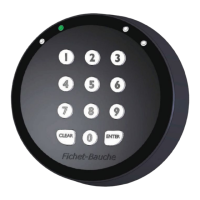

 To Next Page
