Need help?
Do you have a question about the Fike FCP-300ECS and is the answer not in the manual?
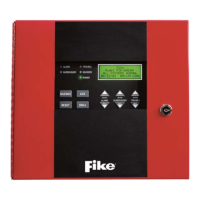
Details the physical components and capabilities of the FCP-300/ECS panel.
Highlights specific features of the FCP-300ECS model, including ECS.
Details UL requirements for various installation types and NFPA compliance.
Explains how to determine system current draw and battery requirements.
Covers battery requirements, connection, and safety precautions for power backup.
Explains how to set unique network IDs for each panel using DIP switches.
Covers tools for diagnosing network performance issues like Ping Panel and Status.
Describes how to program network options, including names, IDs, and computer access.
Details wiring requirements, including wire sizing and types for SLC devices.
Explains how to address Fike SLC devices using rotary dials.
Describes the JumpStart feature for automating system setup and device configuration.
Details how to use the HFSS software for panel programming and configuration.
Lists programming options and their permitted settings according to UL standards.
Details how to program individual points, including type, function, and mapping.
Configures system-wide options like communication, sensitivity, and time settings.
Covers essential operations like setting time, date, and enabling/disabling points.
Describes how the panel behaves in different operational modes like Normal, Alarm, and Trouble.
Details the setup for Double Interlock Zone and Single Interlock Zone releasing.
Explains the functions of the Local Operating Console (LOC) for ECS operations.
Details how to use the microphone for paging and custom ECS events.
Covers recording and managing custom audio messages for the ECS.
Provides solutions for common hardware problems and troubleshooting steps.
Covers built-in tools like SLC Device Locator and I/O Point Control for diagnostics.
Provides a checklist for cyber security tasks during panel installation and maintenance.
Outlines security levels for communication, data, physical access, and control.
Outlines key operations and their corresponding tasks for basic system use.
Instructions on how to silence alarms and troubles using the SILENCE button.
Steps for resetting fire systems and emergency communication systems.
Guidance on gaining or requesting control of the ECS system.
 General
| Type | Fire Alarm Control Panel |
|---|---|
| Operating Temperature | 32°F to 120°F (0°C to 49°C) |
| System Capacity | 300 devices |
| SLC Loops | 1 |
| NAC Outputs | 4 |
| Voltage Input | 120/240V AC, 50/60 Hz |
| Battery Standby | 24 hours |
| Annunciators | Supports remote annunciators |
| Relative Humidity | 93% non-condensing |
| Compliance | UL 864, CSFM |
| Dimensions | 14.5" H x 16.1" W x 4.7" D (36.8 cm H x 40.8 cm W x 11.9 cm D) |


 To Next Page