CONDENSATE PLUME DISPERSAL
When choosing the location for a condensing boiler,
special consideration must be given to the positioning of
the flue terminal. Care should be taken to locate it so as to
prevent either the end user or their neighbours perceiving
the plume to be a nuisance.
It should be noted that the normal statutory clearances
required around low level flue terminals may not be
sufficient to cope with plume dispersal from a condensing
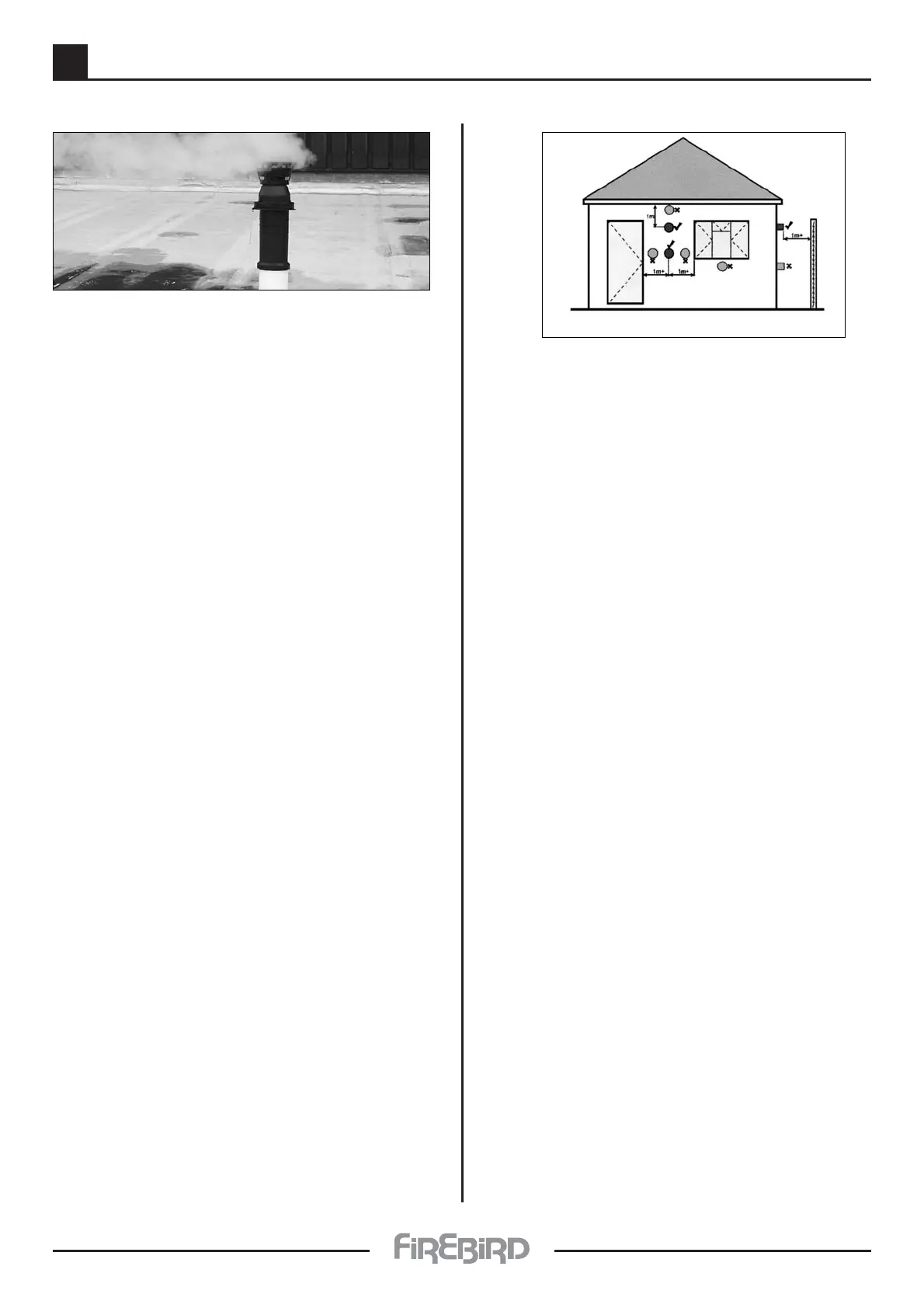
boiler. The following points should be considered:
1. Plumes can extend out horizontally and can also drift
out to the sides and above the terminal. Care needs
to be taken, therefore, to avoid the plume reaching
adjacent surfaces, particularly windows and
neighbours dwellings.
2. Flue terminals need to be located where air can pass
freely across them to disperse vapours.
3. The effect of the moisture generated must be
considered in relation to the possible corrosion of
metal parts it might reach and to the possible
formation of ice on pathways in freezing conditions.
4. Keep flue terminals a minimum of 1m (horizontally)
from openings in the building.
5. Do not install flue terminals directly below a window.
6. Do not install flue terminals next to a door.
7. Do not install flue terminals within 1m of ventilated
soffits or eaves.
8. Keep flue terminals at least 2.5m away from a surface
or boundary facing the terminal.
9. In certain circumstances the installation of a plume
dispersal extension to the flue may be unavoidable.
This takes the plume exhaust from the boiler up and
away from any obstruction, door or window opening
and will also prevent the risk of re circulation of the
plume gasses into the air intake of the burner (on
next page).
10. Follow the appliance manufacturer's instructions.
FLUE TERMINAL
4
18
4.5 - FLUE SYSTEMS - REGULATIONS & GUIDELINES
CONVENTIONAL FLUE SYSTEMS
IMPORTANT
The Firebird condensing boiler must not be installed
with existing flue systems.A flue system suitable for wet
flues must be used. If a flue system which is unsuitable
is used it will invalidate the warranty.
Because of the high operating efficiencies of the
Firebird condensing boilers and low flue gas
temperatures, it is necessary to pay extra special
attention to the flues and chimneys.
Existing chimneys must be lined with a liner certified
as suitable for condensing oil boilers by a flue
manufacturer.
Twin wall insulation must be used for external
applications, with seals and stainless steel inner skin.
Only vitreous enamel or high grade stainless steel can
be used between boiler and chimney in an internal
installation, aluminium or asbestos type material must
not be used (vitreous enamel must not be cut).
Condensate must be able to run back into the flue
chamber of the boiler and not escape, as up to 1.5 ltr. of
condensate can be produced in a conventional flue. No
trap is required in the flue system.
The terminal must be positioned to avoid combustion
products entering the building and as per Building
Regulations. Refer to BS5410 Part 1: 2014 OFTEC
installation requirements book 4.
Every individual concerned with any aspect of
installation should be deemed as competent, and be
aware of all current National and Local Government
Standards and Building & Installation Regulations.


 To Next Page
 Loading...