This document is an operation and installation manual for Isotemp™ Freezers, specifically models designed for Flammable Materials Storage and Explosion Proof applications, as well as general Laboratory Freezers.
Function Description
The Isotemp™ Freezers are designed for professional use in research settings for the storage of samples or inventory within specific temperature ranges. The manual covers three main types of freezers: Explosion Proof Freezers, Flammable Material Storage (FMS) Freezers, and Laboratory Freezers.
Explosion Proof Freezers (Model 05EFEEFSA): These units are specifically constructed for use in hazardous locations where flammable gases or vapors may be present. They are evaluated by Underwriters Laboratories (UL) and are suitable for Class I, Groups C and D classified areas (Class I Div 1, Groups C and D; Class I Zone 1 Group IIB). Their electrical components (thermostats, wiring, splices, relays, compressor motors) are safely housed within explosion-proof enclosures and conduit. Compressor surface temperatures are maintained below the flash point of Class I, Groups C and D materials. These freezers are ideal for storing highly flammable substances such as cyclopropane, ethyl ether, ethylene, acetone, alcohol, benzene, butane, gasoline, hexane, lacquer solvent vapors, naphtha, natural gas, or propane.
Flammable Material Storage (FMS) Freezers (Model 05FFEEFSA): These freezers are designed for use in "Ordinary Locations" (non-hazardous areas) where the build-up or presence of flammable vapors is not expected in the external environment. They are evaluated by UL to meet NFPA Standards Nos. 45, 70, and 99. FMS units have no internal electrical components that could trigger an explosion or fire of hazardous materials inside the unit. They are suitable for storing the same types of flammable materials as explosion-proof units, but in less hazardous external environments.
Laboratory Freezers (Model 05LFEEFSA): These are general-purpose units intended for basic laboratory use only. They are not designed for corrosive environments and are not suitable for storing flammable materials due to the risk of explosion, fire, and injury. For flammable materials, a Flammable Material Storage Unit or an Explosion Proof Unit must be used. Storage of high-value, life science, or clinical biological materials may require additional alarm, monitoring, back-up, and temperature performance features, which are not inherent in these basic laboratory models.
All models feature heavy-gauge, rigid, steel construction with a durable enamel finish. Interiors are made of epoxy enamel or ABS plastic. The units are insulated throughout for energy-efficient operation.
Important Technical Specifications
General for all models (05EFEEFSA, 05FFEEFSA, 05LFEEFSA):
- Freezer Temp. Range: -12°C to -24°C (10.4°F to -11.2°F)
- Electrical Characteristics: 115 Volts / 60 Hz, 1.1 Amps (Amps listed are at normal run mode; starting amps may be higher).
- Net Weight: 90 lbs (41 kg)
- Ship Weight: 95 lbs (43 kg)
- Total Volume: 5.0 cubic feet (under-counter freezer)
- Freezer Chamber Dimensions (H x W x D): 29.5" x 18.63" x 19" (74.9 x 47.32 x 48.2 cm)
- Exterior Dimensions (H x W x D):
- 05EFEEFSA: 33.13" x 21.38" x 30.25" (84.15 x 54.3 x 64.5 cm)
- 05FFEEFSA: 33.13" x 21.38" x 29.5" (84.15 x 54.3 x 74.93 cm)
- 05LFEEFSA: 33.13" x 21.38" x 25.75" (84.15 x 54.3 x 65.4 cm)
- Features: Adjustable Mechanical thermostat, UL Listed, Magnetic gasket, Hermetically-sealed compressor, Manual defrost, White color, 3 Wired shelves and 3 door shelves.
Environmental Operating Conditions:
- Pollution Degree: 2
- Installation Category: II
- Altitude: 2000 Meters MSL (Mean Sea Level)
- Humidity: 80% maximum, non-condensing
- Electrical Supply: 115 V 60 Hz AC
- Voltage Tolerance: ±10% of normal rated line
- Ambient Temperature Range: 16°C to 32°C (59°F to 89.6°F)
- Product Usage: Intended for use indoors only.
Material Compatibility (Interior Cabinet - High Impact Polystyrene):
HIPS plastic deteriorates when exposed to, but not limited to:
- Amines (Aromatic)
- Aldehydes (Aromatic, Aliphatic)
- Ketones (Aromatic, Aliphatic)
- Esters (Aromatic, Aliphatic)
- Ethers (Aromatic, Aliphatic)
- Hydrocarbons (Aromatic, Halogenated)
Corrosive materials should not be stored in these units unless specifically rated as "Corrosion Resistant," and even then, care is required. Damage due to storage of corrosives is not covered under warranty.
Usage Features
Installation:
- Shipping Inspection: Upon delivery, inspect for shipping damage before unpacking. Report any damage to the carrier promptly.
- Unpacking: Verify all parts are accounted for (Freezer, Operation Manual, Inspection Tag) before discarding packing materials.
- Location: Place on a strong, level floor. Adjust leveling legs for stability. Locate away from direct sunlight and heat sources, near a grounded electrical outlet.
- Clearance: Allow 1" space on the sides, and at least 4" above the top and between the back and the wall for proper ventilation.
- Electrical Connection:
- All models (except Explosion-Proof): Must be connected to a grounded outlet matching the nameplate. Do not remove grounding prongs or use electrical extension cords.
- Explosion-Proof models: Do not come with a cord and plug. Must be hard-wired by a qualified electrician.
- Junction Box Sealing (Explosion-Proof Units Only): A critical procedure involving fiber rope dams and sealing compound to prevent gas entry into the junction box and protect against explosions. This involves mixing sealing compound granules with water to form a thick paste, inserting fiber rope into vertical and horizontal conduit openings to surround wiring, and then pouring the sealing compound to create an airtight plug. The sealing compound requires a minimum of 8 hours above 0°C (32°F) to develop sufficient strength.
Operation:
- Temperature Control: Adjusted via the Cold Control Knob. Setting the knob closer to "MAX" lowers the freezer temperature.
- Manual Defrost Procedure: Defrost when frost on freezer walls is 1/4" thick or more to maintain efficiency. Unplug the freezer, remove samples, and use a sponge or towel to remove water and melting ice. Dry the interior thoroughly. Do not use sharp instruments, blades, scrapers, or electrical devices to remove ice.
- Energy Saving Tips:
- Wipe moisture from glassware or materials before placing them in the unit.
- Avoid overcrowding the unit.
- Close the door as soon as possible, especially in hot, humid weather.
- Ensure the door is closed tightly.
- Defrost when frost accumulates to 1/4".
- Keep containers covered to reduce moisture buildup.
- Set operating temperature no colder than necessary.
Safety Tips:
- Avoid contact with cold freezer surfaces, especially with damp hands, to prevent frostbite or skin sticking. Wear gloves when handling samples.
- Never disconnect the unit by pulling the power cord; always grip the plug securely.
- Do not use a power cord with cracks or abrasions; have it repaired or replaced by a qualified electrician.
- Child Entrapment Risk: Before discarding an old freezer, remove doors and leave shelves in place to prevent children from climbing inside.
- Flammable Materials Storage: Only Explosion Proof Units or Flammable Material Storage Units are to be used for storing flammable inventory/samples. Do not store flammable materials in General Purpose Laboratory Freezers.
- Monitoring Devices: For FMS and EXP units, any monitoring devices placed in the cooling chamber must have an intrinsically safe rating from an appropriate certification body (UL, CSA, FM, etc.). Thermocouples for building monitoring systems must be wired through an electrical barrier to prevent sparks.
- Corrosive Materials: Do not store corrosive materials in these units.
Maintenance Features
Cleaning of Units:
- Interior: Turn off the freezer. Wash the interior liner with a solution of two tablespoons of baking soda and a quart of warm water. Rinse and wipe dry. Do not use soaps, detergents, scouring powders, or spray cleaners on the interior liner, as they may cause odors.
- Ice Cube Tray and Shelves: Wash with a mild detergent solution and dry with a soft cloth.
- Exterior: Wipe with a soft cloth dampened with soapy water and dry. Normal appliance spray cleaners can be used on the exterior.
- Door Gaskets: Clean with mild soap and water. Do not use acid, chemical thinners, gasoline, benzene, or boiling water, as these can deform or damage plastic parts.
General Maintenance:
- Service and Repair: Do not attempt to service or repair a Thermo Scientific product under warranty without consulting your Thermo Scientific dealer. After the warranty period, consultation is still advised for complex repairs.
- Qualified Personnel: All internal adjustments and maintenance must be performed by qualified service personnel.
- Safety Precaution: Disconnect the plug from the electrical outlet before attempting any maintenance or repair.
Troubleshooting:
The manual provides a troubleshooting guide for common issues:
- Unit not operating: Check if plugged in, circuit breaker tripped, or fuse blown.
- Compressor turns on and off frequently: Could be due to warm room temperature, frequent door opening, incomplete door closure, incorrect temperature control setting, faulty door gasket seal, or insufficient clearances.
- Noise problems: Trickling or gurgling sounds from refrigerant flow are normal. Popping and crackling sounds from contraction/expansion of inside walls are normal. Check if the unit is level or in contact with another appliance.
Replacement Parts and Ordering:
- To obtain replacement parts, contact the Customer Service Department at 1-800-438-4851. Provide the unit's model, serial, and code numbers (found on data plates on the rear of the unit), date purchased, source of purchase, and purchase order number.
- Prior to returning any materials, obtain a "Return Materials Authorization" (RMA) number from Customer Service. Materials returned without an RMA number will be refused.

 Need help?
 General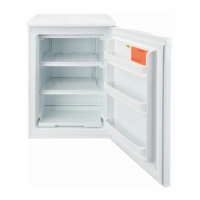



 To Next Page