7
Applications
Applications
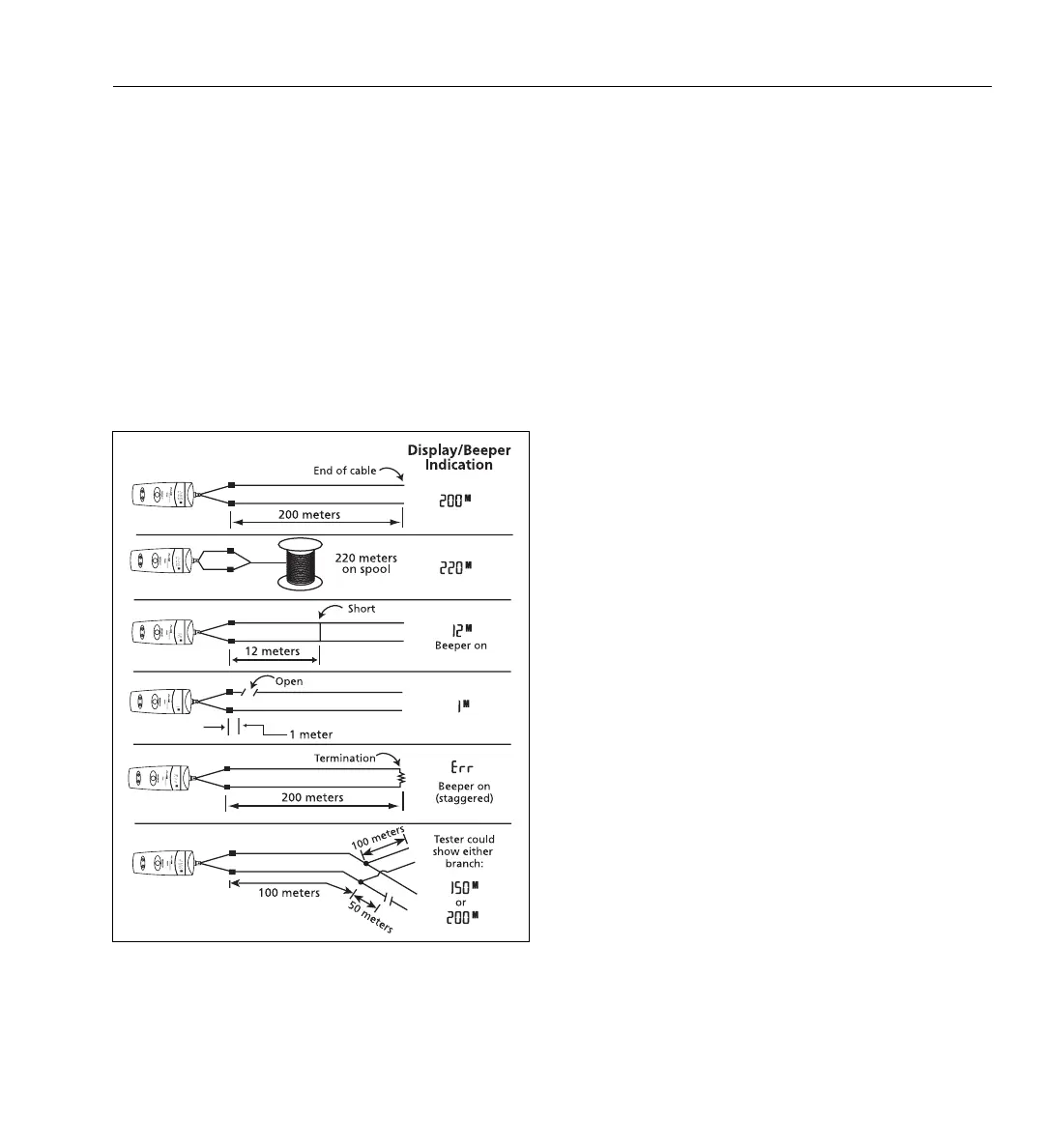
See Figure 3.
The tester locates opens, short circuits, and crosses in
any two metallic conductors (twisted, untwisted, coax,
copper, aluminum, and steel).
It identifies conductors using the PowerTone feature
and an inductive probe (not included) (see Figure 2).
Tone can be sent between two technicians to ID
multiple pairs. Because the tester beeps when it detects
a short circuit, it also serves as a circuit (for example,
continuity) tester.
bfz03.eps
Figure 3. Testing for Lengths, Shorts, Opens, and
Terminations
Multi-Wire Environment
When testing wires in a multi-wire environment, such
as 4 wire telephone cable, 8 wire CAT-5 cable, 12-2 with
ground ac wire, or several THHN wires inside a conduit,
a short could exist between any number of the
conductors, including a shield or the conduit. To detect
the short, you must connect the tester to the wires that
are shorted. This means that to fully test a multi-wire
cable, you must check every wire against every other
wire including the shields and conduits.
While a quick way to test many conductors against
conduit or shield length is to connect all the conductors
to one clip lead and the shield to the other lead, this
will reduce the impedance of the cable, and
measurements may fall below the tester’s range. It is
more reliable to test the wires individually.
Conduit
There are two methods for testing wire in conduit. You
can test a wire pair or a single wire.
Testing a Wire Pair in a Conduit
To test a wire pair, connect the two test leads to the
pair. If one wire separates from the other for 1 ft
(30 cm) or more, the tester indicates an open at the
separation. For example, if the wires separate after
exiting the conduit, the tester indicates an open at the
end of the conduit.
Testing a Single Wire in a Conduit
You can test a single wire by clipping one test lead to
the wire and the other to the conduit. The tester shows
the length up to a fault or to the point where the wire
separates from the conduit by at least 1 ft (30 cm). For
example, if there is a 2 ft (30 cm) service loop outside
the conduit, the tester shows the length up to the
service loop. This is true even if the two sections of
conduit are electrically connected.



 To Next Page