EasyManua.ls Logo

Fluke 410B - Direct Calibration; Set the OUTPUT VOLTAGE; Precision Calibration; Notes on Operation

Fluke 410B
54 pages
Print Icon
To Next Page IconTo Next Page
To Previous Page IconTo Previous Page
Loading...
410B
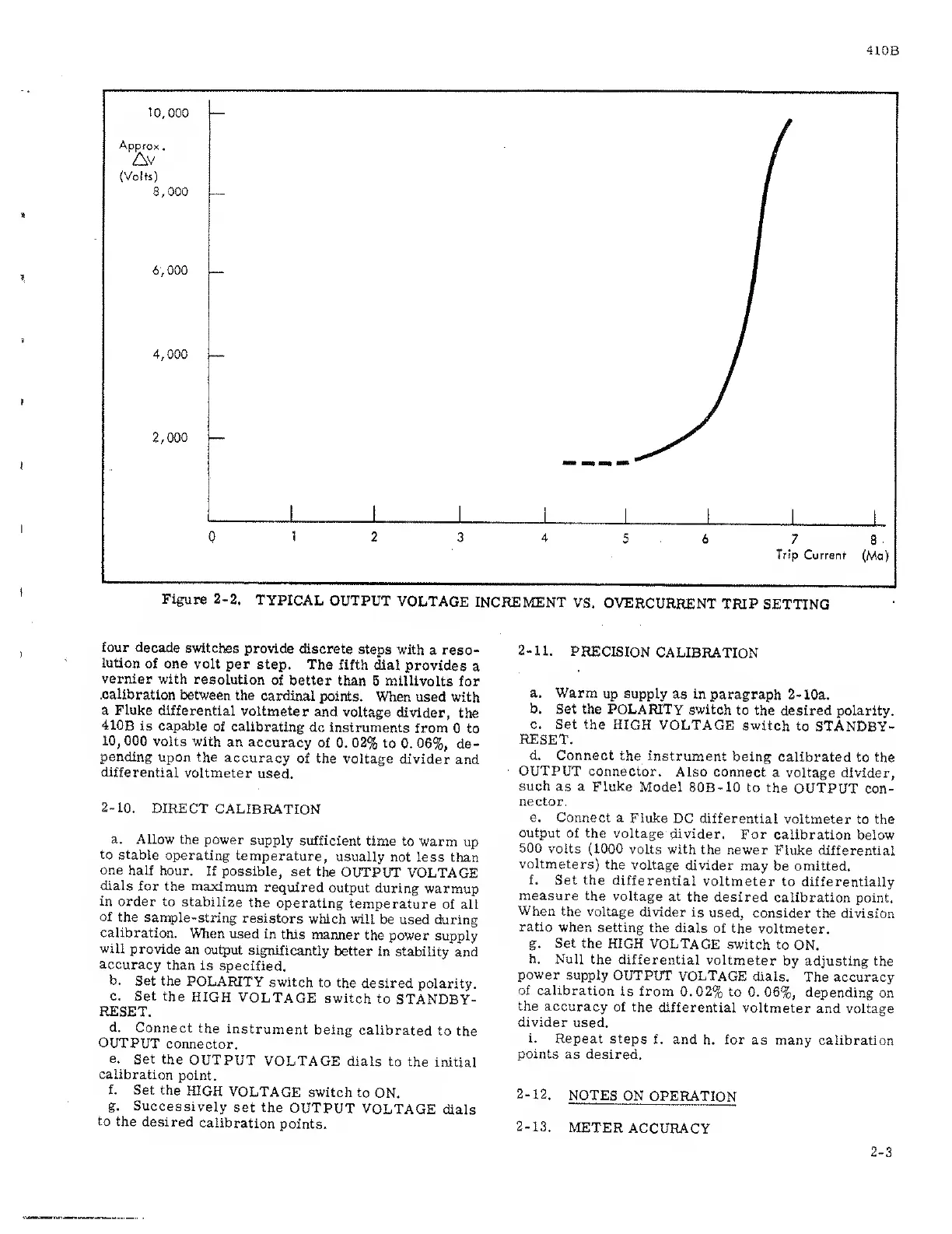
Figure 2-2.
TYPICAL
OUTPUT
VOLTAGE
INCREMENT
VS.
OVERCURRENT
TRIP SETTING
four decade
switches
provide
discrete
steps with
a reso-
lution
of one
volt per
step. The
fifth dial
provides
a
vernier
with resolution
of better than
5 millivolts
for
.calibration
between
the cardinal
points.
When
used with
a Fluke
differential
voltmeter
and voltage
divider,
the
410B is capable
of calibrating
dc
instruments
from
0 to
10,
000
volts with
an accuracy
of
0.
02%
to
0.
06%,
de-
pending
upon the
accuracy
of the voltage
divider
and
differential
voltmeter
used.
2-10.
DIRECT
CALIBRATION
a.
Allow the
power
supply sufficient
time to
warm
up
to
stable operating
temperature,
usually
not less than
one
half hour.
If possible,
set the
OUTPUT
VOLTAGE
dials
for the maximum
required
output during
warmup
in
order to
stabilize
the
operating
temperature
of all
of
the
sample-string
resistors
which will
be
used during
calibration.
When
used in
this manner
the
power supply
will
provide
an output
significantly
better in
stability and
accuracy than
is specified.
b.
Set the
POLARITY
switch
to the
desired
polarity.
c. Set the
HIGH
VOLTAGE
switch
to
STANDBY-
RESET.
d.
Connect
the
instrument
being
calibrated
to the
OUTPUT
connector.
e.
Set
the
OUTPUT
VOLTAGE
dials to
the
initial
calibration
point.
f.
Set the
HIGH
VOLTAGE switch
to
ON.
g. Successively
set the
OUTPUT
VOLTAGE
dials
to
the
desired
calibration
points.
2-11.
PRECISION
CALIBRATION
a.
Warm
up supply as in
paragraph
2-
10a.
b.
Set the
POLARITY switch
to the
desired polarity.
c. Set the
HIGH
VOLTAGE
switch to
STANDBY-
RESET.
d.
Connect the
instrument
being
calibrated to the
OUTPUT
connector.
Also connect
a voltage divider,
such
as a Fluke
Model
80B-10 to the
OUTPUT
con-
nector.
e. Connect
a Fluke
DC differential
voltmeter
to the
output of the
voltage
divider. For
calibration below
500
volts
(1000 volts with
the newer
Fluke differential
voltmeters)
the
voltage divider
may
be omitted.
f.
Set the
differential
voltmeter
to differentially
measure
the
voltage at
the desired
calibration
point.
When the
voltage
divider is
used,
consider the division
ratio
when
setting the dials
of the
voltmeter.
g.
Set
the HIGH
VOLTAGE
switch to
ON.
h.
Null the
differential
voltmeter
by adjusting the
power
supply
OUTPUT
VOLTAGE
dials.
The accuracy
of calibration
is from
0.
02%
to
0.
06%,
depending
on
the accuracy
of the differential
voltmeter
and voltage
divider
used.
i.
Repeat steps
f. and
h.
for
as
many calibration
points
as desired.
2-12.
NOTES
ON
OPERATION
2-13.
METER
ACCURACY
2-3