EasyManua.ls Logo

Fluke 410B - Load Regulation; Stability

Fluke 410B
54 pages
Print Icon
To Next Page IconTo Next Page
To Previous Page IconTo Previous Page
Loading...
4.1
OB
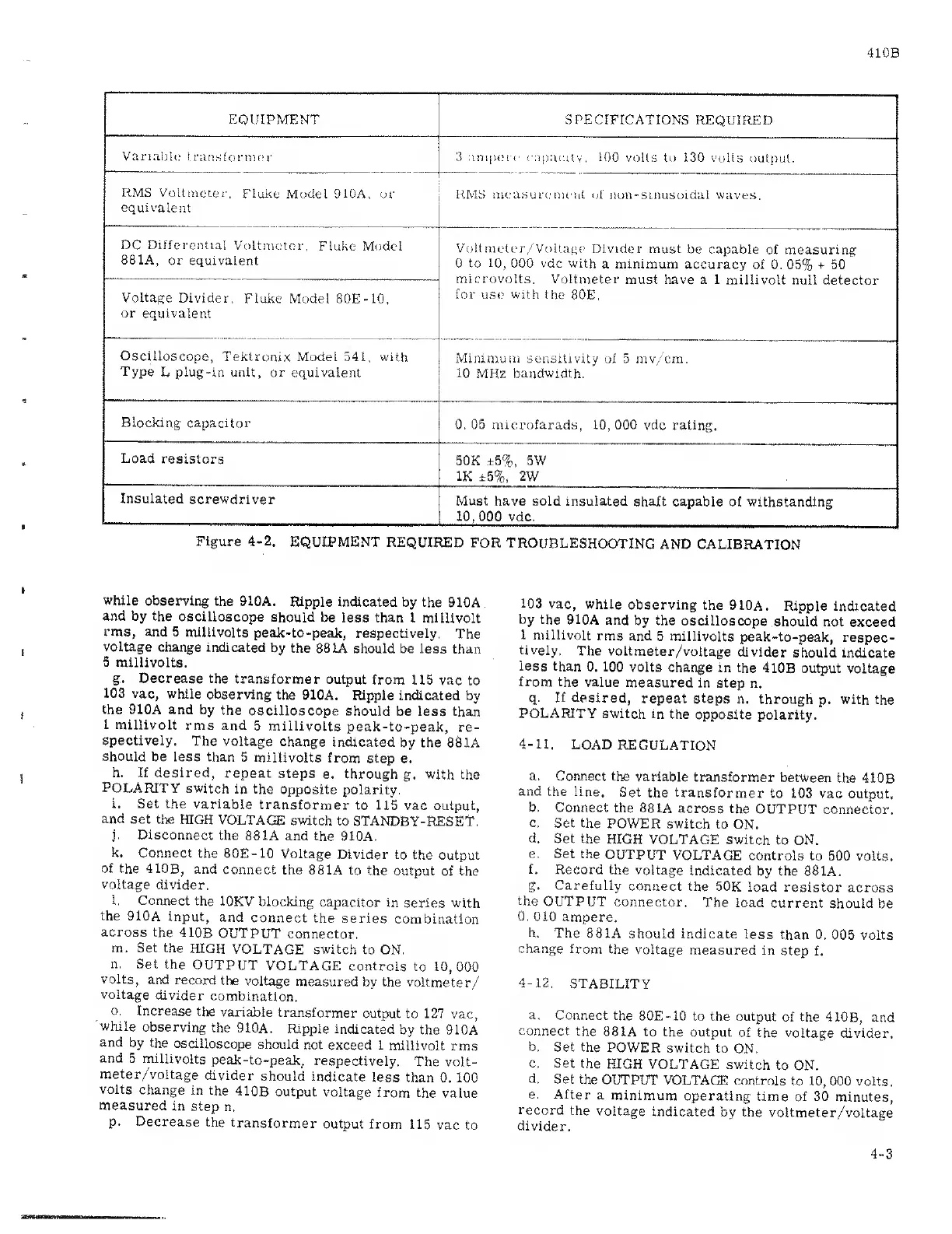
EQUIPMENT
SPECIFICATIONS REQUIRED
Variable
transformer 3 ampere capacity. 100
volts to 130 volts
output.
RMS Voltmeter,
Fluke
Model 910A, or
equivalent
RMS
measurement
of nun-sinusoidal waves.
DC Differential
Voltmeter,
Fluke Model
881A,
or equivalent
Voltmeter/Voltage
Divider must
be capable
of measuring
0 to
10,
000 vdc with
a minimum
accuracy of
0.
05%
+•
50
microvolts.
Voltmeter
must have a 1
millivolt null detector
for
use
with
the
80E.
Voltage
Divider.
Fluke Model
80E-10,
or equivalent
Oscilloscope,
Tektronix
Model 541, with
Type
L plug-in unit, or
equivalent
Minimum sensitivity
of 5 mv/cm.
10
MHz bandwidth.
Blocking
capacitor
0. 05
microfarads, 10,000 vdc rating.
Load
resistors
50K
±5%,
5W
IK
±5%,
2W
Insulated
screwdriver
Must
have sold insulated
shaft capable of withstanding
10,
000 vdc.
Figure
4-2.
EQUIPMENT REQUIRED
FOR
TROUBLESHOOTING
AND
CALIBRATION
while observing
the 9I0A.
Ripple
indicated by the
910A
and by the
oscilloscope
should
be less than 1 millivolt
rms, and 5
millivolts
peak-to-peak,
respectively.
The
voltage change
indicated
by the 88
IA should be less
than
5
millivolts.
g.
Decrease the
transformer
output
from 115 vac
to
103 vac,
while observing
the
910A.
Ripple
indicated by
the
910A and by
the
oscilloscope
should be less than
1
millivolt
rms and
5 millivolts
peak-to-peak,
re-
spectively.
The voltage
change
indicated
by the 88
1A
should
be less than
5 millivolts
from
step e.
h. If desired,
repeat
steps
e. through
g.
with
the
POLARITY
switch
in the
opposite
polarity.
i. Set the
variable
transformer
to 115
vac output,
and
set the
HIGH
VOLTAGE
switch to
STANDBY-RESET.
j.
Disconnect
the 88
1A and the
910A.
k. Connect
the
80E-10 Voltage
Divider to
the output
of the 4
10B, and
connect
the 881A to
the output
of the
voltage
divider.
l. Connect
the
10KV blocking
capacitor
in
series with
the
910A input,
and
connect the
series
combination
across
the
410B OUTPUT
connector.
m. Set the
HIGH
VOLTAGE switch
to ON.
n. Set
the
OUTPUT
VOLTAGE
controls to
10,000
volts, and
record
the
voltage
measured
by
the
voltmeter/
voltage
divider
combination.
o. Increase
the variable
transformer
output to 127
vac,
while
observing
the
910A. Ripple
indicated
by the
910A
and
by
the
oscilloscope
should
not exceed 1
millivolt
rms
and
5
millivolts
peak-to-peak,
respectively.
The volt-
meter/voltage
divider
should
indicate
less than
0. 100
volts
change in
the
410B output voltage
from
the value
measured
in
step
n.
p. Decrease
the
transformer
output
from
115 vac to
103
vac,
while
observing
the
910A. Ripple indicated
by the
910A and
by the
oscilloscope
should not
exceed
1
millivolt rms and
5 millivolts
peak-to-peak,
respec-
tively.
The
voltmeter/voltage
divider
should indicate
less than
0. 100
volts
change in the
410B
output
voltage
from the
value
measured in step
n.
q.
If desired,
repeat steps
n. through
p.
with the
POLARITY
switch in
the
opposite polarity.
4-11.
LOAD
REGULATION
a. Connect
the variable
transformer
between
the
410B
and
the line.
Set
the transformer
to 103 vac
output,
b. Connect
the 88
1A across the
OUTPUT
connector.
c. Set the
POWER switch
to ON.
d.
Set the
HIGH
VOLTAGE switch
to ON.
e. Set the
OUTPUT
VOLTAGE
controls to
500 volts.
f.
Record the
voltage
indicated
by the 88
1A.
g.
Carefully
connect the
50K load resistor
across
the
OUTPUT
connector.
The load
current should
be
0.
010 ampere.
h. The
881A
should indicate
less than 0.005
volts
change
from the
voltage
measured in
step f.
4-12.
STABILITY
a.
Connect
the
80E-10 to the output
of
the
410B,
and
connect
the
881A to the output
of the
voltage divider.
b. Set the
POWER
switch
to ON.
c.
Set
the
HIGH
VOLTAGE
switch to
ON.
d.
Set
the
OUTPUT VOLTAGE
controls
to
10,
000 volts.
e. After
a minimum
operating
time
of 30 minutes,
record
the
voltage indicated
by the voltmeter/voltage
divider.
4-3