EasyManua.ls Logo

Fluke 410B - Introduction; Overall Operation; Circuit Descriptions; Power Supply

Fluke 410B
54 pages
Print Icon
To Next Page IconTo Next Page
To Previous Page IconTo Previous Page
Loading...
3-1.
INTRODUCTION
3-2.
This
section of
the manual
describes the
oper-
ation
of the
Model
4I0B.
Reference is
made to the
functional
schematic
following
Section
V.
This
sche-
matic
is intended
to aid
in understanding
the
theory
of
operation,
and in
troubleshooting.
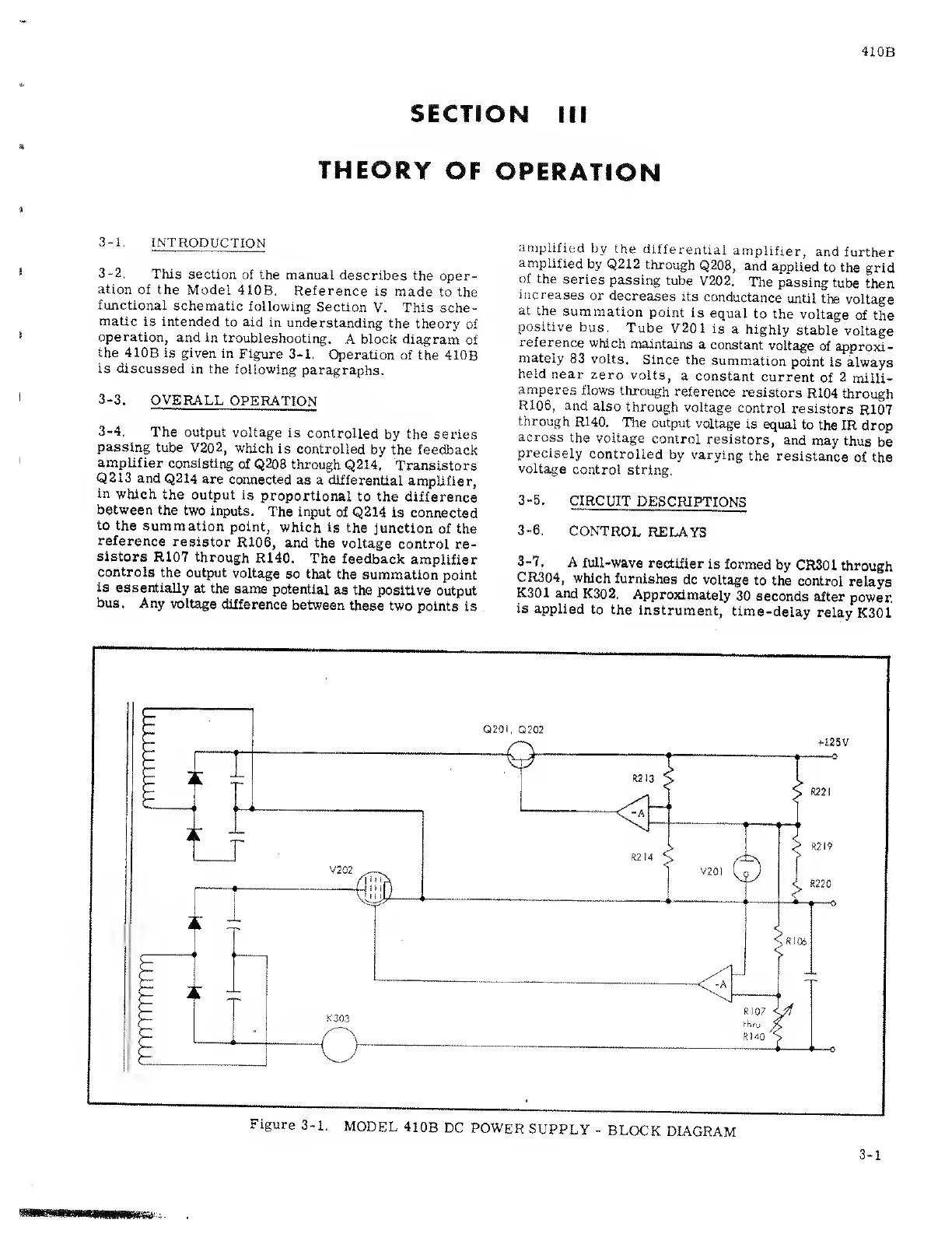
A block diagram
of
the
4
10B
is given
in Figure 3-1.
Operation
of the
410B
is
discussed in the
following
paragraphs.
3-3.
OVERALL
OPERATION
3-4.
The output
voltage
is controlled
by
the
series
passing
tube
V202, which
is controlled
by
the feedback
amplifier
consisting
of
Q208 through
Q214.
Transistors
Q213
and
Q214 are connected
as
a differential
amplifier,
in
which
the output
is
proportional
to the
difference
between the
two
inputs.
The input
of
Q214 is connected
to
the
summation
point,
which is
the junction
of the
reference
resistor
R106,
and the voltage
control re-
sistors
R107 through
R140.
The feedback
amplifier
controls
the
output
voltage
so that the
summation
point
is
essentially
at the
same
potential as
the positive
output
bus.
Any voltage
difference
between these
two
points is
amplified
by
the
differential
amplifier,
and
further
amplified
by
Q212 through
Q208,
and
applied
to
the grid
of the
series
passing
tube
V202.
The
passing
tube
then
increases
or decreases
its
conductance
until
the
voltage
at
the
summation
point is
equal
to
the
voltage
of the
positive
bus.
Tube
V201 is
a highly
stable
voltage
reference
which
maintains
a
constant
voltage
of
approxi-
mately
83
volts.
Since the
summation
point
is always
held
near
zero
volts,
a constant
current
of 2 milli-
amperes
flows
through
reference
resistors
R104 through
R106,
and
also
through
voltage
control
resistors
R107
through
R140.
The output
voltage is
equal
to
the
IR drop
across
the voltage
control
resistors,
and
may
thus
be
precisely
controlled
by
varying
the
resistance
of the
voltage
control
string.
3-5.
CIRCUIT
DESCRIPTIONS
3-6.
CONTROL
RELAYS
3-7.
A
full-wave
rectifier
is formed
by CR301
through
CR304,
which
furnishes
dc voltage
to
the
control
relays
K301
and K302.
Approximately
30
seconds
after
power,
is
applied
to
the
instrument,
time-delay
relay
K301
Figure
3-1.
MODEL
410B
DC POWER
SUPPLY
-
BLOCK
DIAGRAM