EasyManua.ls Logo

Fluke 410B - Coaxial Cable Assembly; Dage Type 486-1 Connector Assembly; Ms 106 A

Fluke 410B
54 pages
Print Icon
To Next Page IconTo Next Page
To Previous Page IconTo Previous Page
Loading...
410B
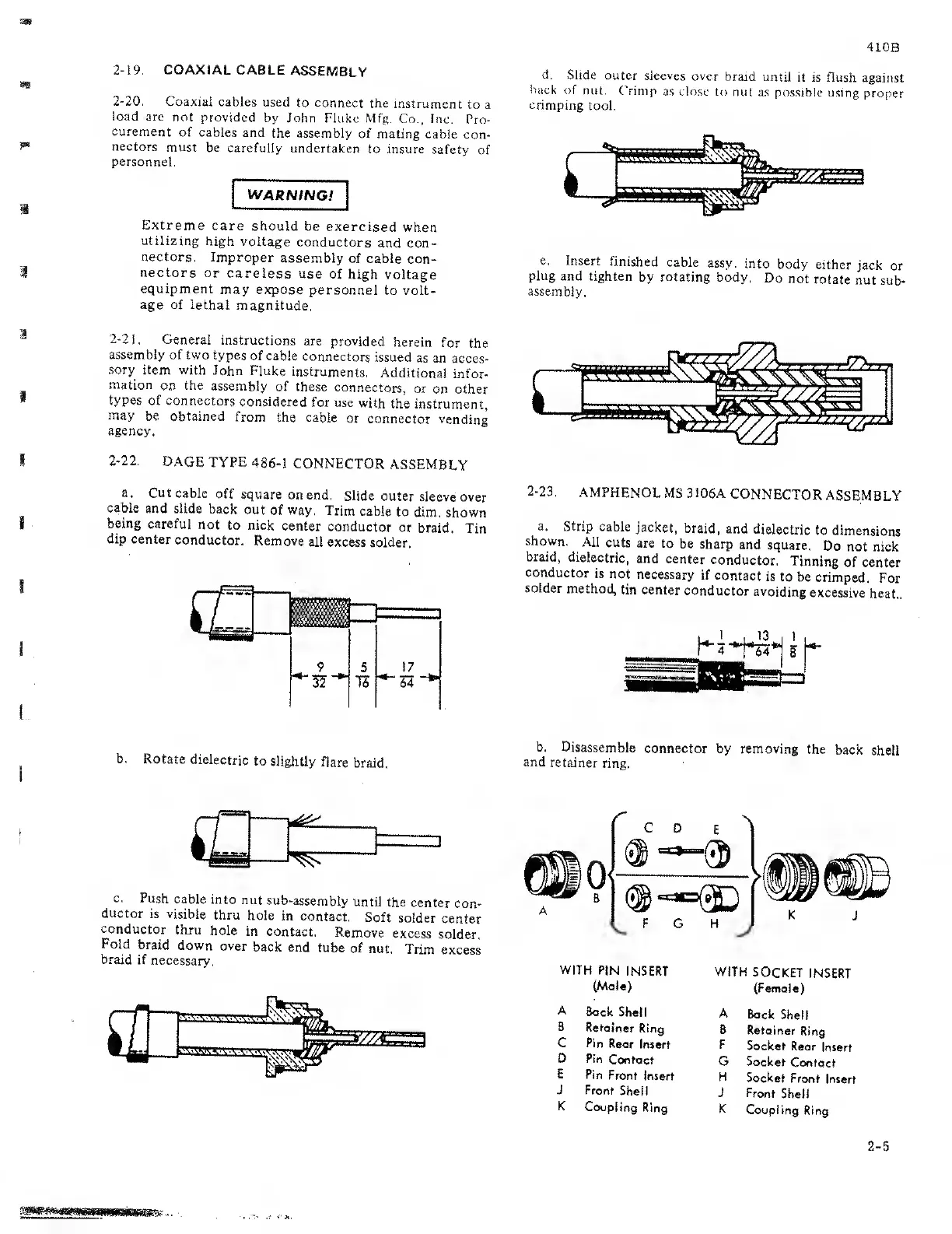
2-19.
COAXIAL CABLE
ASSEMBLY
2-20.
Coaxial cables
used
to connect the
instrument
to a
load are
not provided
by John
Fluke Mfg.
Co., Inc.
Pro-
curement
of cables
and
the assembly
of mating cable
con-
nectors
must be
carefully
undertaken
to insure
safety
of
personnel.
WARNING!
Extreme
care
should be
exercised
when
utilizing
high voltage
conductors
and con-
nectors. Improper
assembly
of cable
con-
nectors or
careless
use of
high
voltage
equipment
may expose
personnel
to volt-
age of lethal
magnitude.
2-21.
General
instructions
are provided
herein
for
the
assembly
of
two
types
of cable
connectors
issued
as an
acces-
sory item with
John
Fluke
instruments.
Additional
infor-
mation
on the
assembly
of these
connectors,
or
on other
types
of connectors
considered
for use
with
the
instrument,
may
be
obtained from
the cable
or
connector
vending
agency.
2-22.
DAGE
TYPE
486-1
CONNECTOR
ASSEMBLY
a. Cut
cable
off
square
on end.
Slide
outer
sleeve
over
cable
and
slide back
out
of way.
Trim
cable
to
dim.
shown
being
careful
not
to nick
center
conductor
or
braid.
Tin
dip
center
conductor.
Remove
all excess
solder.
d.
Slide outer
sleeves
over
braid until
it is flush
against
back
of
nut.
Crimp
as close to
nut as
possible using
proper
crimping
tool.
e. Insert
finished
cable
assy,
into
body
either
jack
or
plug
and tighten
by
rotating
body.
Do
not
rotate
nut
sub-
assembly.
2-23.
AMPHENOL
MS 3
106A
CONNECTOR
ASSEMBLY
a.
Strip cable
jacket,
braid,
and
dielectric
to
dimensions
shown.
All
cuts
are to
be
sharp
and
square.
Do
not
nick
braid,
dielectric,
and center
conductor.
Tinning
of center
conductor
is
not necessary
if
contact
is
to be
crimped.
For
solder
method,
tin center
conductor
avoiding
excessive
heat..
b.
Rotate
dielectric
to
slightly
flare
braid.
b.
Disassemble
connector
by removing
the
back
shell
and
retainer
ring.
c. Push
cable
into
nut
sub-assembly
until
the
center
con-
ductor
is
visible
thru
hole
in
contact.
Soft
solder
center
conductor
thru
hole
in contact.
Remove
excess
solder.
Fold
braid
down
over
back end
tube
of
nut.
Trim
excess
braid
if
necessary.
WITH
PIN
INSERT
(Mate)
A
Back
Shell
8
Retainer
Ring
C Pin
Rear
Insert
D Pin
Contact
£
Pin
Front
Insert
J Front
Shell
K
Coupling
Ring
WITH
SOCKET
INSERT
(Female)
A
Back
Shell
B
Retainer
Ring
F
Socket
Rear
Insert
G Socket
Contact
H
Socket
Front
Insert
J Front
Shell
K
Coupling
Ring