EasyManua.ls Logo

Fluke 80i-410 - Operation; Battery Test

Fluke 80i-410
8 pages
Print Icon
To Next Page IconTo Next Page
To Previous Page IconTo Previous Page
Loading...
-170.0mV
Sa
LEN
y
=
O.K.
-100.0mV
EBENEN
-99.9mV
|
Me
|-
ES
©
Ys
N
|
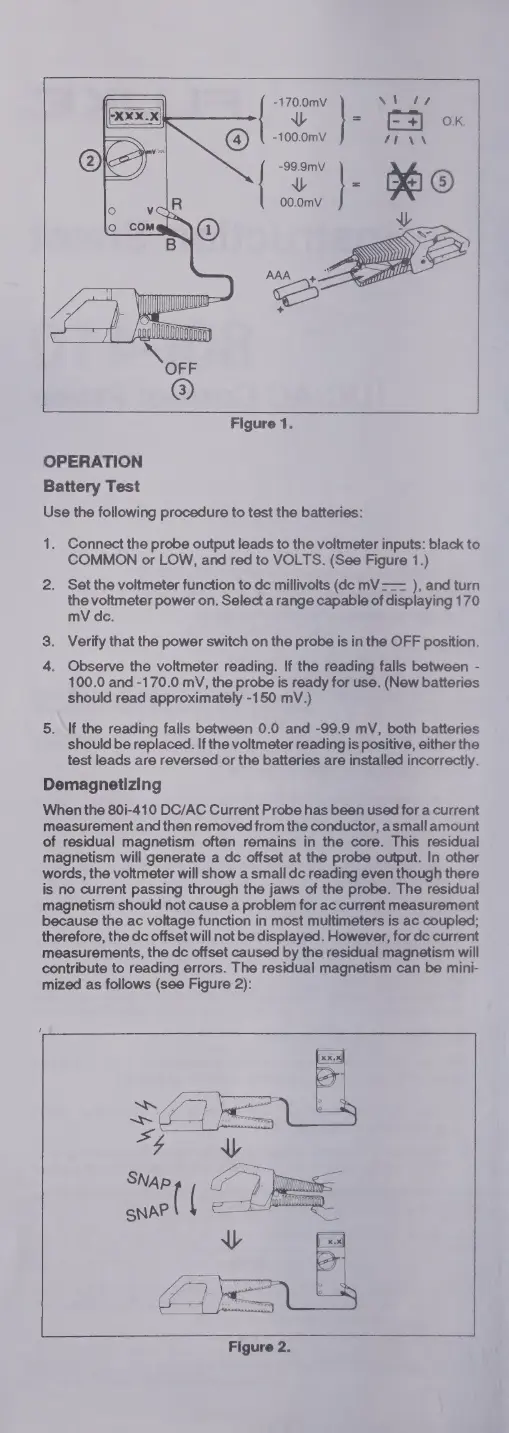
Figure
1.
OPERATION
Battery
Test
Use
the
following
procedure
to
test
the
batteries:
1.
Connect
the
probe
output
leads
to
the
voltmeter
inputs:
black
to
COMMON
or
LOW,
and
red
to
VOLTS.
(See
Figure
1.)
2.
Set
the
voltmeter
function
to
de
millivolts
(de
mV==
),
and
turn
the
voltmeter
power
on.
Select
a
range
capable
of
displaying
170
mV
dc.
3.
Verify
that
the
power
switch
on
the
probe
is
inthe
OFF
position.
4.
Observe
the
voltmeter
reading.
If
the
reading
falls
between
-
100.0
and
-170.0
mV,
the
probe
is
ready
for
use.
(New
batteries
should
read
approximately
-150
mV.)
5.
If
the
reading
falls
between
0.0
and
-99.9
mV,
both
batteries
should
be
replaced.
If
the
voltmeter
reading
is
positive,
either
the
test
leads
are
reversed
or
the
batteries
are
installed
incorrectly.
Demagnetizing
When
the
80i-410
DC/AC
Current
Probe
has
been
used
for
a
current
measurement
and
then
removed
from
the
conductor,
a
small
amount
of
residual
magnetism
often
remains
in
the
core.
This
residual
magnetism
will
generate
a
dc
offset
at
the
probe
output.
In
other
words,
the
voltmeter
will
show
a
small
dc
reading
even
though
there
is
no
current
passing
through
the
jaws
of
the
probe.
The
residual
magnetism
should
not
cause
a
problem
for
ac
current
measurement
because
the
ac
voltage
function
in
most
multimeters
is
ac
coupled;
therefore,
the
dc
offset
will
not
be
displayed.
However,
for
de
current
measurements,
the
dc
offset
caused
by
the
residual
magnetism
will
contribute
to
reading
errors.
The
residual
magnetism
can
be
mini-
mized
as
follows
(see
Figure
2):
Figure
2.

Related product manuals