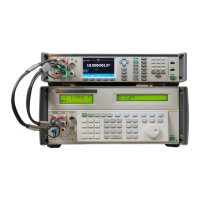
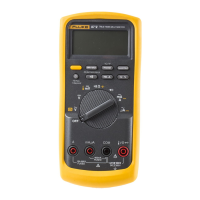
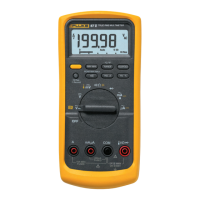
8505A/8506A
e.
The # command
is an immediate character
only
when
used
with the Bit Serial Interface {Option
-06)
or the
Parallel Interface (Option -07). With
the
IEEE-488 Interface (Option -05), the #
command is
not an immediate
character
and can be used as part of the K3
command string.
4. K 4 G 1 :
Clear all of
Calibration
Memory. If it is necessary to clear all calibration
factors
(as
in
a
check sum
error 25 condition
or prior to hardware
calibration of ail
functions), the K4G1 command string can be
used.
Depending on the number
of
entries
being cleared,
several seconds may be necessary to
complete
this operation.
Completion of this comprehensive clearing operation is verified by
return of the status
response.
CAUTION
If any
Interrupting
command Is sent immediately after
K4 (and
before
G1),
the comprehensive
clearing
operation may be
interrupted prior
to
completion. A check sum (error
25)
condition would then be
set. Do
not send any
Interrupting command (Immediate characters, reset, etc.) between K4 and G1.
5.
K 2 : Store
previous reading as scaling factor.
RECALL
Recall DC Zero
(GO)
The GO
command
(recall dc zero and send on next
trigger)
operates in the following
fashion for either the 8505A or
the
8506A:
1 .
The multimeter
can store separate dc zero values for each range. If GO is used when dc
volts function is
selected, the dc
zero recalled is the value for the range selected. If GO is used when
any other function Is
selected, the dc
zero recalled is the value for the
100
mV range only.
2. The multimeter can
store both non-volatile
(“permanent”) and temporary dc zero values. Which values are
recalled
depends on
the state of the Calibration modeat the
time GO
is
used. When Calibration mode is on, the
zero values
recalled are
the permanent values, which are stored
in Calibration Memory. When Calibration
mode is
off, the zero
values recalled are the
temporary
values,
which are stored in
a
separate, temporary
memory. The
temporary zero values
are reset to
0
when the
multimeter is powered-up
or
reset.
Recall
Status (G1)
The
first
two
digits of
the G1
response (error codes) are identified
in two
steps.
The first step involves
a
user-
programmed
error
message
that is returned whenever an error
condition has been generated. This message is stored
in
an error response buffer and serves only as a ’’flag” that an error
exists. It does not identify the error. An error
message
is programmed with the K3 command, followed by any
combination of up to 15 characters. For example, an
obviously illegal multimeter response of 1E20 could be specified as the
error message. If no such special message
has
been programmed, a returned
"0“
is used. In any case,
this message alone is returned whenever an error
condition has been generated and a
response
from the
multimeter has been commanded. The
error
message may be
returned repeatedly. This depends
on the
type of
error condition generated
(momentary or latching) and subsequent
corrective actions. The
following
rules apply:
1. Each
momentary error condition generates only one error message.
2.
A latching error
condition, if not corrected, generates repeated errors. Therefore, the
error message is
returned for
each attempted reading.
For the second step,
the
G1
(get status) command must be sent. The first and second
characters of the status
response then
identify the error condition by number. This two-d igit error code is stored
in
a
separate error
condition
buffer
and
is subject to the
following
rules:
1. A
single two-digit error code can occupy the error buffer.
2.
If
a
multiple error
condition exists, only
the
last error
to
have been generated is stored
in the error
buffer.
2A-30


 To Next Page