Appendix A 49
Appendix A
Intended use of your bicycle
WARNING: Understand your bike and its intended use. Choosing the
wrong bicycle for your purpose can be hazardous. Using your bike
the wrong way is dangerous.
No one type of bicycle is suited for all purposes. Your retailer can help you
pick the “right tool for the job” and help you understand its limitations. There
are many types of bicycles and many variations within each type. There are
many types of mountain, road, racing, hybrid, touring, cyclocross and tandem
bicycles.
There are also bicycles that mix features. For example, there are road/racing
bikes with triple cranks. These bikes have the low gearing of a touring bike, the
quick handling of a racing bike, but are not well suited for carrying heavy loads
on a tour. For that purpose you want a touring bike.
Withineachoftypeofbicycle,onecanoptimizeforcertainpurposes.Visityour
bicycle shop and nd someone with expertise in the area that interests you. Do
your own homework. Seemingly small changes such as the choice of tires can
improve or diminish the performance of a bicycle for a certain purpose.
On the following pages, we generally outline the intended uses of various types
of bikes.
Industry usage conditions are generalized and evolving. Consult your
dealer about how you intend to use your bike.
High-Performance Road
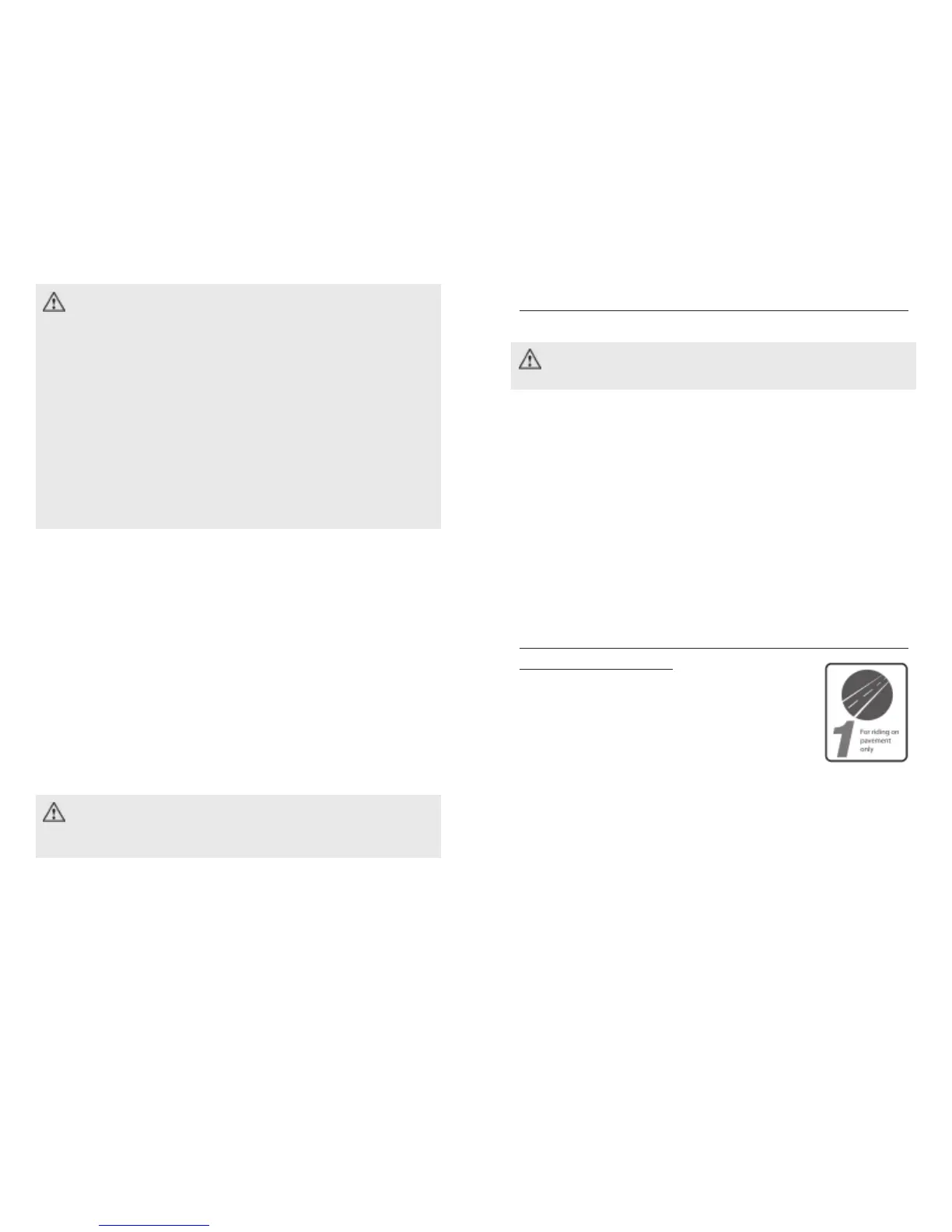
CONDITION 1
Bikes designed for riding on a paved surface where the tires
do not lose ground contact.
INTENDED To be ridden on paved roads only.
NOT INTENDED For off-road, cyclocross, or touring with
racks or panniers.
TRADE OFF Material use is optimized to deliver both light
weight and specic performance. You must understand that (1) these types
of bikes are intended to give an aggressive racer or competitive cyclist a
performance advantage over a relatively short product life, (2) a less aggressive
rider will enjoy longer frame life, (3) you are choosing light weight (shorter
frame life) over more frame weight and a longer frame life, (4) you are choosing
light weight over more dent resistant or rugged frames that weigh more. All
frames that are very light need frequent inspection. These frames are likely to
be damaged or broken in a crash. They are not designed to take abuse or be a
rugged workhorse. See also Appendix B.
WARNING: Like any mechanical device, a bicycle and its components
are subject to wear and stress. Different materials and mechanisms
wear or fatigue from stress at different rates and have different life
cycles. If a component’s life cycle is exceeded, the component can
suddenly and catastrophically fail, causing serious injury or death to
the rider. Scratches, cracks, fraying and discoloration are signs of
stress-caused fatigue and indicate that a part is at the end of its
useful life and needs to be replaced. While the materials and
workmanship of your bicycle or of individual components may be
covered by a warranty for a specified period of time by the
manufacturer, this is no guarantee that the product will last the term
of the warranty. Product life is often related to the kind of riding you
do and to the treatment to which you submit the bicycle. The bicycle’s
warranty is not meant to suggest that the bicycle cannot be broken or
will last forever. It only means that the bicycle is covered subject to
the terms of the warranty. Please be sure to read Appendix A,
Intended Use of your bicycle and Appendix B, The lifespan of your
bike and its components, starting on page 43.
5. As required: If either brake lever fails the Mechanical Safety Check (Section
1.C), don’t ride the bike. Have your dealer check the brakes.
If the chain won’t shift smoothly and quietly from gear to gear, the derailleur is
out of adjustment. See your dealer.
6. Every 25 (hard off-road) to 50 (on-road) hours of riding: Take your bike to your
dealer for a complete checkup.
B. If your bicycle sustains an impact:
First, check yourself for injuries, and take care of them as best you can. Seek
medical help if necessary.
Next, check your bike for damage.
After any crash, take your bike to your dealer for a thorough check. Carbon
composite components, including fames, wheels, handlebars, stems, cranksets,
brakes, etc. which have sustained an impact must not be ridden until they have
been disassembled and thoroughly inspected by a qualied mechanic.
See also Appendix B, Lifespan of your bike and its components.
WARNING: A crash or other impact can put extraordinary stress on
bicycle components, causing them to fatigue prematurely.
Components suffering from stress fatigue can fail suddenly and
catastrophically, causing loss of control, serious injury or death.


 To Next Page