Appendix A 51
NOT INTENDED For Hardcore Freeriding, Extreme Downhill, Dirt Jumping,
Slopestyle, or very aggressive or extreme riding. No spending time in the air
landing hard and hammering through obstacles.
TRADE OFF Cross-Country bikes are lighter, faster to ride uphill, and more
nimble than All-Mountain bikes. Cross-Country and Marathon bikes trade off
some ruggedness for pedaling efciency and uphill speed.
MAXIMUM WEIGHT LIMIT
RIDER LUGGAGE* TOTAL
lbs / kg lbs / kg lbs / kg
300 / 136 5 /2.3 305 / 138
* Seat Bag Only
Front suspension frames manufactured
with original equipment seat stay and
dropout rack mounts only
300 / 136 55 / 25 355 / 161
All Mountain
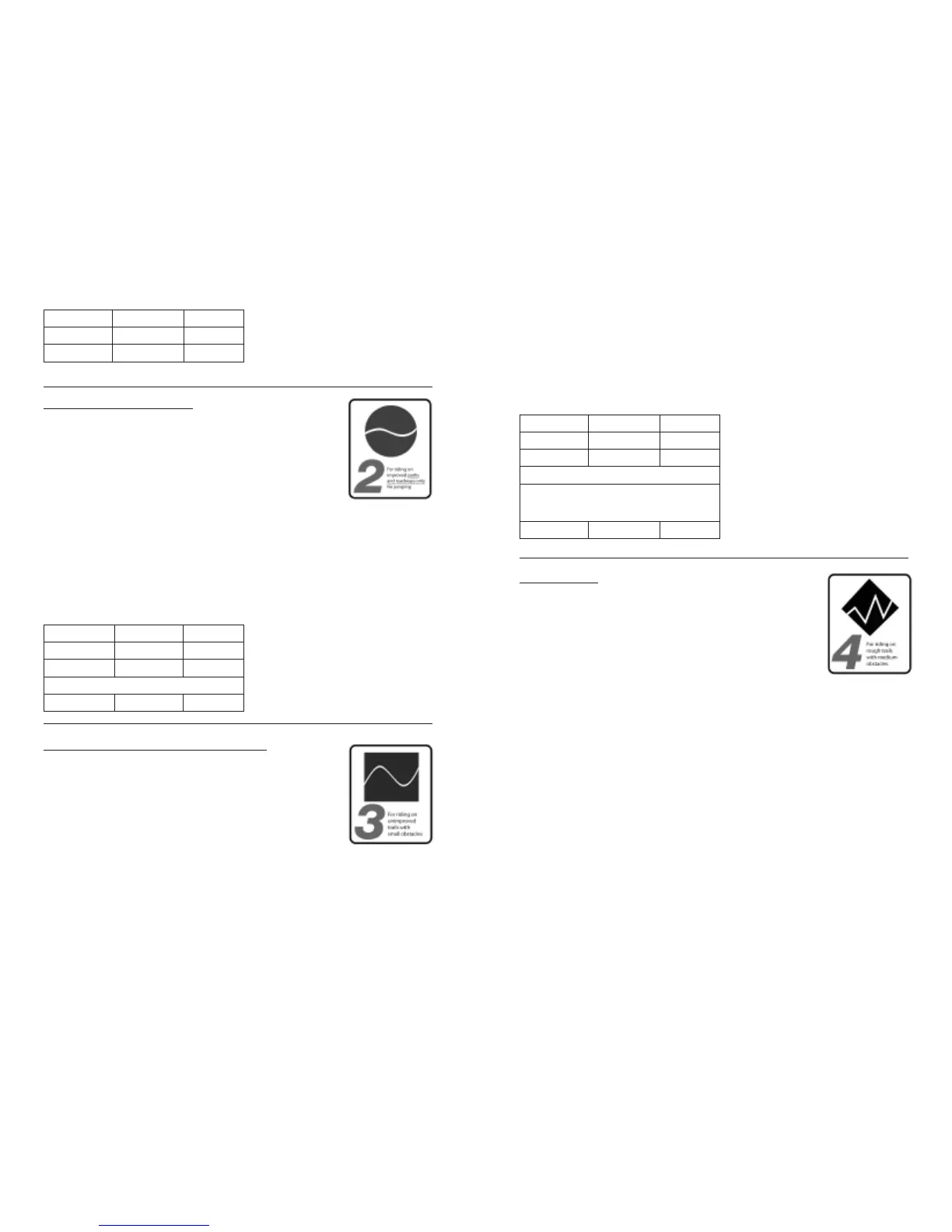
CONDITION 4
Bikes designed for riding Conditions 1, 2, and 3, plus rough
technical areas, moderately sized obstacles, and small jumps.
INTENDED For trail and uphill riding. All-Mountain bicycles
are: (1) more heavy duty than cross country bikes, but less
heavy duty than Freeride bikes, (2) lighter and more nimble
than Freeride bikes, (3) heavier and have more suspension
travel than a cross country bike, allowing them to be ridden in more difcult
terrain, over larger obstacles and moderate jumps, (4) intermediate in
suspension travel and use components that t the intermediate intended use, (5)
cover a fairly wide range of intended use, and within this range are models that
are more or less heavy duty. Talk to your retailer about your needs and these
models.
NOT INTENDED For use in extreme forms of jumping/riding such as hardcore
mountain, Freeriding, Downhill, North Shore, Dirt Jumping, Hucking etc. No large
drop offs, jumps or launches (wooden structures, dirt embankments) requiring
long suspension travel or heavy duty components; and no spending time in the
air landing hard and hammering through obstacles.
TRADE OFF All-Mountain bikes are more rugged than cross country bikes, for
riding more difcult terrain. All-Mountain bikes are heavier and harder to ride
uphill than cross country bikes. All-Mountain bikes are lighter, more nimble and
easier to ride uphill than Freeride bikes. All-Mountain bikes are not as rugged as
Freeride bikes and must not be used for more extreme riding and terrain.
MAXIMUM WEIGHT LIMIT
RIDER LUGGAGE* TOTAL
lbs / kg lbs / kg lbs / kg
275 / 125 10 / 4.5 285 / 129
* Seat Bag /Handlebar Bag Only
General Purpose Riding
CONDITION 2
Bikes designed for riding Condition 1, plus smooth gravel
roads and improved trails with moderate grades where the
tires do not lose ground contact.
INTENDED For paved roads, gravel or dirt roads that are in
good condition, and bike paths.
NOT INTENDED For off-road or mountain bike use, or for
any kind of jumping. Some of these bikes have suspension features, but these
features are designed to add comfort, not off-road capability. Some come with
relatively wide tires that are well suited to gravel or dirt paths. Some come with
relatively narrow tires that are best suited to faster riding on pavement. If you
ride on gravel or dirt paths, carry heavier loads or want more tire durability talk
to your dealer about wider tires.
MAXIMUM WEIGHT LIMIT
RIDER LUGGAGE TOTAL
lbs / kg lbs / kg lbs / kg
300 / 136 30 / 14 285 / 129
for Touring or Trekking
300 / 136 55 / 25 355 / 161
Cross-Country, Marathon, Hardtails
CONDITION 3
Bikes designed for riding Conditions 1 and 2, plus rough
trails, small obstacles, and smooth technical areas, including
areas where momentary loss of tire contact with the ground
may occur. NOT jumping. All mountain bikes without rear
suspension are Condition 3, and so are some lightweight rear
suspension models.
INTENDED For cross-country riding and racing which ranges from mild to
aggressive over intermediate terrain (e.g., hilly with small obstacles like roots,
rocks, loose surfaces and hard pack and depressions). Cross-country and
marathon equipment (tires, shocks, frames, drive trains) are light-weight,
favoring nimble speed over brute force. Suspension travel is relatively short
since the bike is intended to move quickly on the ground.


 To Next Page