Appendix B - Bicycle Lifespan 55
Appendix B
The Lifespan of Your Bike and Its Components
1. Nothing Lasts Forever, Including Your Bike.
When the useful life of your bike or its components is over, continued use is
hazardous.
Every bicycle and its component parts have a nite, limited useful life. The
length of that life will vary with the construction and materials used in the
frame and components; the maintenance and care the frame and components
receive over their life; and the type and amount of use to which the frame and
components are subjected. Use in competitive events, trick riding, ramp riding,
jumping, aggressive riding, riding on severe terrain, riding in severe climates,
riding with heavy loads, commercial activities and other types of non-standard
use can dramatically shorten the life of the frame and components. Any one or a
combination of these conditions may result in an unpredictable failure.
All aspects of use being identical, lightweight bicycles and their components
will usually have a shorter life than heavier bicycles and their components.
In selecting a lightweight bicycle or components you are making a tradeoff,
favoring the higher performance that comes with lighter weight over longevity.
So, If you choose lightweight, high performance equipment, be sure to have it
inspected frequently.
You should have your bicycle and its components checked periodically by
your dealer for indicators of stress and/or potential failure, including cracks,
deformation, corrosion, paint peeling, dents, and any other indicators of
potential problems, inappropriate use or abuse. These are important safety
checks and very important to help prevent accidents, bodily injury to the rider
and shortened product life.
2. Perspective
Today’s high-performance bicycles require frequent and careful inspection and
service. In this Appendix we try to explain some underlying material science
basics and how they relate to your bicycle. We discuss some of the trade-offs
made in designing your bicycle and what you can expect from your bicycle; and
we provide important, basic guidelines on how to maintain and inspect it. We
cannot teach you everything you need to know to properly inspect and service
your bicycle; and that is why we repeatedly urge you to take your bicycle to your
dealer for professional care and attention.
WARNING: Frequent inspection of your bike is important to your
safety. Follow the Mechanical Safety Check in Section 1.C of this
Manual before every ride.
Periodic, more detailed inspection of your bicycle is important. How often
this more detailed inspection is needed depends upon you.
You, the rider/owner, have control and knowledge of how often you use
your bike, how hard you use it and where you use it. Because your dealer
MAXIMUM WEIGHT LIMIT
RIDER LUGGAGE TOTAL
lbs / kg lbs / kg lbs / kg
300 / 136 30 / 13.6 330 / 150
Road Tandems
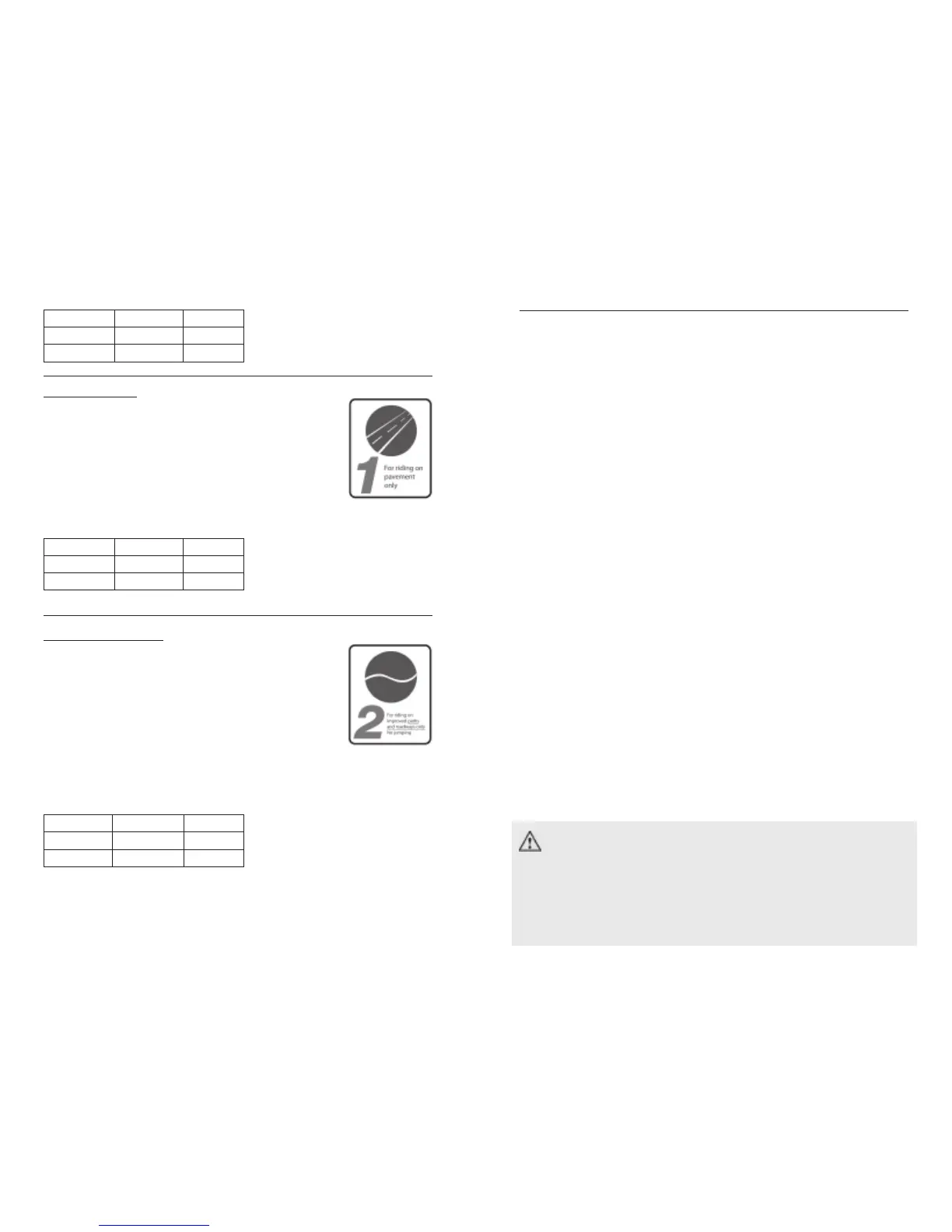
CONDITION 1
Bikes designed for riding on a paved surface where the tires
do not lose ground contact.
INTENDED Are designed to be ridden on paved roads only.
They are not designed for mountain biking or off-road use.
NOT INTENDED Road tandem should not be taken off-road
or used as a mountain tandem.
MAXIMUM WEIGHT LIMIT
RIDER LUGGAGE TOTAL
lbs / kg lbs / kg lbs / kg
500 / 227 75 / 34 575 / 261
Mountain Tandems
CONDITION 2
Bikes designed for riding Condition 1, plus smooth gravel
roads and improved trails with moderate grades where the
tires do not lose ground contact.
INTENDED The challenges of mountain biking are obvious.
The added challenges of tandem riding mean that you should
limit off-road tandem riding to easy-moderate terrain.
NOT INTENDED For very aggressive mountain bike riding.
Mountain tandems are most denitely NOT for Downhill, Freeriding, North Shore.
Choose terrain with the abilities of both the Tandem’s captain and stoker in mind.
MAXIMUM WEIGHT LIMIT
RIDER LUGGAGE TOTAL
lbs / kg lbs / kg lbs / kg
500 / 227 75 / 34 575 / 261


 To Next Page