
 Need help?
Do you have a question about the Fosi Audio BT30A and is the answer not in the manual?
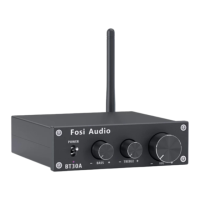
Power switch for the device.
Indicates the operational status of the device.
Adjusts the bass frequency response.
Adjusts the treble frequency response.
Controls the overall volume level.
For optional Bluetooth connectivity.
Selects between Bluetooth and RCA input.
Connects external audio sources like CD, DAC, mobile phone.
Connects speakers, including subwoofer support.
Connects the DC power adapter (up to 24V).
This document provides a comprehensive guide for operating and maintaining your audio amplifier. It covers the front and back panel interfaces, step-by-step operation instructions, and a frequently asked questions section to troubleshoot common issues.
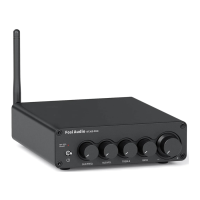
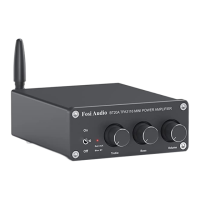
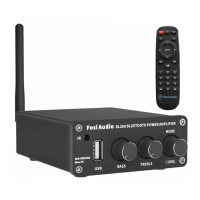
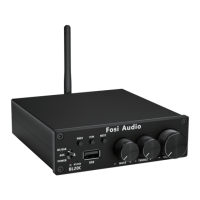
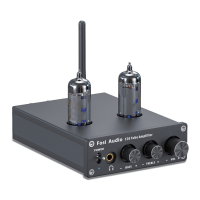
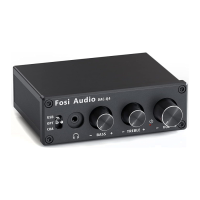
This device is an audio amplifier designed to enhance your listening experience. It features multiple input options, including Bluetooth (optional), and allows for precise control over audio output. The amplifier is equipped with dedicated knobs for adjusting bass, treble, and overall volume, giving you flexibility in tailoring the sound to your preferences. It also includes a power switch and an LED indicator light for easy monitoring of its operational status. The rear panel provides clear connections for speakers, ensuring proper setup with distinct positive and negative terminals, and an input interface for various audio sources like CD players, DAC decoders, mobile phones, and TVs. A dedicated output for a subwoofer is also available, along with a power interface that accepts a DC power supply.
Getting Started: Before powering on the device, ensure the volume knob is set to its minimum position to prevent sudden loud sounds. Connect your speakers to the rear panel, paying close attention to the positive and negative terminals as indicated. Incorrect polarity can affect sound quality. Next, connect your desired audio source. If you plan to use Bluetooth, switch the input selector to the Bluetooth option. The Bluetooth indicator light will flicker, signifying it's in pairing mode. Once your phone or other Bluetooth device is successfully connected, the light will remain steady. Finally, connect the power supply and press the power switch.
Adjusting Audio: Once powered on, you can gradually turn the volume knob clockwise to achieve your desired listening level. The amplifier offers independent controls for bass and treble. The bass knob allows you to increase or decrease the low-frequency response, while the treble knob adjusts the high-frequency response. Both knobs operate by turning clockwise to increase and counter-clockwise to decrease the respective frequency ranges. This allows for fine-tuning the audio to suit different music genres or personal preferences. For versions with volume adjustment, you can also choose a reasonable EQ by rotating the potentiometer.
Input Selection: The device features an option switch to toggle between Bluetooth and RCA inputs. This allows you to seamlessly switch between wireless audio streaming and wired connections from other audio devices.
Troubleshooting No Sound Output: If you've connected all cables but hear no sound, first check if the POWER indicator light is on. If it's off, press the power switch. If the indicator light still doesn't illuminate after pressing the power switch, try connecting a different power supply, such as a laptop power adapter, to determine if the issue is with the amplifier or the power supply itself. If the indicator light is on, ensure the volume knob is not at its minimum position; turn it clockwise to a normal listening level. Finally, verify that your input device (e.g., phone, CD player) is not paused, muted, or has its volume minimized.
Addressing Cracking Sound: A cracking sound typically indicates that the output power is exceeding the amplifier's normal capacity, leading to distortion. To resolve this, simply reduce the volume, either from the amplifier's volume knob or from your audio source device.
Resolving Electric Noise: If your loudspeakers produce a lot of electric noise, it's often related to the power supply. If you are not using the original factory-standard power supply, replace it with a reputable one for testing. Many aftermarket power supplies can introduce significant interference, leading to current noise.
Dealing with Interferential Sound from Signal Lines: Interferential sound when signal lines are connected but no music is playing usually points to unshielded signal lines. These lines can pick up interference signals that are then amplified. To eliminate this, it is recommended to use shielded signal lines or simply unplug the signal lines when not in use.
Addressing Amplifier Shutdowns: If the amplifier stops working after a period and then resumes after being off for a while, it's likely due to overheating protection. This occurs when the output power exceeds the designed capacity. To prevent this, try lowering the volume slightly.
Understanding Volume Differences Across Audio Sources: Different audio source devices have varying output ranges. For example, a mobile phone typically has an output of around 0.35mV, while a CD player might output 1V. These differences in signal amplitude directly influence the perceived volume from the amplifier. This is normal behavior and not an indication of a fault.
Improving Sound Quality Over Time: It's common for the sound quality of a new power amplifier to not be optimal initially, with high frequencies sometimes lacking clarity. Speakers and amplifiers are sensitive equipment that require a "break-in" period. After approximately ten hours of operation, the sound quality typically improves significantly as the components settle and "get to know each other."
Important Safety Warnings: To ensure your safety and the longevity of the device, do not open the shell without permission, as improper operation can lead to electric shock. Always use a power supply from a regular manufacturer; using an unapproved power supply can damage the machine. Avoid using the device in high-temperature or high-humidity environments.
 General
| Amplifier Type | Class D |
|---|---|
| Bluetooth Version | 5.0 |
| Input | RCA, Bluetooth |
| Speaker Impedance | 4Ω - 8Ω |
| Frequency Response | 20Hz - 20kHz |
| Bluetooth Range | 10m |
| Output | Speaker output |
| Power Supply | 24V DC |
| Input Voltage | 24V DC |

 To Next Page