EasyManua.ls Logo

Fostex 3180 - INTRODUCTION; Understanding Reverberation

Fostex 3180
14 pages
Print Icon
To Next Page IconTo Next Page
To Previous Page IconTo Previous Page
Loading...
3.
INTRODUCTION
-
Why
Reverberation?
Reverberation
is
an
important
part
of
our
everyday
experience
of
sound.
Without
the
natural
ambience
caused
by
multiple
reflec-
tions
and
gradually
decaying
sound
sources,
music,
especially,
would
sound
flat,
empty.
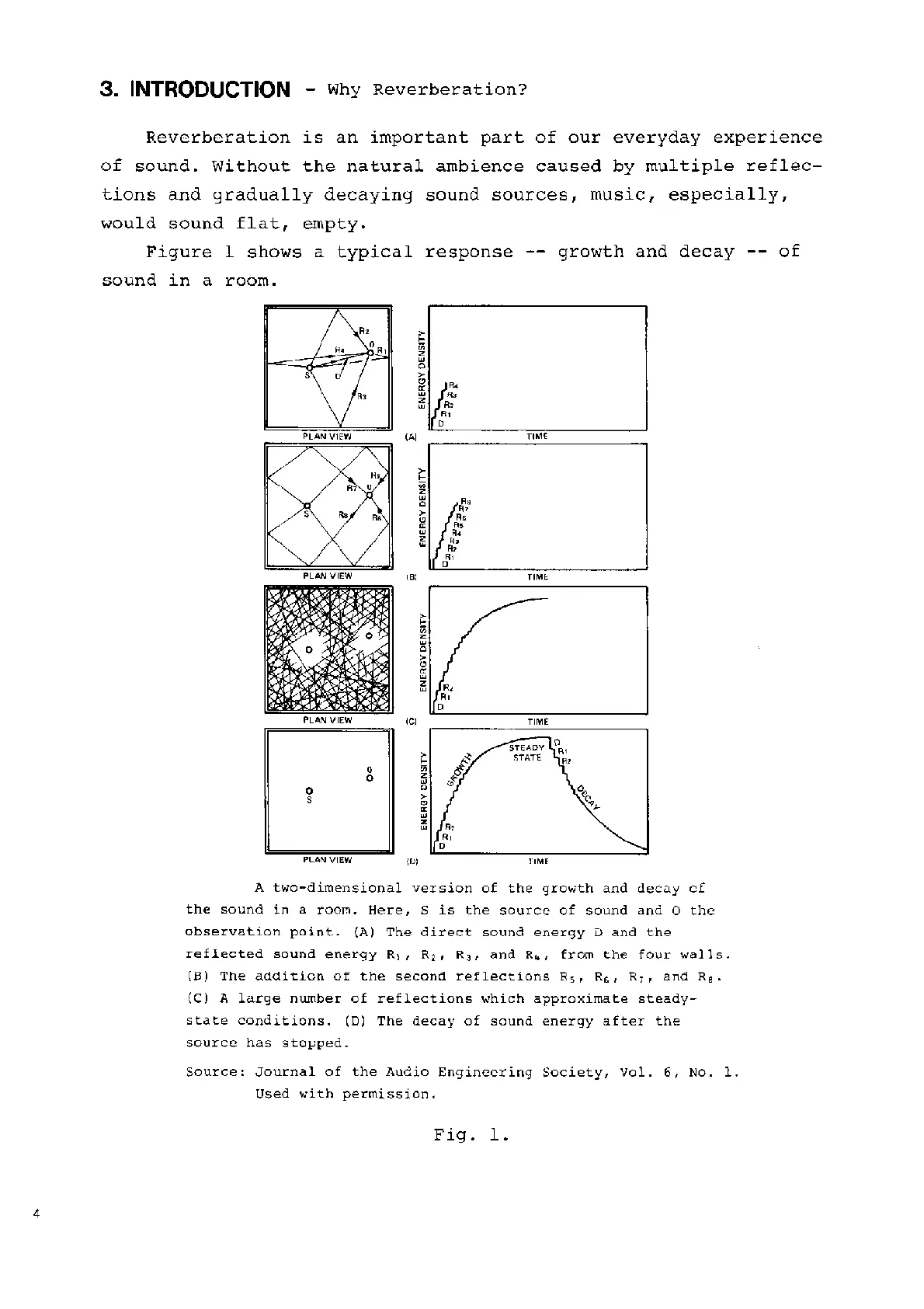
Figure
1
shows
a
typical
response
--
growth
and
decay
--
of
sound
in
a
room.
ENERGY
DENSITY
PLAN
View
wl
TIME
ENERGY
DENSITY.
1B;
TIME
ENERGY
DENSITY.
PLAN
VIEW
w
TIME
>
E
8
$
o
3
3
&
2
PLAN
VIEN
m
TIME
A
two-dimensional
version
of
the
growth
and
decay
cf
the
sounĂ¡
in
a
room.
Here,
S
is
the
source
of
sound
and
O
the
observation
point.
(A)
The
direct
sound
energy
D
and
the
reflected
sound
energy
Ri,
Rz,
Ra;
and
Rae,
from
the
four
walls
(B)
The
addition
of
the
second
reflections
Rs,
Re,
Ry,
and
Re.
(C)
A
large
number
of
reflections
which
approximate
steady-
state
conditions.
(D)
The
decay
of
sound
energy
after
the
source
has
stopped.
Source:
Journal
of
the
Audio
Enginecring
Society,
Vol.
6,
No.
1.
Used
with
permission.
Fig.
1l.

Related product manuals