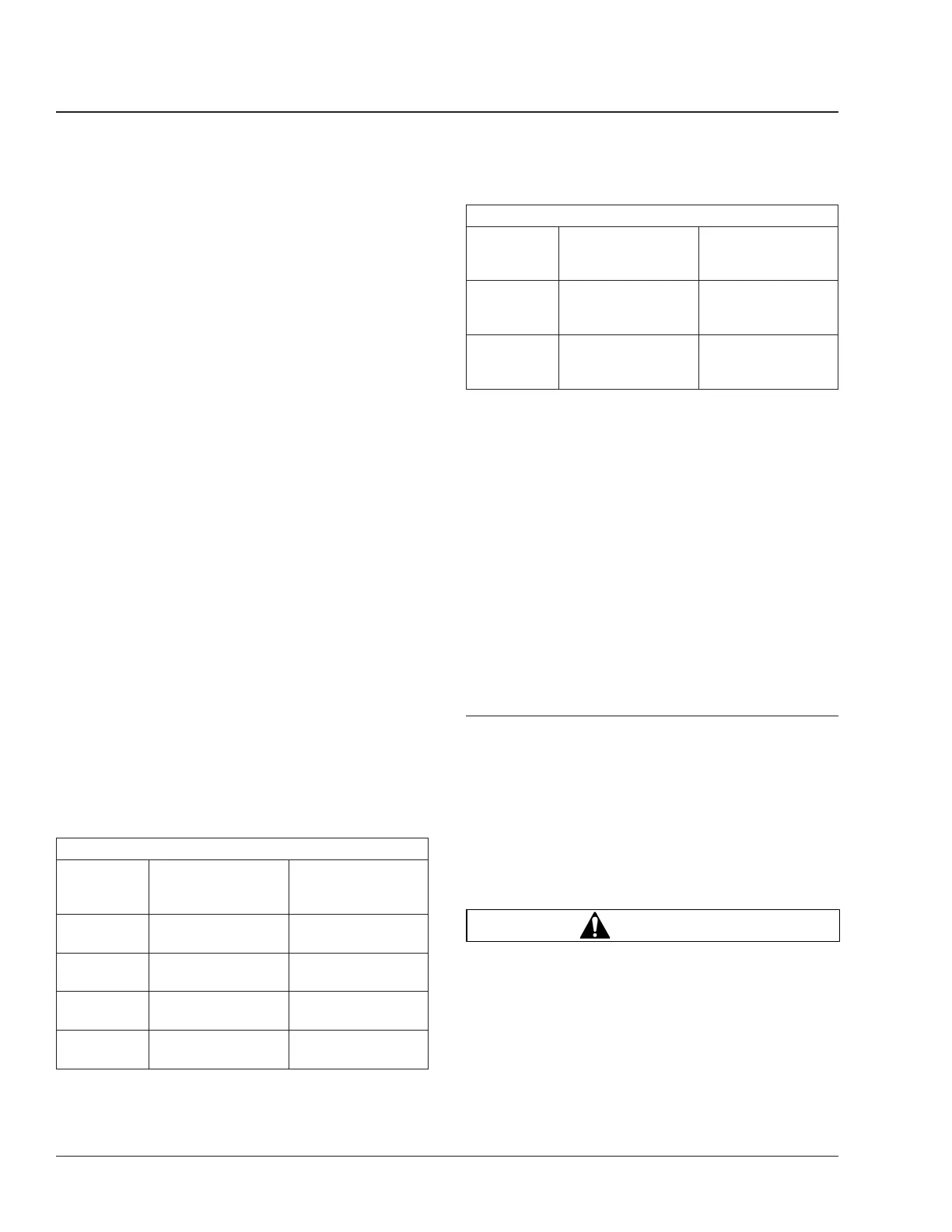
14. Fill the cooling system with new coolant. See
Table 1 for the vehicle’s coolant capacity. Certain
equipment such as fuel heaters, water filters and
auxiliary heaters may increase the coolant ca-
pacity and require additional coolant. The cooling
system is filled when the coolant level reaches
the MAX line on the surge tank. Freightliner rec-
ommends the use of a precharged and premixed
antifreeze when refilling the cooling system. See
Table 2 for a list of some of the precharged anti-
freeze available. Use of an equivalent antifreeze
to those listed in the table is also acceptable.
Always check that the antifreeze used meets
Freightliner’s specifications and is at the proper
concentration for protection in the vehicle operat-
ing area. See Table 3 for antifreeze protection
information. Freightliner specifies that the anti-
freeze must be an ethylene glycol solution that
meets GM 6038 M Engineering Standards or a
ethylene glycol solution that has less than 0.1%
anhydrous sodium metasilicate, and meets either
GM 1825 M or GM 1899 M Engineering Stan-
dards. If supplemental coolant additives are
being used, add the supplements to the coolant
as necessary. See the coolant additive manufac-
turer’s instructions for the correct amount of addi-
tive required. Don’t forget to consider the volume
of the supplemental coolant additive being added
to the system when determining the amount of
coolant required to refill the system.
NOTE: You can mix purple-pink coolant (pre-
charged with a borate/nitrate-based additive)
with the common green coolant, although some
color change will be apparent.
15. Replace the surge tank cap(s).
Engine Coolant Capacity (pre-EPA07 engines)
Engine
Capacity with 1000
sq. inch Radiator:
qt (L)
Capacity with 1200
sq. inch Radiator:
qt (L)
Caterpillar
C10 (3176)
39.5 (37.4) 40.6 (38.5)
Caterpillar
3406
53.2 (50.4) 54.1 (51.5)
Cummins
M11
39.0 (37.0) 40.2 (38.1)
Cummins
N14
51.1 (48.4) 52.3 (49.5)
Engine Coolant Capacity (pre-EPA07 engines)
Engine
Capacity with 1000
sq. inch Radiator:
qt (L)
Capacity with 1200
sq. inch Radiator:
qt (L)
Detroit
Diesel Series
55
43.0 (40.7) 44.1 (41.8)
Detroit
Diesel Series
60
54.8 (51.9) 56.0 (53.0)
Table 1, Engine Coolant Capacity (pre-EPA07
engines)
16. Return the hood or cab to the operating position.
See Group 60 of the
Century Class Trucks
Workshop Manual
for cab tilt instructions.
17. Start the engine and turn on the cab heater.
Allow the engine to warm up to normal operating
temperature. Check the radiator and hoses for
leaks. Repair if necessary.
18. Shut off the engine, then check the coolant level
in the surge tank. Add coolant if the level is not
between the MIN and MAX lines on the surge
tank.
20–03 Fan Clutch Check (Noise
Emission Control)
Horton Advantage
®
Fan Clutch
NOTE: If any part of the fan clutch needs to be
repaired or replaced, after performing the
checks below, see Group 20 of the
Century
Class Trucks Workshop Manual
.
1. Disconnect the electrical cables from the battery.
Drain all air from the air system. If equipped with
an air starter, drain the air starter reservoir.
WARNING
If the engine starts during this procedure, the fan
could cause personal injury. If the vehicle is
equipped with an air starter, be sure that the air
starter reservoir is drained.
2. Inspect the electrical connections and wires to
the fan clutch solenoid. Secure the connection if
loose; replace wires and connectors if damaged.
Engine Cooling/Radiator20
Century Class Trucks Maintenance Manual, January 200720/4


 To Next Page