3.2 Clean the filter element with cleaning sol-
vent.
3.3 Reassemble the clutch valve solenoid air
filter assembly and install on the vehicle.
4. Visually check the fan for bent, cracked, or dam-
aged blades. Replace if damaged. Check for ad-
equate clearance between the fan and other
components.
5. Check the fan belt for wear, tension, and align-
ment. Correct if necessary.
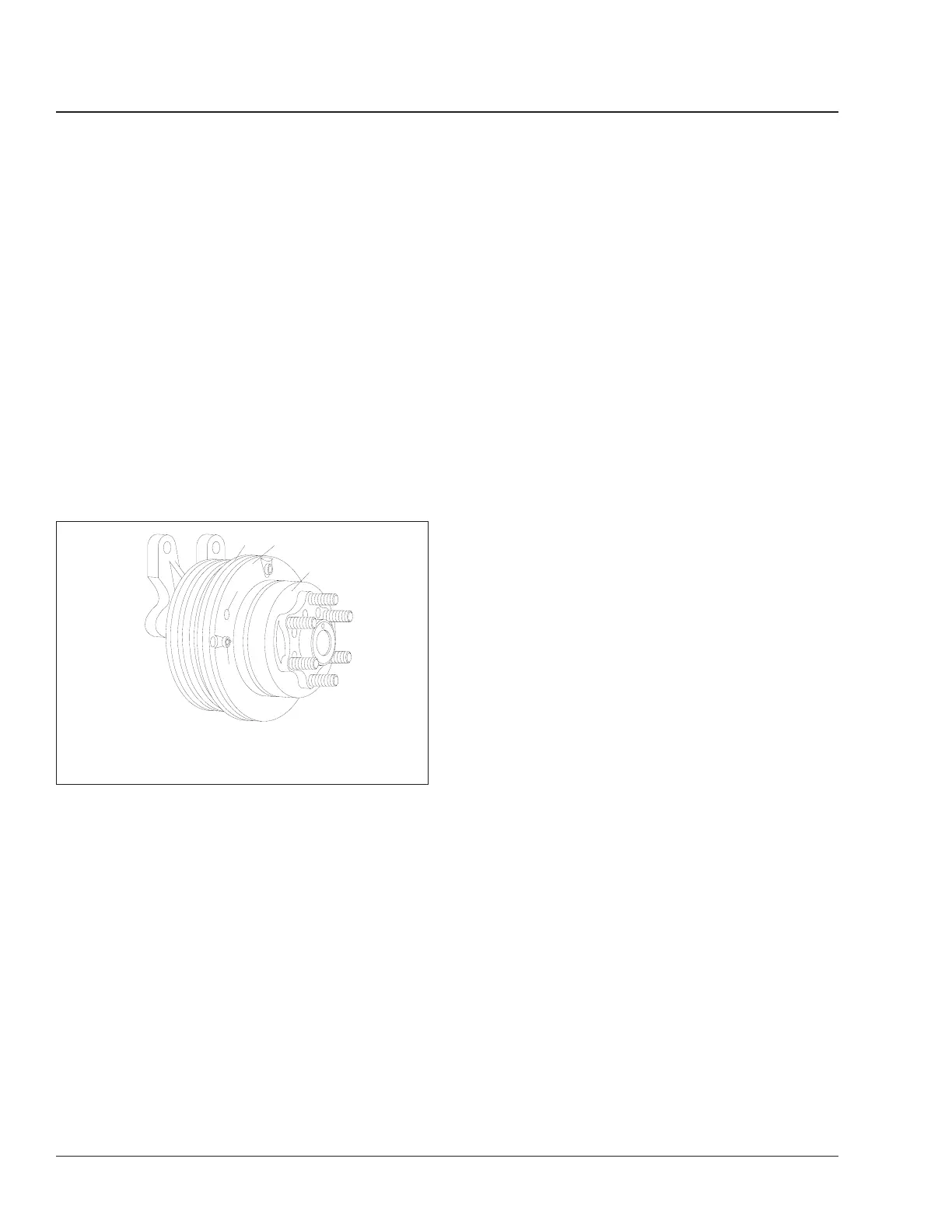
6. Check for wear on the friction facing. See Fig. 6.
Replace the friction facing if it is worn to a 1/16-
inch (1.6-mm) thickness or less. Also check the
facing for signs of oil contamination or burn
marks. If evidence of oil or burn marks are
found, replace the friction facing.
7. Connect the battery cables. Start the engine, and
charge the air system to 120 psi (827 kPa). Shut
down the engine. Separate the halves of the fan
solenoid connector. The fan clutch should en-
gage.
If the fan does not operate correctly, see Group
20 of the
Century Class Trucks Workshop
Manual
for troubleshooting and repair proce-
dures.
8. With the air system charged to 120 psi (827
kPa), and with the fan solenoid connector halves
separated, check the fan clutch for audible air
leaks, using a suitable listening device.
9. If a leak is detected, remove the fan blade. Using
a soapy water solution, check the fan clutch at
the following locations to locate the source of the
leak. Install a new seal kit. See Group 20 of the
Century Class Trucks Workshop Manual
for re-
pair procedures.
9.1 Check for a leak at the bleed hole on the
fan pilot. Air leakage means that the car-
tridge assembly (Fig. 7, Ref. 16) or face
seal (Ref. 17) is damaged.
9.2 Check for air leaks between the air cham-
ber and the piston friction disc. Air leak-
age means that the large O-ring (Ref. 14)
is damaged.
9.3 Check for air leaks around the safeguard
hole on the piston friction disc. Air leak-
age means the small O-ring (Ref. 18) is
damaged.
9.4 Check for air leaking from the System
Sentry
®
fuse. Leaking air means the
clutch has gotten so hot the lead alloy in
the fuse melted. This released the clutch
before the heat could damage the clutch
bearings. Before replacing the fuse, find
and repair the source of the heat.
10. If equipped with an override toggle switch on the
dash, check the fan clutch operation as follows:
10.1 Connect the halves of the fan solenoid
connector.
10.2 Turn the air conditioner off.
10.3 Start the engine and charge the air sys-
tem to 120 psi (827 kPa). Tests must be
performed with the engine temperature
below 205°F (96°C) for Caterpillar en-
gines, and below 200°F (93°C) for Cum-
mins and Detroit Diesel engines.
10.4 Set the toggle switch to the ON position;
the fan clutch should engage.
10.5 Apply the foot brake, and release the
parking brakes.
10.6 Set the toggle switch to the AUTO or OFF
position; the air should exhaust and the
fan clutch should disengage. Replace the
switch if necessary.
11. If the fan stays engaged at all times on a Detroit
Diesel engine, check the circuit breaker labeled
"engine fan."
f200290
1
2
08/08/94
3
4
5
1. System Sentry
®
Fuse
2. Safeguard Hole
3. Friction Facing
4. Piston Friction Disc
5. Air Chamber
Fig. 6, Horton Advantage Fan Clutch
Engine Cooling/Radiator20
Century Class Trucks Maintenance Manual, January 200720/6










 To Next Page