Need help?
Do you have a question about the FrSky XJT and is the answer not in the manual?
Describes products enabled with Smart Port for data transmission.
Details usage for telemetry display and firmware upgrades.
Explains the meaning of Green and Red LED status lights.
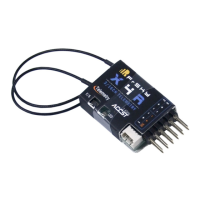
Outlines XJT module modes and compatible receivers.
Step-by-step guide for associating receivers with the transmitter module.
Procedure for performing a pre-flight range check to ensure signal reliability.
Information on Received Signal Strength Indication (RSSI) and warning alarms.
Describes the Smart Port interface for data transmission.
Explains the LED status indicators on the receiver.
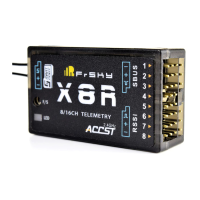
Details the SBUS output for channels 1-16.
Describes standard channel outputs CH1-CH8.
Lists technical specifications of the X8R receiver.
Highlights new features of the X8R receiver.
Steps to bind the X8R receiver to a transmitter module.
Procedure for performing a pre-flight range check.
How to set and disable failsafe positions for the receiver.
Describes the RSSI analog voltage output.
Explains the LED status indicators on the receiver.
Details the SBUS output for channels 1-12.
Describes standard channel outputs CH1-CH8 and CH9.
Lists technical specifications of the L9R receiver.
Highlights new features of the L9R receiver.
Steps to bind the L9R receiver to a transmitter module.
Procedure for performing a pre-flight range check.
How to set and disable failsafe positions for the receiver.
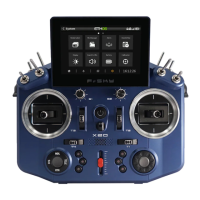
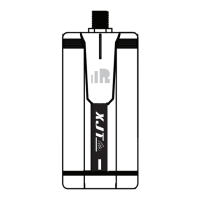
The FrSky XJT telemetry module is a sophisticated radio frequency (RF) module designed to enhance the capabilities of remote control (RC) systems, particularly for model aircraft and other remote-controlled vehicles. It operates on the 2.4GHz band, utilizing FrSky's ACCST (Advanced Continuous Channel Shifting Technology) to ensure robust and reliable communication between the transmitter and receiver. This module is a key component in FrSky's ecosystem, offering advanced features like telemetry, multiple operating modes, and compatibility with a wide range of FrSky receivers.
The primary function of the FrSky XJT module is to establish a wireless link between an RC transmitter and a compatible receiver, enabling control commands to be sent from the pilot to the model and, crucially, telemetry data to be sent back from the model to the transmitter. This two-way communication is a hallmark of modern RC systems, providing pilots with real-time information about their model's status.
The module supports two main modulation types: PXX and CPPM, which are auto-detected for ease of use. PXX modulation allows for advanced features such as mode selection, binding, model match, range check, and failsafe settings to be managed directly from the radio side, offering a more integrated and user-friendly experience. CPPM (Combined Pulse Position Modulation) is a more traditional signal type, also supported for compatibility.
A core capability of the XJT module is its support for various operating modes: D8, D16, and LR12.
The module also features a Smart Port (S. Port) interface, which is a signal wire full duplex digital transmission interface developed by FrSky. This port allows for seamless connection with other Smart Port enabled devices, such as the FrSky Smart Dashboard, X8R receivers, new hub-less sensors, and other user input/output devices. The Smart Port facilitates high-speed data transmission without limitations on the number or sequence of connected devices, creating a flexible and expandable telemetry system.
In addition to the Smart Port, the XJT module includes an RS232 Serial Port. This port serves multiple purposes, including connecting to an FLD-02 telemetry display for real-time data viewing, a FrUSB-3 for alarm setting and firmware upgrades, and a VSpeak module for voice output of telemetry data.
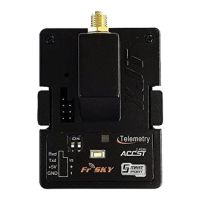
The FrSky XJT module is designed for ease of integration and operation within JR/Graupner type module slots found in many RC transmitters. Its user interface includes a combination of LED indicators and switches to provide feedback and allow for mode selection and binding.
LED Indication: The module features both green and red LEDs that provide visual cues about its operational status.
Mode Selection: The XJT module incorporates two switches (Switch 1 and Switch 2) that allow the user to manually select the desired operating mode (D8, D16, or LR12) to match the receiver being used. For example:
Binding Procedure: The binding process is straightforward, ensuring a unique association between the transmitter module and a receiver. To bind, the user holds the F/S (Failsafe) button on the XJT module while turning on the transmitter. The module's red LED will flash, indicating it's ready to bind. The receiver is then powered on while holding its F/S button, completing the binding. This process needs to be done only once unless either the module or receiver is replaced.
Range Check Mode: A critical pre-flight safety feature, the range check mode, is easily activated by pressing the F/S button on the XJT module for 4 seconds. In this mode, the effective communication distance is reduced to approximately 1/30th of the full range, allowing the pilot to walk away from the model and verify control integrity at a safe, reduced distance. The red LED turns off, and the green LED flashes rapidly during range check. Pressing the F/S button again for 1-4 seconds exits this mode.
Failsafe Setting: While the XJT module itself doesn't directly set failsafe positions, it facilitates the process through its binding and communication with compatible receivers. Receivers like the X8R and L9R have their own failsafe setting procedures, often involving pressing the F/S button on the receiver after binding and moving controls to desired positions. The XJT module's reliable link ensures that these failsafe settings are effectively communicated and stored in the receiver.
Low Latency and High Precision: The XJT module boasts super low latency (approximately 1/3 of current systems) and higher precision, which are crucial for responsive and accurate control, especially in demanding flight conditions or for high-performance models. This benefit is fully realized when paired with FrSky transmitters that support these advanced hardware and software capabilities.
The FrSky XJT module incorporates features that contribute to its reliability and ease of maintenance, particularly concerning its antenna and firmware.
Antenna Working Status Detection: A significant maintenance feature is the module's ability to detect its antenna's working status. If the module antenna is broken or does not have intact contact, the system will provide sound warnings. This proactive alert helps prevent potential signal loss due to antenna issues, which could lead to loss of control of the model. This feature is crucial for ensuring the integrity of the RF link before and during flight.
Firmware Upgradeable: Both the XJT module and its compatible receivers (like X8R and L9R) are firmware upgradeable. This is a vital maintenance feature as it allows users to update the device's software to fix bugs, improve performance, or add new functionalities as they become available. Firmware upgrades can be performed via the RS232 Serial Port using a FrUSB-3 adapter or, for Smart Port enabled devices, directly through the Smart Port. This ensures the system remains current and compatible with future FrSky products and standards.
Smart Port for Diagnostics and Upgrades: The Smart Port not only facilitates telemetry but also serves as an upgrade interface. This unified port simplifies the process of connecting to a computer for diagnostics or firmware updates, reducing the need for multiple specialized cables or interfaces.
In summary, the FrSky XJT telemetry module is a versatile and robust RF module that significantly enhances the functionality and safety of RC systems. Its advanced communication protocols, multiple operating modes, comprehensive telemetry capabilities, and user-friendly features, combined with proactive maintenance alerts and upgradeability, make it a cornerstone of the FrSky ecosystem for hobbyists and professionals alike.
 General
| Compatibility | D8, D16, LR12 receivers |
|---|---|
| Telemetry | Yes |
| Firmware Upgrade | Yes |
| Operating Mode | D16, D8, LR12 |
| Channels | 16 (D16) |
| RF Power | 16dBm (EU), 20dBm (non-EU) |

 To Next Page