Need help?
Do you have a question about the Fryette Power Station 100 and is the answer not in the manual?
Covers reading instructions, proper connection, handling, placement, and servicing guidelines.
Alerts users about high sound pressure levels and hazardous internal voltages.
Details thermal stress, tube condition, and specific amplifier compatibility.
Controls high-frequency (EDGE/BRITE/FLAT) and low-frequency (DEEP/WARM/FLAT) response.
Covers SELECT, INPUT LEVEL, VOLUME, PRESENCE, DEPTH, STANDBY/BYPASS, and AC MAINS.
Details LINE IN, LINE OUT, LINE OUT XLR, FX SEND, and FX RETURN jacks.
Covers LINE LEVEL, FX LEVEL, and AMPLIFIER IMPEDANCE selector.
Describes AMP IN jack and SPEAKER OUT jack with impedance matching.
Includes CABINET IMPEDANCE, FOOTSWITCH JACK, GROUND LIFT, MAINS FUSE, and AC MAINS INPUT.
Illustrates connecting an amp head to the Power Station for cab output and mixer feed.
Shows connecting a combo amp to the Power Station with an effect in the loop.
Details using the Power Station to boost a preamp with an effect in the loop.
Demonstrates silent mode for recording via line out without a speaker cab.
Presents a complex setup involving multiple devices and FX.
Addresses problems like 'Won't Turn On', 'No Sound', and 'Won't Switch to Operate'.
Covers issues such as squeel/feedback, running hot, and distortion.
Troubleshoots effects not operating and blowing main fuses.
Declaration of compliance with the Restriction of Hazardous Substances directive.
Declaration of compliance with Registration, Evaluation, Authorization of chemicals.
Declaration of conformity with EMC and Low Voltage Directives.
Details what is covered, what is excluded, and conditions for warranty service.
Instructions for warranty registration and obtaining service.
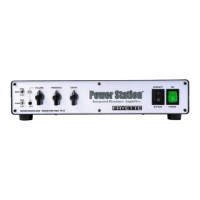
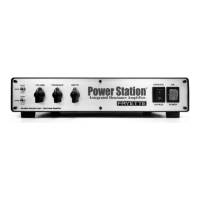
The Fryette Power Station 100 (PS-100) is a dual-mode variable reactive load and tube power amplifier designed to enhance and expand the capabilities of guitar amplifiers. It serves as a transparent attenuator, a power booster for smaller amplifiers, and a silent reactive load for direct recording.
The PS-100 addresses common shortcomings of traditional amplifier attenuators, such as lack of transparency, limited controllability, and loss of dynamic amplifier performance. Its core innovation lies in its reactive load design, which emulates the natural interaction between a speaker and a power tube stage. This ensures that the amplifier's original tone and feel are preserved at any volume level, whether attenuating a high-powered amp or boosting a low-powered one.
In attenuation mode, the PS-100 absorbs the output power of a connected amplifier, allowing users to achieve desired listening volumes without sacrificing tone. The reactive load acts as a substitute for a physical speaker, interacting with the amplifier in a way that maintains its dynamic response.
As a power booster, the PS-100 can amplify the output of smaller amplifiers, mini-amps, vintage combos, preamps, or modeling preamps, enabling them to be heard in larger venues without losing their characteristic feel and tonal quality. This feature is particularly useful for musicians who want to gig with their favorite low-wattage amps.
For direct recording, the PS-100 functions as a versatile silent reactive load. By connecting its Balanced or Unbalanced Line Out to a recording interface, users can capture their amplifier's tone silently, making it ideal for studio environments or late-night practice sessions. In Silent Mode, the PS-100 does not need to be powered on; the voicing switches, low pass filter, FX Send (with FX Level switch), and balanced/unbalanced line outputs all operate without AC power.
The PS-100 also features a foot-switchable FX loop, allowing users to integrate external effects processors seamlessly into their signal chain. This loop is positioned post-AMP IN and LINE IN, ensuring that effects are inserted between the load amplifier or external preamp and the Power Station's internal tube power amp.
The front panel controls offer extensive tonal shaping and volume management:
The rear panel provides comprehensive connectivity:

 To Next Page
 General