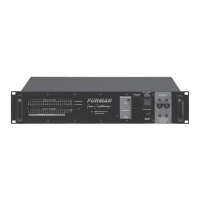
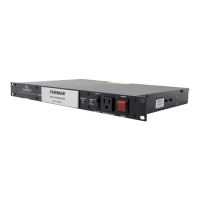
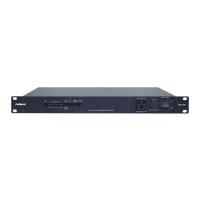
AR-PRO – AC LINE VOLTAGE REGULATOR
VOLTAGE REGULATION – VOLTAGE REGULATION
is a number indicating the nominal electrical poten-
tial that has been adopted by a region for powering
electrical equipment of all kinds. In the United States
and Canada it is 120 volts; in Japan, 100 volts; and
in many other countries 220 to 240 volts. The actual
voltage can fall below or rise above this nominal level
due to brownouts, power cutbacks, use of substandard
wiring, and other causes. These deviations can cause
poor performance or malfunction. A regulator is a de-
vice which, through use of a transformer, corrects the
voltage deviation by stepping it up or down so that it is
as close as possible to the nominal level.
A pulse of energy on the power line. Spikes
can have voltages as high as 6000 volts.
Though they are usually of very short duration, the
energy they contain can be considerable, enough to
damage sensitive solid-state components in audio
and computer equipment. Spikes can also foul switch
contacts and degrade wiring insulation. They are an
unavoidable component of electric power. They are
caused unpredictably by electric motors switching on
or off (on the premises or outside), utility company
maintenance operations, lightning strikes, and other
factors. Spikes (also called surges or transients) are
absorbed by special components in the AR-PRO to
provide safe voltage levels to protect your equipment.
RFI / EMI INTERFERENCE – RFI / EMI INTERFERENCE
Frequency Interference) or EMI (Electro Magnetic
Interference) involves lower voltages and less energy
than is found in spikes, but it is continuous rather than
transient in nature. It is not likely to cause damage, but
it can certainly be annoying, producing static in audio
circuits, “snow” on video screens, or garbled data in
computers. Noise can be introduced into AC lines by
nearby radio transmitters, certain kinds of lighting,
electric motors, and others. Because noise occurs at
higher frequencies than the 50 or 60 Hz AC line, it can
be effectively reduced through use of low-pass fi lter-
Before returning any equipment for repair, please be
sure that it is adequately packed and cushioned against
damage in shipment, and that it is insured. We suggest
that you save the original packaging and use it to ship
the product for servicing. Also, please enclose a note
giving your name, address, phone number and a de-
scription of the problem.
NOTE: All equipment being returned for repair must
have a Return Authorization (R/A) Number which can
be obtained by calling the Furman Service Department,
(707) 763 – 1010 ext. 120 or 121, between 8 a.m. and 5
p.m., U.S. Pacifi c Time. Please display your R/A Number
prominently on the front of all packages.


 To Next Page
 Loading...